


 Muslim
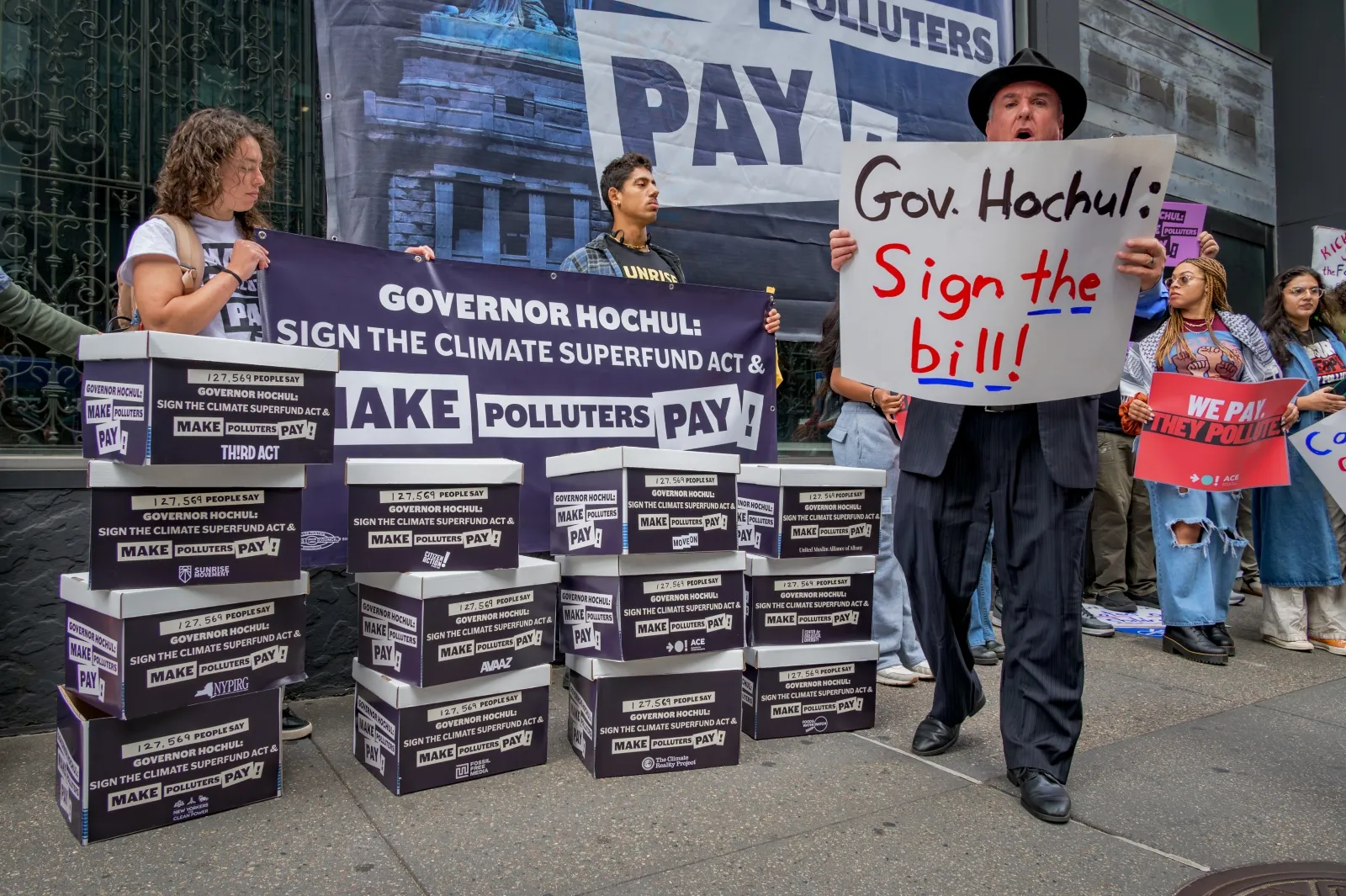
The burgeoning movement to hold the fossil fuel industry financially responsible for the catastrophic effects of a warming planet has encountered its most significant legal hurdle to date. In a pair of rulings that have sent shockwaves through statehouses across the United States, federal judges recently blocked New York’s "Climate Change Superfund Act." The legislation, which aimed to extract tens of billions of dollars from major polluters, was envisioned as a blueprint for state-level climate accountability.
While the New York rulings represent a tactical victory for "Big Oil," the broader war over climate liability is far from over. Even as proponents in several states vow to push forward, an even more existential threat looms on the horizon: the U.S. Supreme Court’s upcoming consideration of Suncor v. Boulder County. The outcome of that case could potentially strip states of their power to seek any climate-related recourse, leaving taxpayers to shoulder the multi-billion-dollar burden of environmental adaptation alone.
Main Facts: The Collapse of the New York Model
The New York Climate Change Superfund Act, signed into law in 2024, was designed to be a transformative piece of environmental policy. It sought to establish a $75 billion fund, financed by the world’s largest fossil fuel companies, to pay for climate-adaptive infrastructure. This included the modernization of stormwater drainage systems, the installation of cooling systems in public buildings to combat rising temperatures, and the repair of infrastructure damaged by increasingly frequent extreme weather events.
The legal basis for the law was inspired by the federal Comprehensive Environmental Response, Compensation, and Liability Act (CERCLA) of 1980—commonly known as the Superfund Act—which forced chemical and petroleum companies to pay for the cleanup of hazardous waste sites. However, the application of this logic to global carbon emissions faced immediate legal challenges from industry trade groups and a coalition of 22 Republican-led states.
Last week, Judge Brenda Sannes of the U.S. District Court for the Northern District of New York delivered a decisive blow, ruling that the state law was preempted by federal law. Specifically, the court found that the Clean Air Act (CAA) provides the exclusive framework for regulating air pollution, and that New York’s attempt to impose retroactive financial liability for global emissions exceeded the boundaries of state authority. Judge Sannes noted that the measure was "simply beyond the limits of state law," effectively siding with the fossil fuel interests and the red-state attorneys general who argued that climate policy is a federal, not a state, prerogative.
Chronology: The Rise and Stalling of State Accountability
The trajectory of climate liability legislation has moved rapidly over the last five years, evolving from fringe legal theories to mainstream legislative efforts.
- 2018: The City and County of Boulder, Colorado, file a lawsuit against Suncor Energy and Exxon Mobil, alleging that the companies’ production and marketing of fossil fuels contributed to local climate damages. This case would eventually become the centerpiece of the national legal debate.
- 1980–2023: The federal Superfund model remains the gold standard for "polluter pays" principles, but is largely restricted to localized chemical contamination rather than atmospheric carbon.
- Early 2024: New York passes and signs the Climate Change Superfund Act. The move inspires a "flurry" of similar bills in Connecticut, Hawaiʻi, Rhode Island, and New Jersey.
- May 2024: Vermont becomes the only other state to successfully enact a climate superfund law. Almost immediately, it is met with lawsuits from industry groups and the Trump administration’s legal allies.
- Late 2024: Federal judges in New York issue two rulings blocking the state’s law.
- Next Week: The U.S. Supreme Court begins hearing arguments for Suncor v. Boulder County, a case that could decide the fate of all such state-level initiatives.
Supporting Data: The Financial and Political Stakes
The financial impetus behind these laws is staggering. New York’s $75 billion target was not an arbitrary figure; it reflected a calculated assessment of the state’s projected costs for climate resiliency over the next two decades.
In Vermont, legal experts like Pat Parenteau, an emeritus professor at Vermont Law School, note that the state is currently defending its law against a coordinated campaign. This opposition includes not just legal filings but a significant public relations blitz. For example, industry-aligned groups like the National Federation of Independent Business (NFIB) have called for the law’s repeal, citing "legally dubious" grounds.
The political divide is equally stark. While 22 Republican attorneys general sued to block New York’s law, Democratic lawmakers in coastal and climate-vulnerable states are doubling down. In Hawaiʻi, Senator Karl Rhoads sponsored a superfund bill last year and remains undeterred by the New York ruling. Similarly, in Rhode Island and Connecticut, legislators are preparing to reintroduce their versions of the bill in the upcoming 2025 sessions.
However, the "lawfare" described by New Hampshire Representative Tony Caplan highlights a grim reality: even if the laws are popular, the cost of litigation can be prohibitive. Caplan noted that his state’s Republican-controlled legislature has effectively killed climate accountability measures, forcing him to pivot toward decarbonization efforts instead of litigation.
Official Responses: A Divided Legal Landscape
The reactions to the New York rulings highlight a deep rift in how legal experts and officials interpret the limits of state power.
The Fossil Fuel Industry and Allies:
Republican attorneys general have hailed the New York decision as a victory for the rule of law and economic stability. West Virginia Attorney General JB McCuskey has been particularly vocal, stating that his office would sue "almost instantaneously" if any other state attempted to pass similar legislation. The core argument from this camp is that climate change is a global phenomenon that cannot be adjudicated state-by-state, and that doing so would create a "patchwork" of regulations that would cripple the energy sector.
State Legislators and Proponents:
Despite the New York setback, many Democratic lawmakers view the rulings as a temporary hurdle rather than a dead end. Rhode Island Representative Jennifer Boylan dismissed the New York case as a "convenient strategy to try to scare us all," asserting that she is "full speed ahead" with her state’s bill. New Jersey Senator John McKeon expressed a similar lack of concern, noting that New Jersey sits in a different federal court circuit (the Third Circuit) and is governed by different state precedents.
Legal Scholars:
Rachel Rothschild, an assistant professor at the University of Michigan Law School, argues that states "can and should push ahead." She points out that District Court rulings are not binding on other states or even other circuits. However, she joins other experts in warning that the Supreme Court is the real "death knell" to watch.

Implications: The Shadow of the Supreme Court
While the New York rulings are localized, the upcoming Supreme Court case, Suncor v. Boulder County, carries national implications. The case focuses on a seemingly procedural question: should climate lawsuits against fossil fuel companies be heard in state or federal courts?
Fossil fuel companies argue that because climate change involves transboundary pollution and international policy, these cases belong in federal court—where they are more likely to be dismissed under the Clean Air Act. If the Supreme Court agrees, and goes a step further to rule that federal law "preempts" all such claims, the entire movement for state-level climate accountability could vanish.
The Worst-Case Scenario:
Pat Parenteau warns of a "worst-case" ruling where the Supreme Court declares that both statutory and constitutional federal law preempts these cases entirely. This would not only kill Superfund-style legislation but also quash consumer rights cases, racketeering (RICO) claims, and antitrust suits related to climate change. "This would leave every state in the country with billions and billions of dollars [in damages] piling up with no recourse," Parenteau said.
The "Yardstick" Scenario:
There is a more moderate possibility. Jonathan Adler, a professor at William and Mary Law School, suggests the Court might provide a "yardstick" for what is permissible. For instance, the Court could rule that states can only claim damages for pollution released within their own borders, or for specifically demonstrated harms rather than global contributions. This would narrow the scope of Climate Superfund laws but keep the door open for some form of accountability.
The Recusal Factor:
In a notable twist, Justice Samuel Alito has recused himself from the Suncor case, likely due to his ownership of energy sector stocks. This leaves an eight-justice court. A 4-4 tie would uphold the lower court’s ruling—which in this case favored the City of Boulder—but a 5-3 ruling in favor of the energy companies would set a binding national precedent.
As states like California, Massachusetts, and Illinois prepare to debut their own "polluter pays" bills in 2025, they do so under a cloud of legal uncertainty. The New York rulings have shown that the fossil fuel industry has a potent weapon in the "federal preemption" argument. Whether that weapon becomes a total shield for the industry depends entirely on the eight justices in Washington D.C. For now, the battle for who pays for the climate crisis remains stuck in a high-stakes legal limbo, with the environment—and the taxpayers—waiting for a definitive answer.


 Jia Lissa
 Suro Senen






