



 Ali Ikhwan

In the modern era, the pursuit of total life management has become a cultural obsession. From optimized productivity schedules and fitness tracking to the relentless curation of our social and professional personas, we are constantly incentivized to believe that with enough discipline, we can "solve" the complexity of our existence. However, according to psychotherapist and author Steve Hauptman, this desire for mastery is not merely a healthy ambition—it is an addiction to control that ultimately destabilizes the very life we are trying to perfect.
The Rubik’s Cube Fallacy: A Metaphor for Human Struggle
The human experience is frequently compared to a complex puzzle. In his observations on the psychology of control, Hauptman draws upon a poignant metaphor: the Rubik’s Cube. For many, life feels like an insoluble puzzle where every attempt to align one facet of existence—such as professional success—inevitably leaves another, like personal well-being or familial connection, in a state of chaotic disarray.
"I once heard someone say that a sign of enlightenment was the ability to say, ‘Well, this isn’t what I want, but it’s what I got, so okay,’" notes Sylvia Boorstein, a sentiment that serves as the cornerstone for understanding the psychological toll of perfectionism. The struggle is not in the effort itself, but in the underlying belief that every aspect of life should be simultaneously aligned. When we inevitably fail to achieve this total synchronization, we internalize the resulting "scrambled" state of our lives as a personal failure rather than an inherent byproduct of existence.
The Paradoxes of Control
Psychological research into control-seeking behaviors reveals that our efforts to master our environment often backfire, creating three distinct, self-defeating paradoxes:
- The Inversion of Security: The more we perceive a need for control, the less in control we actually feel. Anxiety thrives on the gap between our expectations of how things should go and the reality of how they actually unfold.
- The Feedback Loop of Resistance: The harder we attempt to control or manipulate the behaviors and reactions of others, the more we invite them to exert their own autonomy in opposition to us.
- The Trade-off Necessity: To gain control in one specific area of life, one must inevitably relinquish it in another. This is the "zero-sum" nature of time and energy that most individuals struggle to accept.
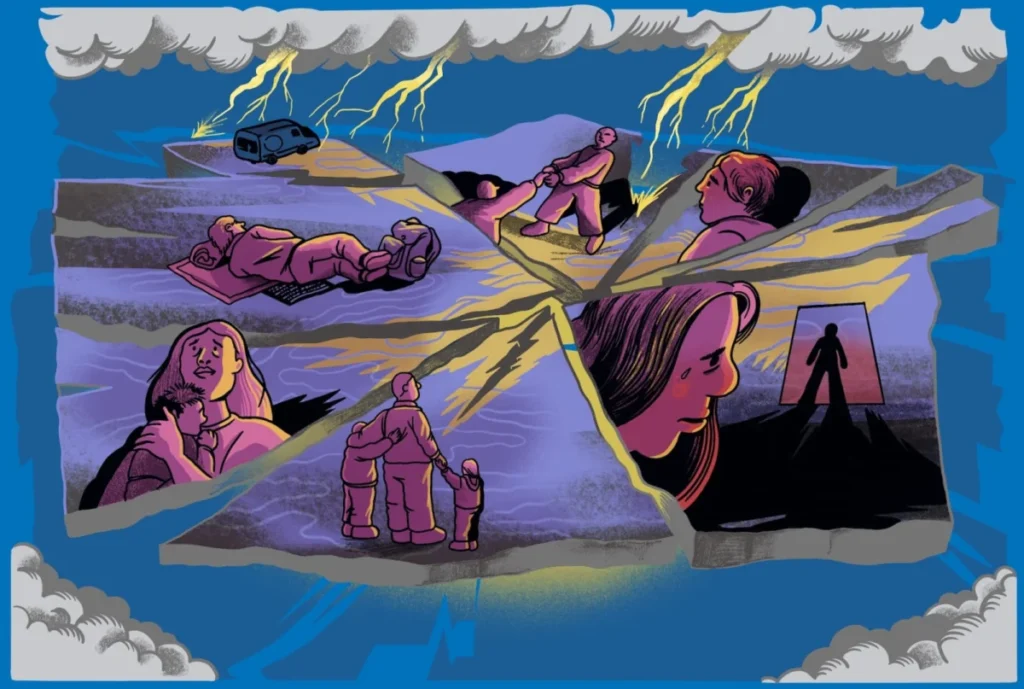
These paradoxes are not merely theoretical; they are visible in the wreckage of modern life. The professional who achieves a C-suite position at the cost of their marriage, the individual who uses substances to regulate emotions only to lose agency over their own health, and the parent who centers their entire identity on their children only to find themselves isolated as the children grow older—all represent the high price of rigid control.
Chronology of a Shifting Perspective
For many, the realization that "everything cannot be done at once" is a slow, often painful, evolution. For years, individuals often cycle through a predictable pattern of behavior:
- Phase 1: The Expectation. A belief that with enough willpower, the "Rubik’s Cube" of life can be solved.
- Phase 2: The Collision. The reality of limited resources (time, energy, emotional capacity) forces a collision between conflicting desires—career advancement versus rest, social obligations versus personal health.
- Phase 3: The Internalization of Failure. The individual views the resulting trade-offs as personal failings, leading to guilt, shame, and increased efforts to "fix" the perceived mess.
- Phase 4: The Acceptance. A gradual transition toward understanding that trade-offs are not failures, but choices.
This transition is highlighted by personal anecdotes, such as the unexpected hospital visit. When an individual is forced by a medical event—such as a potential TIA—to stop all productivity, the initial instinct is to panic over the "scrambled" sides of their life. However, when the individual chooses to embrace the stillness rather than fight the circumstances, they often discover a profound sense of relief. This marks the shift from being an "addict of control" to an observer of reality.
Supporting Data: The Psychological Impact of Control Addiction
The psychological community has long documented the dangers of the "need for control" (NFC). Studies in cognitive-behavioral therapy (CBT) consistently show that individuals with high NFC scores are more prone to chronic stress, burnout, and anxiety disorders.

According to data from the American Psychological Association (APA), the "hustle culture" that encourages total life optimization is a primary driver of the current mental health crisis. When the brain is constantly scanning for ways to "solve" life, it never enters a state of rest. The neurological implication of this constant hyper-vigilance is a depletion of the prefrontal cortex—the area responsible for executive function and emotional regulation.
Furthermore, sociologists point to the "Jurassic Park" effect: the more we attempt to engineer a controlled environment, the more chaotic the system becomes. Just as in the cautionary tales of old—from Midas to Scrooge—the attempt to possess or command every variable leads to a loss of the very joy or status one sought to secure.
Implications for Modern Living
The implications of this shift are profound for both mental health professionals and the general public. If we accept that life is not a puzzle to be solved but a series of choices to be navigated, the following changes emerge:
- Redefining Failure: We stop viewing the "scrambled side" of our lives as a sign of incompetence. Instead, it becomes a reminder that we have prioritized a specific path.
- The Power of the "No": Every "yes" to a project, a commitment, or a desire is inherently a "no" to something else. Acknowledging this makes our decisions more intentional.
- Compassionate Surrender: We begin to treat the addicted, demanding part of ourselves—the part that wants "the cake and the eating of it too"—with the same patience we would offer a child.
Expert Perspectives
Steve Hauptman, LCSW, a psychotherapist whose work focuses on the "Monkeytraps" of control, argues that the most critical step is acknowledging the difference between influence and control.
"We want to influence our outcomes, which is healthy," Hauptman notes. "But when we demand that reality conforms to our expectations, we lose the ability to live in the present. We become trapped in the future, obsessing over what should be rather than what is."
The upcoming revised edition of his work, Monkeytraps: Why We Try to Control Everything and How We Can Stop, seeks to provide a roadmap for this transition. By identifying the triggers that drive our need for control, individuals can begin to replace the exhausting habit of manipulation with the more sustainable practice of acceptance.
Conclusion: Toward a Life of Trade-offs
The pursuit of the perfect life is a mirage. The "speed-cuber" who can solve the puzzle in sixty seconds is a rare exception; for the rest of humanity, the colors will never all match at once.
Accepting that we cannot do everything is not an act of surrender or defeat—it is an act of maturity. It is the realization that inside every "yes" is a "no," and that there is a profound peace to be found in the space between those choices. When we stop trying to force the sides of our life to click into a perfect, static image, we finally become free to live within the movement of the reality we actually have. The goal is no longer to finish the puzzle, but to appreciate the texture of the pieces we are currently holding.


 Pevita Pearce





