
 Dwi Wanna
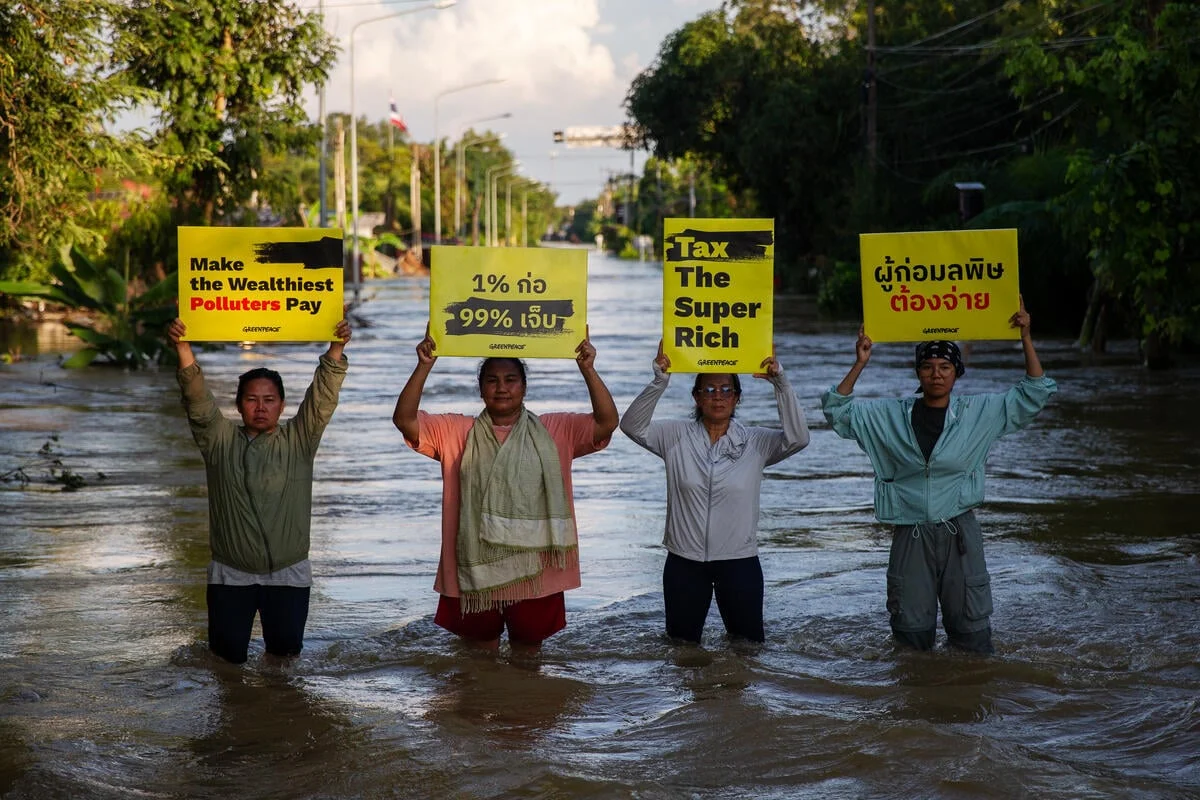
BANGKOK, Thailand — As delegates from the International Monetary Fund (IMF) and the World Bank gather in Bangkok this week, the city serves as a stark, living backdrop to the very crisis they are purportedly there to solve. Outside the air-conditioned boardrooms where global economic policy is debated, Thailand is battling severe, widespread flooding—a tangible manifestation of the climate emergency.
For the millions of people whose homes are submerged and whose livelihoods have been washed away, the juxtaposition is not merely ironic; it is a profound indictment of a global financial system that continues to shield the wealthiest polluters while placing the burden of recovery on those least responsible for the crisis.
The Climate Debt: A Crisis of Inequality
The current floods in Thailand are a microcosm of a broader, systemic failure. While ordinary citizens navigate the wreckage of their lives, the financial machinery that fuels the climate crisis remains largely untouched. The core of the issue, according to climate advocates, is "climate debt"—the concept that the catastrophic costs of global warming are being socialized, while the profits generated by carbon-intensive industries remain privatized and concentrated in the hands of the ultra-wealthy.
Pichmol Rugrod, project lead for the Plastic-Free Future campaign at Greenpeace Thailand, notes that the current recovery efforts are being funded by public money, further stretching the resources of developing nations. "The floods affecting communities across Thailand show how the costs of a changing climate are increasingly being borne by ordinary people—through damaged homes, lost income, and the diversion of public funds needed for recovery," Rugrod said. "Those who have contributed the least should not continue to pay the highest price, while the wealthiest polluters continue to profit and pay nothing."
Chronology of a Financial Disconnect
The tension between international financial institutions (IFIs) and climate activists has been escalating for years. To understand the urgency of the current gathering in Bangkok, one must look at the timeline of the global response to the climate crisis:
- Pre-2015: The focus of international finance remained strictly on growth and fiscal stability, with climate risks often sidelined as "long-term" externalities.
- 2015-2020: The Paris Agreement catalyzed a shift in discourse, yet financial mechanisms failed to keep pace. Debt-strapped developing nations began calling for climate-resilient finance, but were largely met with loan-based packages that increased their sovereign debt.
- 2022: A landmark report revealed that the world’s richest 0.01% were responsible for a staggering US$992 billion in climate-related costs through their investments in carbon-intensive sectors. This figure matches the estimated global requirement for climate finance, highlighting that the money exists, but is currently locked in the hands of those driving the crisis.
- 2024 (Present): The IMF and World Bank meetings in Bangkok represent a boiling point. With extreme weather events now occurring annually, the demand for a fundamental redesign of global tax systems—specifically targeting the ultra-wealthy—has moved from the fringes of activism to the center of policy debate.
Supporting Data: The Cost of Carbon Wealth
The economic argument for taxing the ultra-wealthy is backed by sobering data. When the investment portfolios of the top 0.01% are analyzed, the correlation between extreme wealth and planetary degradation is undeniable.
The US$992 billion in climate damage attributed to these investors in 2022 is not just a statistical anomaly; it is a reflection of a system that incentivizes investment in fossil fuels and deforestation over renewable energy and sustainable agriculture. When these investments lead to environmental collapse—such as the current flooding in Southeast Asia—the costs are rarely recovered from the investors. Instead, they are pushed onto local and national governments, forcing them to choose between essential social services and climate mitigation.
Furthermore, international financial institutions often demand fiscal austerity as a condition for loans. This "austerity trap" prevents countries from investing in the infrastructure needed to protect their citizens from climate impacts, essentially forcing them to pay twice: once through the loss of their land and property, and again through the crippling interest on climate-related debt.
Official Responses and Calls for Reform
The atmosphere at the Bangkok meetings is charged with frustration. Alongside the official IFI sessions, an "International Peoples’ Assembly" has convened, bringing together over 200 civil society organizations, trade unions, and climate justice coalitions from Asia, Africa, and Latin America.
Gerance Mutwol, Fair Share project lead at Greenpeace Africa, has been a vocal critic of the current status quo. "It is outrageous that ultra-wealthy polluters continue to profit from investments in and ownership of highly polluting industries," Mutwol stated. "Meanwhile, international financial institutions continue to put debt repayments and fiscal austerity ahead of protecting communities."
The solution, according to these organizations, lies in a complete overhaul of global tax architecture. They are advocating for:
- The UN Tax Convention: Moving tax policy away from the OECD—which is often perceived as a "rich countries’ club"—toward the United Nations, where every nation has an equal vote.
- Ending Tax Loopholes: Eliminating the mechanisms that allow multinational corporations and ultra-high-net-worth individuals to shift profits to tax havens, thereby depriving national budgets of billions in potential revenue.
- Wealthy-Polluter Levies: Implementing direct taxes on the carbon-heavy assets of the ultra-wealthy, with funds explicitly earmarked for climate loss and damage compensation in vulnerable nations.
The Implications: Why a Global Tax Treaty Matters
The push for a Global Tax Treaty is not just about revenue; it is about sovereignty and equity. Currently, tax rules are fragmented, allowing for a "race to the bottom" where countries compete to lower taxes to attract investment, often at the expense of their own environment and social safety nets.
A UN-led framework would provide a unified, democratic platform to establish fair global tax rules. The next round of negotiations, INC-6, scheduled for Nairobi, Kenya, from November 30 to December 12, will be a critical test of whether the global community has the political will to challenge the interests of the elite.
The implications of failure are severe. If the IMF and World Bank continue to prioritize fiscal austerity over climate justice, the cycle of disaster and debt will accelerate. Vulnerable regions will see their development gains reversed, leading to greater migration, social instability, and economic collapse. Conversely, a successful implementation of a global tax on extreme wealth could unlock the necessary capital to build resilient infrastructure, fund the transition to renewable energy, and provide a buffer for those on the frontlines of the climate emergency.
Conclusion: A Turning Point
As the Bangkok meetings conclude, the message from the streets to the boardrooms is clear: the era of impunity for the wealthiest polluters must end. The floods in Thailand are not just a weather event; they are a warning.
The global financial system stands at a crossroads. It can either continue to protect the accumulated wealth of the few at the expense of the many, or it can evolve to serve the needs of a planet in crisis. By leveraging the UN Tax Convention to close loopholes and tax the climate damage caused by the ultra-wealthy, governments have a unique opportunity to turn the tide. The money is there. The moral imperative is clear. All that remains is the political courage to act before the next flood, fire, or drought makes the cost of inaction irreversible.

 Basiran
 Nila Kartika Wati