


 Lina Hope
For decades, the prevailing wisdom in philanthropy has been clear: generosity is contagious. When individuals witness their neighbors, peers, or community members engaging in acts of altruism, they are statistically more likely to follow suit. This “visibility effect” has served as the bedrock for countless fundraising campaigns, public awareness initiatives, and community-building efforts. However, new research from GivingTuesday’s GivingPulse study suggests that this model of behavioral contagion is incomplete.
A segment of the population—dubbed "Spectators"—defies this traditional logic. While they are susceptible to the initial nudge of social pressure, they lack the internal engine required to transform those single, isolated acts into a broader, lifelong habit of giving. Understanding this cohort is the next frontier in increasing global philanthropy.
Main Facts: Defining the Spectator
In their ongoing research titled The Perception Effect, GivingTuesday researchers categorized the population into four distinct quadrants based on two metrics: the individual’s personal value placed on giving and their perception of the generosity of those around them.
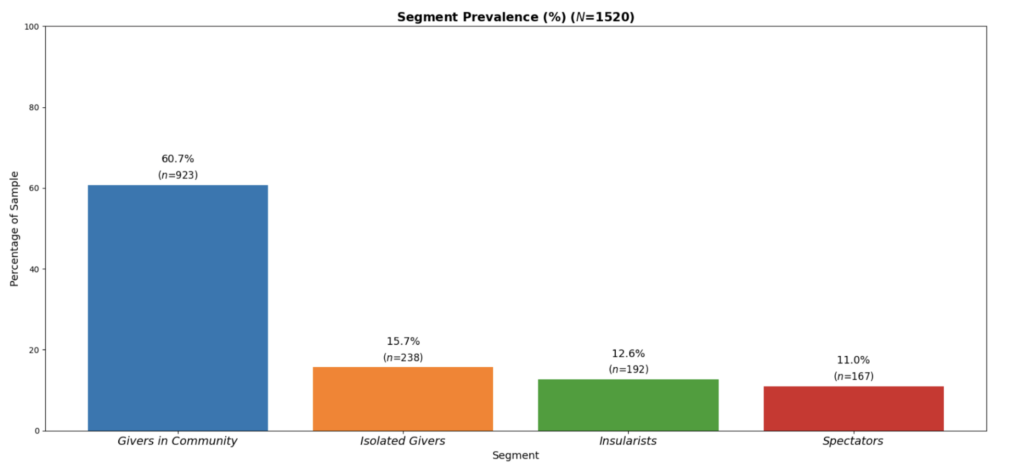
The majority of the population (61%) falls into the "Givers in Community" group—individuals who personally value generosity and feel surrounded by others who do the same. However, the most enigmatic group identified is the Spectators.
Spectators account for approximately 11% of the population. They are defined by a distinct psychological profile: they do not hold giving as a core personal value, yet they are acutely aware of the generosity occurring within their social circles. On paper, they are the ideal candidates for social influence. They see the norms, they feel the pressure of the community, and they are embedded in environments where kindness is expected. Yet, their response to this environment is markedly different from the rest of the population.
Chronology of the Discovery
The identification of the Spectator paradox began with the GivingPulse survey, a multi-year effort to quantify not just the "how much" of giving, but the "why."
- Initial Observations (Phase 1): Researchers noted that while social visibility successfully nudged people to give at least once, there was a divergence in subsequent behavior.
- The Segmentation (Phase 2): By mapping personal values against perceived community generosity, researchers identified the four-quadrant model. This allowed them to isolate the 11% who were "surrounded by givers" but "internally indifferent."
- The Comparative Analysis (Phase 3): Researchers compared the Spectators against the other three groups—Givers in Community, Isolated Givers, and Insularists—by analyzing their response to social signals such as charity requests, workplace drives, and media coverage of humanitarian disasters.
- The Divergence Point (Current Status): The study reached its definitive conclusion: Spectators are as likely as anyone else to make a first gift, but they are significantly less likely to expand their giving into a multi-faceted lifestyle.
Supporting Data: The "Door vs. Threshold" Effect
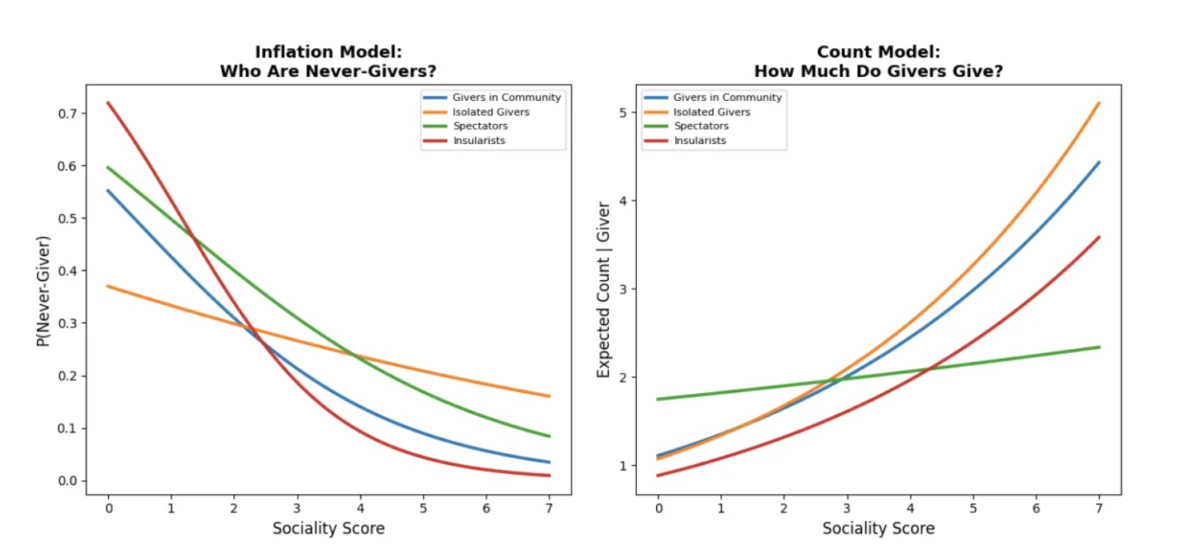
The data collected by GivingPulse reveals a nuanced reality. Researchers measured two distinct metrics: Participation (the act of giving at all) and Breadth (the variety of ways a person gives, including money, time, advocacy, and item donation).
The Participation Metric
When it comes to the first act of giving, Spectators behave like the rest of the population. Across all groups, high exposure to giving signals—such as hearing about a local charity in the news or receiving a request to participate—reduced the likelihood of a person giving nothing by approximately 38%. In this regard, the social nudge works perfectly for Spectators. It gets them through the door.
The Breadth Metric
The divergence occurs at the threshold. For the general population, increased exposure to social signals leads to a 22–25% increase in the variety of ways they give. They move from simple monetary donations to volunteering, advocacy, and beyond.
For Spectators, however, the needle barely moves. Increased exposure only correlates to a 4% increase in the breadth of their giving. This statistical gap is the "Spectator Paradox." While they can be nudged into an isolated act of generosity, that nudge does not compound. They are participating, but they are not evolving as donors.
Theoretical Framework: Why the Paradox Exists
While the data identifies the behavior, researchers look to established psychological frameworks to explain the "why." Two primary theories emerge:
1. The Identity-Congruence Theory
According to Identity-Congruence theory (Stryker & Burke, 2000), individuals are most responsive to cues that align with their existing sense of self. For a "Giver in Community," seeing a neighbor donate is a reflection of their own identity—it validates who they are. For a Spectator, who does not view generosity as a core pillar of their character, the same signal acts as an external prompt rather than an internal mirror. It is a transactional interaction rather than an expressive one.
2. Self-Determination Theory (SDT)
Self-Determination Theory (Deci & Ryan, 2000) posits that behavior driven by internal motivation is more durable than behavior driven by external pressure. Spectators are being motivated by "outside-in" forces—requests, expectations, and reminders. Because this motivation is external, it is inherently fragile. Without an internal shift in values, the Spectator is unlikely to cultivate a broad, self-sustaining habit of philanthropy.
Implications for the Future of Philanthropy
The discovery of the Spectator group necessitates a fundamental shift in how non-profits and community organizations approach engagement.
Moving Beyond "Everyone Is Doing It"
For the 76% of the population who are already inclined toward giving, social proof ("See? Everyone is doing it!") is a powerful motivator. However, for the 11% who are Spectators, this message is largely ineffective for long-term growth.
Organizations must pivot their strategy for these individuals. Instead of broad, normative messaging, Spectators require:
- Low-lift, high-impact opportunities: Since they are not inherently driven by a long-term identity as a "donor," they are best engaged through easy, frictionless opportunities that do not require a massive psychological commitment.
- Personalized narratives: Because their motivation is not driven by the collective, they need to see the direct, personal impact of their gift. They need a "reason of their own" to bridge the gap between an isolated gift and a recurring habit.
- Value-alignment marketing: To move a Spectator from a one-time donor to a lifelong philanthropist, organizations must find ways to connect the act of giving to the donor’s existing, non-philanthropic interests (e.g., hobby-based volunteering or community-based sports).
The "Untapped" Potential
The data suggests that the sector is missing an opportunity. Nearly 89% of people would be more involved if they were asked more frequently, yet only about 70% of people are currently involved in any given week. By recognizing that different segments of the population respond to different stimuli, the philanthropic sector can move away from a "one-size-fits-all" approach.
Conclusion
The Spectator Paradox reminds us that the narrative of generosity is not monolithic. It is a complex tapestry woven from personal values, social pressures, and individual life goals.
For many, social visibility is the wind in their sails, pushing them toward a lifetime of broad, multifaceted contribution. For the Spectator, however, social visibility is merely a prompt that occasionally forces them to act. To bring this group into the fold, the charitable sector must stop relying solely on the "normative" approach. We must learn to speak to their internal motivations, meeting them where they are with opportunities that feel meaningful to them personally, rather than just socially expected.
As we continue to navigate the landscape of modern giving, the challenge lies in understanding that while the "social nudge" may get people through the door, it is the alignment of values that keeps them there. By evolving our strategies to accommodate the Spectator, we can move closer to unlocking the full potential of human generosity.


 Ammar Sabilarrohman

 Suro Senen





