




 Raul Delapena Setiawan
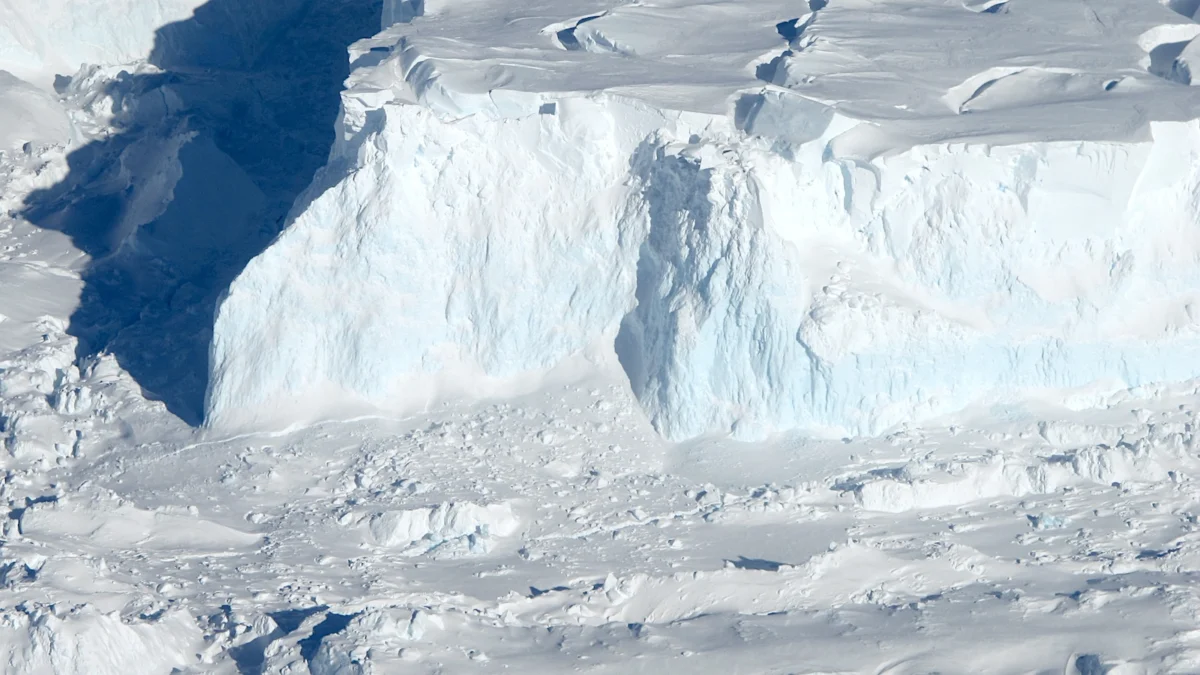
At the frozen periphery of the West Antarctic Ice Sheet sits a behemoth of ice so influential that its fate may dictate the future of human civilization’s coastal geography. The Thwaites Glacier, colloquially known as the "Doomsday Glacier," has long been the subject of intense scientific scrutiny. However, recent breakthroughs in glaciological modeling have revealed a reality far more precarious than previously understood. New research suggests that the mechanisms driving the glacier’s retreat are more aggressive than older simulations could account for, potentially doubling the projected sea-level rise contributed by this single ice mass by the turn of the century.
As the planet continues to warm, the race to understand Thwaites has become a race against time. Scientists are no longer merely asking if the glacier will fail, but rather how quickly the "cork" will be pulled from the bottle, unleashing the vast interior ice of West Antarctica into the rising global oceans.
Main Facts: The Anatomy of a Global Threat
The Thwaites Glacier is a gargantuan frozen entity, roughly the size of the state of Florida. Its sheer scale is difficult to comprehend: it spans approximately 80 miles across its front and reaches depths that extend far below the surface of the Southern Ocean. Currently, Thwaites acts as a critical bulwark, or a "cork," for the West Antarctic Ice Sheet (WAIS).
The geography of this region is uniquely dangerous. Much of the WAIS sits in a vast topographical basin that lies below sea level. Thwaites sits on the edge of this basin, preventing the surrounding ocean from flooding the interior. If Thwaites were to collapse, it would not only release its own massive volume of ice—enough to raise global sea levels by approximately two feet—but it would also expose the rest of the West Antarctic Ice Sheet to the warming sea. This "marine ice sheet instability" could trigger a feedback loop resulting in a total sea-level rise of up to 10 feet, an event that would submerge major metropolitan areas from Miami to Shanghai.
Currently, Thwaites is responsible for about 4% of the world’s annual sea-level rise. While that percentage may seem modest, the cumulative effect over the last three decades has already contributed to the displacement of coastal communities in Senegal and the Solomon Islands, and the literal collapse of beachfront homes in North Carolina.
Chronology: From Satellite Observation to Predictive Modeling
The history of monitoring Thwaites is a testament to the evolution of climate science. For decades, researchers relied primarily on satellite imagery to track the glacier’s retreat. These observations provided a clear, albeit grim, visual record: the glacier’s front was fracturing, and its flow toward the sea was accelerating.
However, a significant gap existed between observation and prediction. For years, the computer models used to simulate the future of Thwaites failed a fundamental test: they could not accurately replicate the retreat that had already occurred. These models often underestimated the speed of ice loss, leading to a sense of "model uncertainty" that hampered policy discussions regarding coastal adaptation.
The timeline of our understanding shifted significantly in early 2024. A landmark paper published in Nature Communications by a team led by Mattia Poinelli, a glaciologist at the University of California Los Angeles, introduced a "missing piece" to the puzzle. By incorporating the dynamic behavior of the "grounding zone"—the area where the glacier loses contact with the seafloor and begins to float—scientists were finally able to align their models with satellite data.
This was followed in July 2024 by a study in Geophysical Research Letters, led by Rosie Williams of the British Antarctic Survey. This study utilized these advanced models to test hypothetical "best-case" scenarios, providing a chronological projection of how Thwaites might respond even if global warming were miraculously halted today.
Supporting Data: The Grounding Zone and the Tidal Feedback Loop
The core of the recent "bad news" lies in the physics of the grounding zone. Until recently, glaciologists treated the grounding line—the point where the ice meets the seabed—as a relatively static boundary. The new research by Poinelli and his colleagues reveals that this zone is highly dynamic, oscillating in response to the tides.
The "Pumping" Mechanism
As the tide rises and falls, the massive ice shelf bobs up and down. This movement creates a "pumping" effect, forcing warm, salty seawater miles underneath the glacier’s underbelly. This warm water creates "basal melting," carving out massive channels and cracks in the ice from the bottom up.
- The Result: The glacier becomes thinner and loses its grip on the seafloor (the "pinning points").
- The Projection: The model suggests that Thwaites could become permanently "unpinned" from the seafloor as early as 2038. There is a 60% probability of this occurring before the end of the century.
Doubling the Projections
Previous models, which ignored this tidal pumping, projected a certain rate of melt. The Poinelli model, however, indicates that Thwaites could contribute 3 centimeters (roughly 1.2 inches) to sea-level rise by 2100 under current temperature conditions. While 3 centimeters may seem negligible to a layperson, it represents a 100% increase over previous projections. When combined with the melting of other glaciers and the thermal expansion of the oceans, this acceleration poses an existential threat to low-lying infrastructure.
Official Responses and Scientific Perspectives
The scientific community has responded to these findings with a mixture of professional rigor and palpable urgency. The consensus is that the "Doomsday" moniker, once dismissed by some as hyperbolic, may accurately reflect the glacier’s unique vulnerability.
Mattia Poinelli (UCLA): Poinelli emphasizes that while many unknowns remain, the inclusion of grounding zone dynamics is a game-changer. "This solves a specific and very important piece of the puzzle," Poinelli stated. He warned that his model’s "grim picture" is based on current temperatures. Since global warming is expected to continue ramping up, the reality could be even more severe than the 3-centimeter projection.
Rosie Williams (British Antarctic Survey): Williams’ research provides a sobering comparison between Thwaites and its neighbor, the Pine Island Glacier. Her team’s "what-if" scenario—simulating a complete "switch-off" of ocean melting—showed that while Pine Island could potentially recover and regrow within a decade, Thwaites is likely past the point of no return. "Thwaites… would keep losing ice and raising sea levels worldwide for at least 150 years," Williams noted. She attributes this to the fact that Thwaites’ structural integrity is already too far gone, with its eastern half diminished and its western half shattered into icebergs.
These official responses underscore a shift in the scientific narrative: we are moving from a phase of "monitoring the decline" to "modeling the collapse."
Implications: A Coastal Crisis and the Call for Mitigation
The implications of an accelerated Thwaites retreat are global and multi-faceted, affecting everything from international security to the global economy.
1. The Disappearance of Coastal Geography
A two-to-ten-foot rise in sea level would redraw the world map. Coastal cities, which house a significant portion of the global population and economic infrastructure, would face frequent "nuisance flooding" at best and permanent inundation at worst. The cost of building sea walls and moving critical infrastructure (power plants, sewage systems, transit hubs) is estimated in the trillions of dollars.
2. Forced Migration and Climate Refugees
We are already seeing the beginning of this trend. In the Solomon Islands, entire villages have been forced to relocate to higher ground as their ancestral lands vanish beneath the waves. In West Africa, the rising Atlantic is swallowing the historic coastlines of Senegal. An acceleration of the Thwaites melt would turn this trickle of climate refugees into a flood, potentially displacing hundreds of millions of people by the end of the century.
3. The Irreversibility Factor
Perhaps the most daunting implication of the recent research is the suggestion of irreversibility. If Williams’ model is correct, Thwaites may continue to melt for 150 years even if we manage to cool the oceans today. This suggests that some level of sea-level rise is now "baked in" to the Earth’s system.
4. The Value of Every Degree
Despite the grim outlook, scientists insist that human action still matters. "That doesn’t mean there’s nothing we can do," Williams argued. The speed of the disintegration is still linked to greenhouse gas emissions. By aggressively reducing carbon output, humanity can slow the rate of the melt, buying precious decades for coastal cities to adapt, engineer defenses, or execute managed retreats.
In conclusion, the Thwaites Glacier stands as a stark reminder of the sensitivity of the Earth’s climate systems. The "Doomsday" glacier is no longer a distant, static block of ice; it is a dynamic, crumbling barrier that is beginning to fail. The new data from the grounding zones of Antarctica serves as a final wake-up call: the "cork" is loosening, and the global community must prepare for the waters that will follow.


 Nana

 Ammar Sabilarrohman






