

 Basiran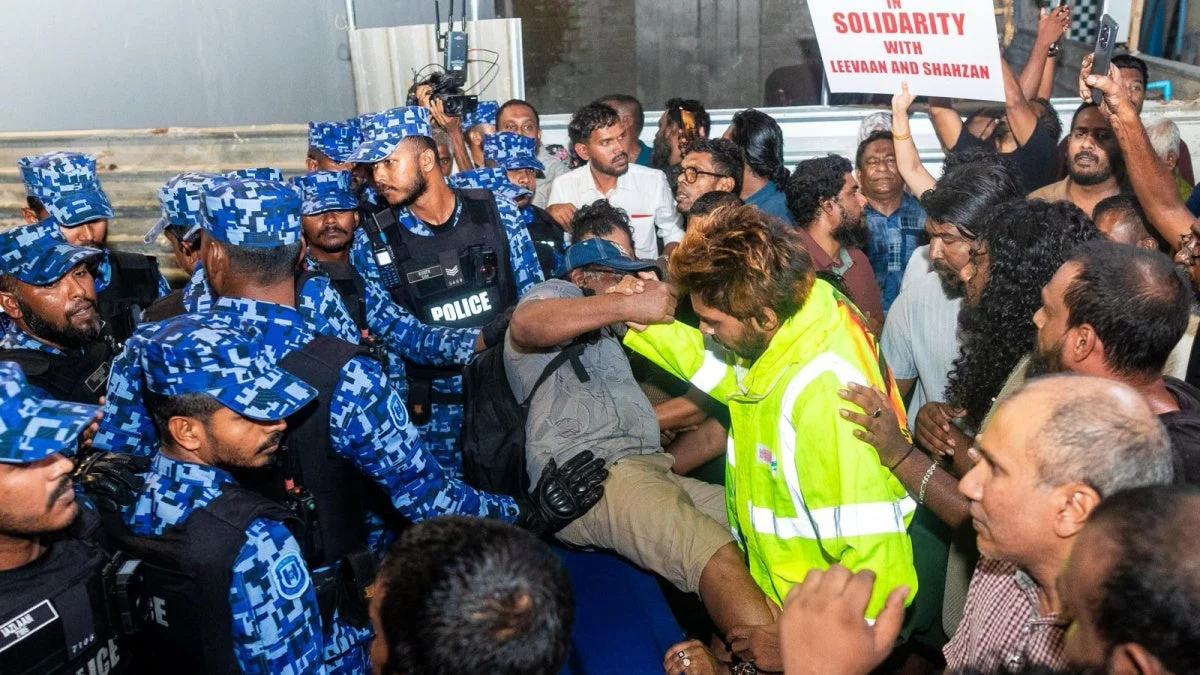
MALE, MALDIVES — The Maldives, an archipelago nation celebrated globally for its pristine turquoise waters and luxury tourism, is currently grappling with a severe domestic crisis that threatens the very foundations of its democratic identity. In a harrowing development that has sent shockwaves through international human rights circles, the Maldivian government has initiated an unprecedented crackdown on the press, marking the first time journalists have been incarcerated on criminal charges since the country’s transition to a multi-party democratic constitution in 2008.
The arrests of Leevan Ali Naseer, 29, and Mohamed Shahzan, 31, in the second week of May 2026, represent a grim milestone in the erosion of civil liberties. As the state intensifies its campaign against independent voices, observers warn that the nation is sliding back into an era of authoritarianism, marked by the weaponization of the judiciary and the systematic silencing of dissent.
The Catalyst: A Documentary, a Raid, and a Gag Order
The current hostilities trace back to March 28, 2026, when the independent online newspaper Adhadhu released a groundbreaking documentary titled "Aisha." The film presented allegations of sexual misconduct and abuse of power involving President Mohamed Muizzu and a former employee. While the President has categorically denied these claims, the state’s reaction was immediate and heavy-handed.
On April 27, the Serious and Organized Crime Department launched a raid on Adhadhu’s headquarters in Malé. During the operation, security forces seized laptops, hard drives, and sensitive journalistic materials—actions that media watchdogs describe as a blatant violation of press confidentiality and source protection.
The escalation did not stop there. Following the raid, authorities imposed strict travel bans on Adhadhu’s CEO, Hussain Fiyaz Moosa, and managing editor, Hassan Mohamed. On May 10, the situation reached a boiling point when the Prosecutor General’s Office charged both men under Section 612(a) of the Penal Code for "qazf"—a provision under Islamic law concerning the false accusation of adultery. If convicted, the two journalists face up to 19 months in prison and the draconian punishment of up to 80 lashes.
That same day, the Maldivian Criminal Court issued a sweeping gag order, prohibiting any public discussion or reporting on the contents of the "Aisha" documentary. It was in the aftermath of this order that Naseer and Shahzan were arrested, convicted, and sentenced to 10 and 15 days in prison, respectively, for the "crime" of reporting on the existence and implications of the gag order itself.
Chronology of a Crackdown
- September 16, 2025: The People’s Majlis (Parliament) passes the Maldives Media and Broadcasting Regulation Bill, granting the government extensive discretionary power over media outlets.
- March 28, 2026: Adhadhu publishes the "Aisha" documentary, alleging misconduct by President Muizzu.
- April 27, 2026: Authorities raid Adhadhu’s offices in Malé, seizing critical equipment.
- May 8, 2026: Human Rights Watch and various international bodies issue a formal letter to President Muizzu, expressing alarm over the targeting of journalists.
- May 10, 2026: The Prosecutor General charges Adhadhu leadership with "qazf." A criminal court issues a total gag order on the documentary.
- May 12, 2026: Journalists Leevan Ali Naseer and Mohamed Shahzan are sentenced to jail time for reporting on the gag order.
- May 13, 2026: Police violently break up peaceful protests in Malé, arresting 10 demonstrators.
- May 15, 2026: Naseer is placed in solitary confinement in Maafushi prison, reportedly denied medical treatment for a worsening skin condition.
- May 19, 2026: Thirteen independent media outlets conduct a 12-hour "blackout" to protest state repression. Former presidents issue a joint call for the release of detained journalists.
Institutionalized Censorship: The 2025 Media Law
The legal architecture for this crackdown was codified in the Maldives Media and Broadcasting Regulation Bill, passed in late 2025. Critics argue that the law was specifically designed to stifle investigative journalism under the guise of "regulation."
The bill established the Maldives Media and Broadcast Commission, a body whose members are elected via a government-controlled parliament. Consequently, the commission lacks the independence required to act as a fair arbiter. The commission possesses the power to demand corrections for online content and impose crushing fines—ranging from MVR 5,000 to MVR 25,000—on media workers who fail to comply with government dictates.
"The law isn’t meant to promote media rights; it’s meant to suppress them," said an Adhadhu spokesperson. In late April, the commission flexed this new muscle by ordering Channel 13 to cease live transmissions of opposition protests, effectively censoring real-time documentation of public dissent.
Human Rights and Prison Conditions
The treatment of the incarcerated journalists has raised severe concerns regarding human rights standards within the Maldivian penal system. Reports indicate that Naseer and Shahzan are being held in Maafushi prison under unsanitary and overcrowded conditions.
The situation for Naseer took a particularly ominous turn on May 15, when he was transferred to a solitary confinement unit. Advocates note that he has been denied access to necessary medical treatment for a painful skin condition that has exacerbated significantly since his incarceration. Mohamed Junayd, executive director of the Maldives Journalists Association, described the judicial process as "shocking," citing "secret trials without lawyers" and a complete disregard for the fundamental legal safeguards that once protected the Maldivian press.
A Rare Unified Voice: The Former Presidents
In an extraordinary display of political unity, three former presidents of the Maldives—Mohamed Nasheed, Abdulla Yameen Abdul Gayoom, and Ibrahim Solih—issued a joint letter to the international community. This cross-party consensus highlights the severity of the crisis.
The letter explicitly warns that the current administration is dismantling the country’s democratic pillars. "A free press is among the clearest markers of democracy," the leaders wrote, noting that the suppression of journalists is part of a broader, more dangerous pattern that includes the disempowerment of Parliament and the gutting of independent oversight commissions. They have called for the immediate release of all journalists and protesters currently held in state detention.
The Shadow of Extremism and the Cost of Silence
The current government’s rhetoric has also exacerbated the risks faced by journalists on the ground. In the Maldives, Islamist extremist gangs have a history of targeting those labeled as "anti-Islamic" or "offensive" to religious sensibilities. These groups often operate with a degree of impunity, and there have been documented instances of collusion between such gangs and prominent political figures.
For working journalists, the state’s narrative has real-world consequences. "The Maldives is a very small country," one journalist noted. "When officials label us as anti-Islamic or aggressive, it puts us at real risk. It affects how we live our daily lives—going to work, taking our children to school." By framing journalistic work as a threat to faith or state security, the administration is effectively putting a target on the backs of media professionals.
Implications for the Future
Elaine Pearson, Asia director at Human Rights Watch, has been unequivocal in her assessment. "The Maldives government’s wrongful jailing of two journalists and raiding of independent news outlets sends a chilling message about media freedom in the country," she stated. "The government should urgently reverse the dangerous backsliding on media freedom."
The implications of this crackdown extend far beyond the Maldives’ borders. As a small nation that relies heavily on its international reputation for stability and tourism, the degradation of the rule of law could lead to international sanctions, loss of donor support, and a broader decline in the country’s standing on the global stage.
The media blackout on May 19, in which 13 outlets suspended operations for 12 hours, served as a stark reminder of what the Maldivian information landscape looks like without independent voices. As President Muizzu remains silent on the calls for reform, the international community is left watching a democracy unravel in real-time. For the journalists of the Maldives, the fight is no longer just about reporting the news; it is about the survival of the democratic experiment itself.

 Rifan Muazin
 Asep Darmawan