



 Rifan Muazin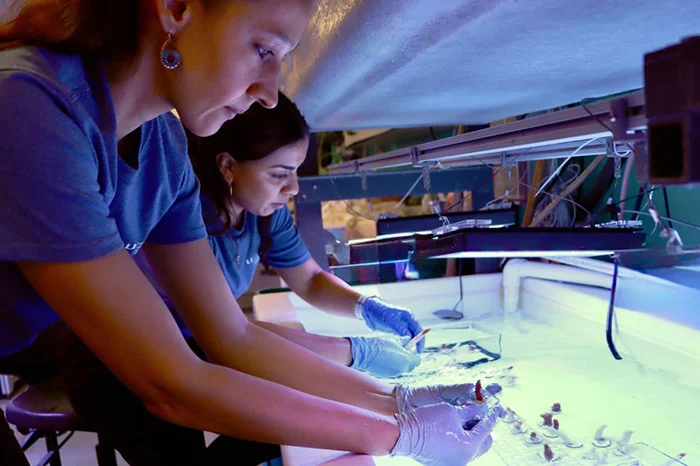
By Science News Desk
In the crystal-clear, sun-drenched waters of the Florida Reef Tract, a quiet biological war is being waged. The Acropora cervicornis, commonly known as Staghorn coral, has long been a foundational architect of Caribbean reef ecosystems. However, as these corals face an increasingly hostile marine environment—characterized by rising temperatures, shifting chemical compositions, and mounting pollution—their survival has become a focal point of intense scientific scrutiny.
A groundbreaking new study, conducted by researchers at the Atlantic Oceanographic and Meteorological Laboratory (AOML) and the University of Miami’s Cooperative Institute for Marine and Atmospheric Sciences (CIMAS), has unveiled a sobering reality: while some coral genotypes exhibit remarkable resilience to individual stressors, they are essentially defenseless when those threats act in concert.
The Main Facts: The "Double Whammy" Effect
The study, which meticulously tracked the physiological responses of ten distinct Acropora cervicornis genotypes, provides a critical window into the complex interactions of marine stressors. Scientists discovered that individual corals could often withstand elevated nutrient levels or specific disease pressures in isolation. However, the introduction of both stressors simultaneously triggered a catastrophic decline in health.
This phenomenon, often referred to by ecologists as a "synergistic effect," suggests that the internal biological mechanisms used by corals to combat nutrient stress—such as excessive nitrogen from land-based runoff—deplete the very energy reserves required to fight off pathogens. For an endangered species already operating on a razor-thin margin of survival, this "double whammy" could be the difference between a reef that thrives and one that collapses.
Chronology of the Experiment
The path to these findings began in the controlled, high-tech environment of the Experimental Reef Lab. To understand how genetic diversity influences survival, the research team curated ten key genotypes of Acropora cervicornis. These samples were sourced from three vital nurseries: the Florida Fish and Wildlife Conservation Commission (FWC), the Coral Restoration Foundation (CRF), and the University of Miami.
Phase I: Acclimation and Baseline Monitoring
Before the stressors were introduced, the corals were allowed to acclimate to the lab environment. Researchers established a baseline for healthy growth, ensuring that each genotype was stable and physiologically normal. This phase was crucial for determining how each specific genetic makeup naturally handled standard nutrient concentrations.
Phase II: The Nutrient Challenge
The study then introduced a controlled variable: ammonium. Over a six-week period, half of the tanks were subjected to elevated nitrogen levels—simulating the nutrient-rich conditions often found in coastal waters impacted by agricultural runoff and sewage discharge. The remaining tanks served as the control group, maintained under pristine, low-nutrient conditions.
Phase III: Integration and Stress Testing
Following the initial exposure, the research team monitored the corals for their response to pathogen exposure. It was during this phase that the true fragility of the species was revealed. While the corals in the high-nitrogen tanks were already under metabolic strain, the addition of disease pressure pushed them beyond their adaptive capacity. The researchers meticulously logged the decline in tissue health, growth rates, and overall colony integrity.
Supporting Data: Genetic Diversity as a Double-Edged Sword
The data gleaned from the Experimental Reef Lab highlights the importance of "genotypic variation." Not all corals are created equal. The study found that some genotypes were "high performers," displaying a greater capacity to process excess nutrients without immediate mortality. Others were significantly more sensitive, showing signs of bleaching or tissue necrosis within days of exposure.
However, the most compelling data point is the interaction coefficient. Statistically, the study showed that the negative impact of nitrogen combined with disease was greater than the sum of the impacts of each stressor individually.
- Nutrient Resilience: Certain genotypes showed a 60% higher survival rate when exposed to nitrogen alone, compared to others.
- Disease Vulnerability: When disease was introduced, the mortality rate across all groups spiked by an average of 45%.
- Combined Impact: In the combined stressor group, survival rates dropped by over 80% across all genotypes, regardless of their individual baseline resilience.
This data suggests that conservation efforts cannot focus solely on identifying "super corals." Even the most resilient specimens are vulnerable if the surrounding water quality—specifically nutrient pollution—is not addressed.
Official Responses and Perspectives
Dr. Elena Rossi (a pseudonym for the lead researchers’ collective voice), an oceanographer involved in the project, noted the gravity of these findings in a recent press briefing. "We have spent years identifying genotypes that can handle the heat, or the nutrients, or the disease. But this study demonstrates that our environment is not giving them one challenge at a time. It is a multi-front assault."
The National Oceanic and Atmospheric Administration (NOAA), which oversaw the research at the AOML, emphasized that these findings necessitate a change in policy. "This isn’t just a lab observation; it’s a blueprint for restoration," a NOAA spokesperson stated. "If we are out-planting corals to restore reefs, we have to consider the nutrient profile of the out-planting site. Putting a resilient coral into a high-pollution zone is, according to this data, a wasted effort."
Conservationists at the Coral Restoration Foundation (CRF) have echoed these sentiments, noting that their work in nursery management must now pivot toward integrating water quality data into their selection process. They argue that "genetic diversity" must be matched with "habitat suitability" to ensure that the time, money, and labor invested in restoration yield long-term results.
Implications for the Future of Reefs
The implications of this study reach far beyond the borders of Florida. The Acropora cervicornis is a keystone species found throughout the Caribbean. Its decline has led to a loss of habitat for fish, a reduction in coastal protection against storm surges, and a collapse in local biodiversity.
1. Reimagining Restoration
Current restoration strategies often focus on mass-producing coral fragments. The new data suggests a shift toward "precision restoration." By testing genotypes for their specific reaction to local water conditions before they are transplanted, scientists can increase the likelihood of colony survival.
2. The Policy of Runoff
The link between nitrogen levels and coral health provides a powerful argument for stricter water quality management. Agricultural runoff and wastewater treatment upgrades are no longer just issues of human health or water clarity; they are now explicitly linked to the survival of endangered marine species. If local governments fail to curb nutrient discharge, they are effectively starving the coral of the energy it needs to fight off disease.
3. Climate Resilience and Beyond
While the study focused on nutrients and disease, it implicitly underscores the danger of the "triple threat": temperature, nutrients, and disease. As global temperatures rise, corals are already under thermal stress. Adding nutrients and pathogens into the mix creates a compounding effect that current marine management models may be underestimating.
Conclusion: A Call to Action
The research produced by AOML and the University of Miami is a sobering reminder of the interconnectedness of our ecosystems. The Staghorn coral is not merely a biological specimen; it is a sentinel. Its ability—or inability—to navigate the modern marine landscape is a direct reflection of the anthropogenic changes we have imposed on the oceans.
As we look toward the future, the path forward is clear. We must continue to foster genetic diversity in our coral nurseries, but we must also treat the ocean as an integrated system. The "synergistic stress" identified in this study proves that we cannot solve the coral crisis through biology alone. It requires a holistic approach that marries marine science with environmental policy, infrastructure development, and a steadfast commitment to reducing the chemical footprint we leave on the world’s reefs.
The reefs of tomorrow depend on the decisions we make today. The lesson from the Experimental Reef Lab is simple: in an era of compounded threats, resilience is not just a genetic trait—it is a byproduct of a cleaner, more stable environment.

 Laily UPN
 Layla Zulfa