



 Laily UPN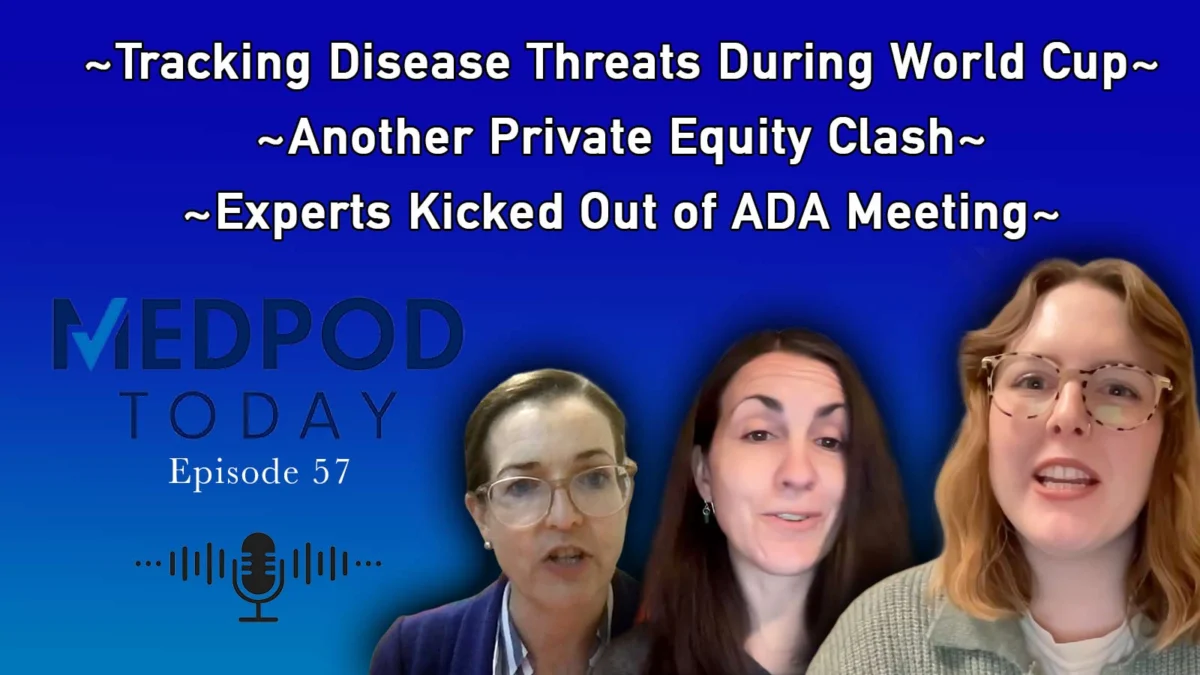
This week, the healthcare landscape has been defined by a convergence of high-stakes public health monitoring, the escalating tension between clinical autonomy and private equity, and a profound crisis of confidence within the scientific community. As the FIFA World Cup brings a surge of global travel to North American soil, a grassroots coalition of public health experts is attempting to fill the void left by shifting government priorities. Simultaneously, the medical profession is grappling with the unsettling displacement of independent physician groups by private equity interests, while the American Diabetes Association (ADA) faces a reckoning following a controversial incident involving the censorship of prominent researchers.
I. Global Health Security: The Grassroots Surveillance of the World Cup
As millions of soccer fans descend upon North American stadiums, the risk of infectious disease transmission has become a primary concern for public health officials. With the U.S. federal public health infrastructure currently in a state of flux—compounded by the administration’s withdrawal from the World Health Organization—a new, independent collaborative has emerged to bridge the monitoring gap.
The Rise of the HSOC
The Health Security Operations Center (HSOC), a project of Georgetown University’s National Center for Health Security and Resilience in partnership with MedStar Health, is currently spearheading a massive, decentralized surveillance effort. More than 30 collaborators, including epidemiologists, wastewater monitoring firms, and science communicators like Katelyn Jetelina, PhD, MPH, have united to track potential outbreaks.
"This is really the first time we’re trying this, to see how a nongovernmental entity can work independently but in support of all of these efforts," noted Rebecca Katz, PhD, MPH, director of the HSOC.
Methodology and Scope
The HSOC operates as a central command, synthesizing data from social listening and, crucially, wastewater surveillance. By analyzing genetic material in sewage samples via PCR and metagenomic sequencing, the group can detect pathogens—ranging from common seasonal influenza and norovirus to more concerning viral threats—with a turnaround time ranging from 48 hours to a week. Experts liken this system to a "weather radar" for pathogens, providing early warnings that allow emergency managers and hospital systems to proactively adjust their preparedness.
Despite the critical nature of this work, the project operates on a shoestring budget, relying heavily on the individual resources of its collaborators. While it currently serves as a vital bellwether for mass-gathering public health, the long-term sustainability of such a decentralized model remains a significant question for future events, such as the 2028 Los Angeles Olympics.
II. The Private Equity Clash: Clinical Autonomy Under Fire
In West Virginia and Virginia, the medical community is reeling from a stark example of corporate consolidation. Emergency Medicine of Blue Ridge (EMBR), a physician-led, democratic group with a 25-year history of service, was recently blindsided by their partner, Valley Health, which moved to replace them with a private-equity-owned practice management firm, SCP Health.
A Sudden Displacement
On April 2, EMBR leadership was informed that their contract would be terminated effective September 30, citing a "no-cause" termination clause. The move forces EMBR’s physicians and advanced practice providers into a difficult ultimatum: accept employment under SCP Health as independent contractors (1099 employees) with reduced benefits and lower compensation, or lose their positions entirely.
Internal projections from the affected physicians suggest a drastic shift in care delivery. Plans involve reducing physician staffing from 90 hours per day to 70, while simultaneously doubling the hours for advanced practice providers from 30 to 60. Practitioners have described this pivot as a severe blow to the quality of patient care and professional morale.
Legal and Economic Obstacles
The physicians sought support from the American Academy of Emergency Medicine (AAEM) to challenge the transition. However, they faced three insurmountable hurdles:
- Legal Jurisdictions: While West Virginia offers some protections against the corporate practice of medicine, Virginia lacks similar safeguards, leaving the group with limited legal recourse.
- Financial Constraints: The high cost of litigation serves as an effective barrier for younger physicians saddled with student debt.
- Time Sensitivity: The uncertainty led many staff members to seek alternative employment, effectively dismantling the group’s capacity to continue operations regardless of a potential legal victory.
The fallout serves as a grim case study for independent physicians nationwide, prompting renewed calls for federal and state legislation to protect the physician-patient relationship from the encroachment of private equity.
III. The ADA Incident: Science Censored in New Orleans
Perhaps the most public display of institutional dysfunction occurred at the American Diabetes Association’s annual conference in New Orleans, where five leading diabetes researchers were forcibly removed from the convention center.
The Chronology of the Confrontation
The incident began on Friday, June 5, outside a keynote session. Several experts, including Steven Kahn, MBChB, editor-in-chief of the society’s flagship journal, Diabetes Care, were distributing copies of an editorial they had authored. The editorial, which had already been published in the journal, criticized federal policy shifts regarding diabetes research funding.
Within ten minutes of their arrival, convention center security—supported by local and state police—intervened. Video footage captured by reporters shows security personnel seizing the editorials and physically escorting the researchers from the premises, confiscating their professional badges in the process.
Fallout and Institutional Response
The immediate aftermath was marked by widespread professional condemnation. Two high-ranking ADA leaders—president-elect Jennifer Green, MD, and scientific sessions planning committee chair Mark Atkinson, PhD—resigned in protest. During the Sunday morning keynote, a silent walkout of attendees holding "We Stand With Science" banners served as a powerful visual rebuke of the organization’s actions.
The pressure reached a boiling point when a session chaired by John Buse, MD, PhD, became a site of defiance. Buse called for a standing ovation for Dr. Kahn, honoring his commitment to scientific integrity. Facing immense pressure and a 95% disapproval rating from their own membership, the ADA CEO eventually issued a formal video apology. While the ADA offered to return the badges to the researchers, most declined, viewing the gesture as an insufficient remedy for the violation of scientific discourse.
IV. Implications for the Future of Healthcare
These three distinct narratives—the HSOC’s grassroots monitoring, the displacement of EMBR, and the ADA’s censorship—paint a complex picture of modern healthcare.
- Public Trust and Professionalism: The ADA incident highlights a growing disconnect between professional organizations and their members, particularly when political pressures influence administrative decision-making. The overwhelming condemnation from the scientific community suggests that researchers are increasingly unwilling to tolerate the suppression of evidence-based advocacy.
- The Consolidation Trend: The struggle of EMBR underscores the fragility of the independent practice model. As private equity continues to acquire hospital staffing contracts, the "corporate practice of medicine" is creating a standard of care driven more by margin optimization than by clinical experience.
- The Public Health Gap: The reliance on the HSOC to monitor infectious disease threats highlights a vulnerability in national security. As global events increase the speed and volume of travel, the reliance on ad-hoc, volunteer-driven public health infrastructure may not be enough to contain the next major outbreak.
As we look toward the remainder of the World Cup and beyond, the healthcare sector remains in a state of transition. Whether through the lens of infectious disease preparedness or the preservation of physician autonomy, the common thread is a struggle for control over the future of the medical profession and its role in protecting the public.
Quick Data Update: Measles Trends
While the World Cup dominates headlines, public health monitoring remains focused on endemic threats. The past two weeks have seen a fluctuation in measles cases, with 32 new reports recorded last week—a decrease from the 56 cases reported the prior week. With nearly half of the 48 participating World Cup nations reporting active measles transmission, the HSOC and the CDC are maintaining high-alert status for regions like Virginia and Pennsylvania, where recent clusters have been identified. Health officials urge attendees to ensure vaccination status is up to date, as mass gatherings continue to serve as a critical test for national and global surveillance networks.

 Dwi Wanna
 Reynand Wu