

 Laily UPN
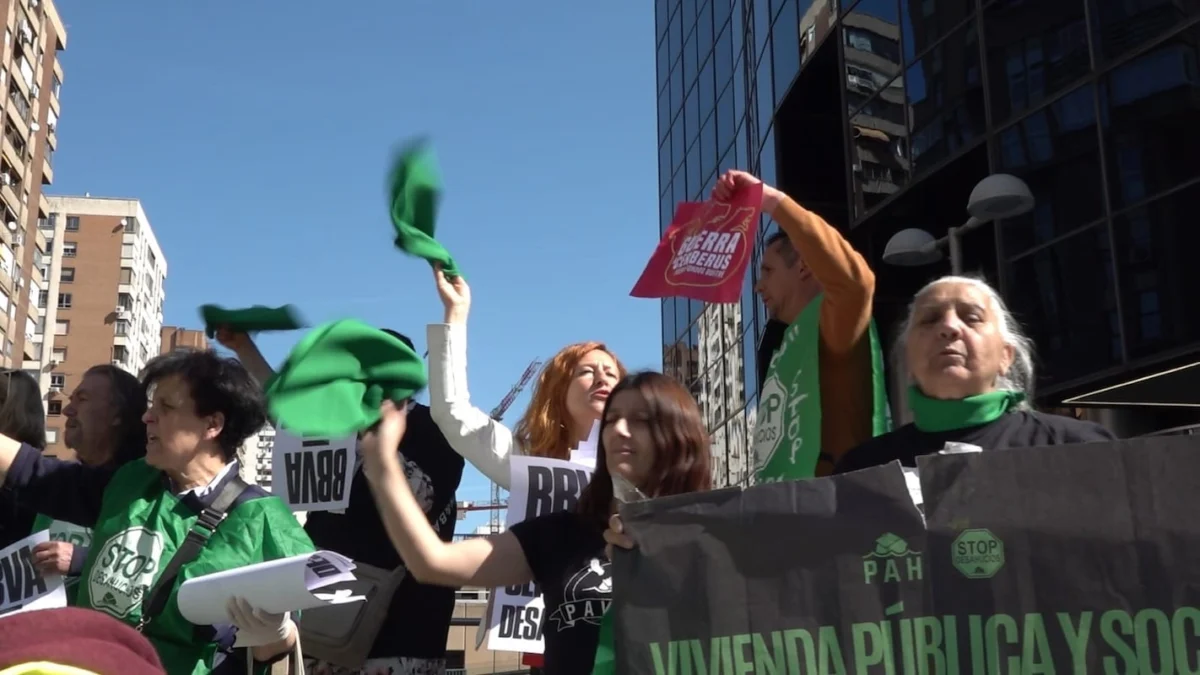
For Angelines, a resident of the Usera district in Madrid, life was once defined by the rhythmic, often invisible labor of domesticity: school runs, grocery shopping, and maintaining a home. This routine was shattered not by a personal failing, but by the systemic collapse of the Spanish housing market. When she found herself facing eviction from her council flat—a property that had seen her rent spike from €90 under her grandmother’s tenure to an unsustainable €500—she was forced to step outside the domestic sphere and into the radical, assembly-based world of the Plataforma de Afectados por la Hipoteca (PAH).
Today, Angelines’ life bears little resemblance to her past. Her days are no longer mapped by household chores, but by the demands of collective action: sit-ins at administrative offices, negotiating with housing officials, and organizing to block evictions. "My son has experienced it as a job," she reflects. "Because every day I left them at school, I had something to do."
Angelines’ transition from a housewife to a frontline activist is not an isolated case; it is the blueprint for a movement that has redefined civil society in Spain.
Chronology of a Crisis: The Birth of the PAH
The Platform for People Affected by Mortgages (PAH) emerged in 2009, a direct response to the predatory lending practices and subsequent mortgage scams that devastated Spanish families in the wake of the 2008 global financial crisis.
- 2009: The first PAH chapters form in Catalonia, establishing a model of horizontal, assembly-based mutual aid.
- 2010–2012: As evictions skyrocket, the PAH gains national prominence, utilizing civil disobedience to physically block police from carrying out home removals.
- 2013: The movement successfully triggers a Popular Legislative Initiative (ILP) in the Spanish Parliament, forcing a national debate on mortgage debt relief.
- 2015–2018: The movement shifts focus from mortgage-based evictions to rental and squatting crises as the housing market changes.
- 2024–2026: The PAH continues to evolve, publishing manuals and handbooks—such as Yes, It’s Possible!—to share their organizational methodologies with global social movements.
The Mechanics of Horizontality: How the Movement Operates
At the heart of the PAH’s longevity is its rigid commitment to horizontal, assembly-based decision-making. Unlike traditional NGOs or political parties, the PAH rejects hierarchical leadership. Instead, the movement relies on a decentralized structure where local chapters—numbering over 200 nationwide—operate autonomously.
The Power of the Assembly
The assembly is the primary site of governance. These meetings are open to everyone, regardless of experience or social status. To ensure that these gatherings do not devolve into chaos or become dominated by a few voices, the PAH employs specific facilitation techniques:
- Facilitation Committees: Teams are responsible for setting agendas in advance, often via communication platforms like WhatsApp, allowing participants to propose topics.
- Time Management: To avoid burnout and respect the lives of working-class participants, strict time limits (e.g., ending at 9 p.m.) are enforced.
- Visual Communication: Using whiteboards and established sign language (gestures to signal "off-topic" or "too long") allows facilitators to maintain order without relying on top-down authority.
- Consensus Over Voting: The movement prioritizes consensus to ensure that diverse opinions are respected and integrated. As Delia, a member from the Barcelona chapter, notes, "The PAH has taught me to respect different opinions… We do what’s decided at the assembly, even if I don’t agree with it."
The Role of Committees
Parallel to the assemblies are thematic work groups or "committees." These groups manage specific tasks—from social media and press relations to protest logistics and legal mediation. These committees are subordinate to the general assembly, meaning they are empowered to handle operational details but must bring strategic or major organizational decisions to the broader group for approval.
Supporting Data: The Impact of Collective Intelligence
The effectiveness of the PAH is not measured in financial capital, but in "social capital"—the mobilization of human energy and collective knowledge. Because the movement operates with minimal overhead, it remains immune to the co-option often seen in organizations reliant on government or corporate funding.
Financing is handled through "money boxes" at assemblies, where members contribute what they can afford to cover costs like banners, megaphones, and printed materials. This lack of professional staff, while challenging, has fostered a culture of deep personal commitment.

"The main thing that the PAH has shown me," says Santi, a member of the Barcelona chapter, "has been the practical potential of collective intelligence." By opening decisions to everyone, the movement often finds solutions that are "much stronger than what went in."
Key Organizational Indicators:
- Scale: Over 200 local chapters across Spain.
- Participation: Diverse demographic, heavily skewed toward women, who frequently lead committees.
- Sustainability: Over 17 years of continuous operation without formal leadership structures.
- Engagement: A mix of formal assemblies and informal "family" networks (e.g., Telegram groups) that provide emotional and logistical support.
Official Responses and Political Implications
The PAH has frequently been at odds with both the Spanish state and banking institutions. Historically, the movement’s tactics—including the "escrache" (publicly shaming politicians at their homes or offices)—have faced intense criticism from conservative political factions and law enforcement.
However, the movement’s persistence has forced a shift in the legislative landscape. By bringing the human reality of housing insecurity into the light, the PAH transformed housing from a private, shameful burden into a public, political issue.
While the PAH has occasionally collaborated with human rights organizations or utilized the expertise of academics who provide pro-bono support, they maintain strict boundaries. Even when professional experts or those with "paid time" to support the cause are involved, they possess no more power in the decision-making process than a newcomer attending their first assembly. This safeguards the movement against the "professionalization" of activism, which many members fear would erode the grassroots spirit of the PAH.
Challenges: Burnout and the "Investment Bank" Syndrome
The movement is not without its internal struggles. As the nature of the housing crisis has shifted—moving from long-term mortgage disputes to immediate, rapid-fire rental and eviction cases—the PAH has had to constantly reinvent its strategy.
One of the most significant challenges is the "investment bank" mentality, where some individuals attend only when they have a personal crisis, viewing the PAH as a service provider rather than a collective project. Furthermore, the risk of informal hierarchy remains a constant threat. "The most empowered people… used to make a group and sit in the same place," Edu notes, highlighting how social power can inadvertently cluster. To combat this, chapters have implemented policies to rotate facilitators and encourage those with the most experience to mentor new members rather than hoarding authority.
Conclusion: A Model for Global Change
The lessons documented in Yes, It’s Possible! suggest that the PAH’s success is not contingent on specific economic conditions, but on the human capacity for mutual aid. By stripping away the need for professionalized leadership and emphasizing the "collective intelligence" of the assembly, the PAH has created a model of resilience that has survived nearly two decades of economic volatility.
For those like Angelines, the movement offers more than just a roof over their heads; it offers a reclamation of dignity. "When you come with a housing problem, you have low self-esteem and think you’re worthless," says Lucía, a fellow activist. "The assembly makes us feel important and that our viewpoints should be taken seriously, and that’s really special."
In a world where housing remains one of the most pressing global challenges, the PAH stands as a testament to the fact that when communities organize horizontally, they do more than stop evictions—they rewrite the rules of political engagement.


 Siti Muinah

 Nana Wu






