



 Neng Nana
Florida’s vibrant coral reefs, a cornerstone of marine biodiversity and coastal protection, are facing an unprecedented crisis. The relentless march of Stony Coral Tissue Loss Disease (SCTLD) has decimated vast swathes of these underwater cities, leaving behind bleached skeletons and jeopardizing the delicate ecosystems they support. However, a groundbreaking study published in Frontiers in Marine Science offers a beacon of hope, detailing the successful application of a beneficial bacterial probiotic, strain MCH1-7, in mitigating the spread of this deadly affliction in the resilient great star coral (Montastraea cavernosa). This research, building upon earlier discoveries, not only demonstrates the potential of probiotics in coral restoration but also refines the application methods for maximum efficacy, paving the way for broader implementation in the fight against coral mortality.
The discovery of MCH1-7 in 2018 by scientists at the Smithsonian Marine Station marked a pivotal moment in coral disease research. This naturally occurring bacterium was found colonizing a Montastraea cavernosa colony that had miraculously survived an aggressive SCTLD outbreak. This observation hinted at a potential symbiotic relationship, where the bacteria might possess inherent protective properties against the disease. Subsequent research has focused on understanding the mechanisms behind this protection, with a particular emphasis on a compound produced by MCH1-7 known as tetrabromopyrrole (TPB).
Unraveling the Mechanism: Tetrabromopyrrole and Coral Resilience
The scientific community’s attention has increasingly turned to TPB, a molecule synthesized by the MCH1-7 probiotic. Researchers hypothesize that TPB plays a dual role: not only does it exhibit antimicrobial properties that directly combat the pathogens responsible for SCTLD, but it may also act as a signaling molecule, influencing coral behavior and settlement.
"If TBP is a natural settlement cue, and if bacteria that also produce this compound protect corals from disease, it makes sense that larvae would settle where those compounds are being produced," explained Jennifer Sneed, a biologist at the Smithsonian Marine Station, in a statement to the press. "More of them would survive to be able to recognize the compound." This suggests a potential evolutionary advantage for corals that associate with TPB-producing bacteria, leading to healthier, more resilient populations. The idea is that coral larvae, attracted to the presence of TPB, would settle in areas where these protective bacteria are abundant, thereby increasing their chances of survival and growth. This natural mechanism, if harnessed effectively, could be a powerful tool in ecological restoration.
A Novel Application Technique: Whole-Colony Bagging for Probiotic Delivery
While previous studies had explored the efficacy of the MCH1-7 probiotic on individual adult corals, the latest research aimed to assess its potential for whole-colony treatment, a crucial step for effective disease management in reef environments. Scientists employed two distinct methods to apply the probiotic to Montastraea cavernosa colonies:
-
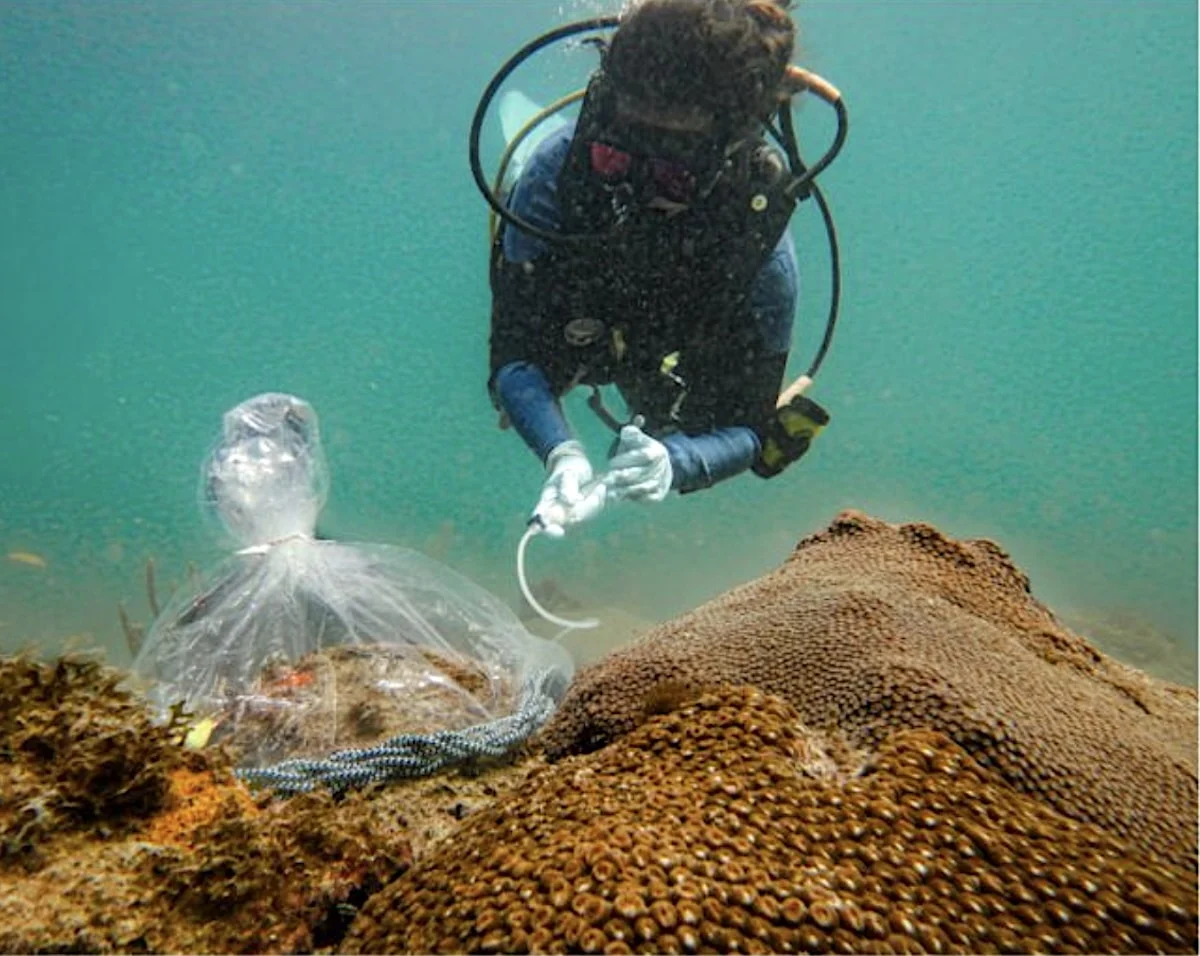
Whole-Colony Bagging: This innovative technique involved encasing the entire coral colony within a weighted, underwater bag. The probiotic solution was then injected into the seawater contained within the bag, allowing for sustained contact and uniform distribution across the coral’s surface and tissues. This method provided a controlled environment to evaluate the probiotic’s impact on the entire colony’s health.
-
Paste Application: In a more targeted approach, the probiotic was formulated into a paste and applied directly to visible lesions caused by SCTLD on individual coral polyps. This method aimed to directly address existing disease sites and assess the probiotic’s healing capabilities at a localized level.
The research team meticulously monitored the treated coral colonies and collected tissue samples over a significant period of 2.5 years, a testament to the long-term commitment required for such ecological studies. This extended observation period was critical for understanding the sustained effectiveness of the probiotic treatment and its ability to confer long-term resistance against SCTLD.
Promising Results: Significant Reduction in Tissue Loss
The findings from the whole-colony bagging method were remarkably encouraging. According to a report by Mongabay News, corals treated using this technique experienced a significantly lower rate of tissue loss, averaging only 7% over the study period. In stark contrast, untreated control colonies succumbed to the disease at a much higher rate, losing an average of 35% of their tissue to SCTLD. This dramatic difference underscores the profound protective effect of the MCH1-7 probiotic when applied to the entire coral colony.

Crucially, these positive results persisted throughout the 2.5-year monitoring period, indicating that the probiotic treatment offered not just immediate relief but also a lasting defense against the disease’s progression. This sustained efficacy is a vital characteristic for any potential large-scale coral restoration strategy.
However, the paste application method, while intended to be a more direct intervention, did not yield comparable results. The localized treatment of individual lesions proved less effective in preventing the overall spread and impact of SCTLD on the coral colony. This observation suggests that a comprehensive, colony-wide approach is likely more beneficial for combating this pervasive disease.
Refining the Approach: Scuba Diving and Inter-Species Compatibility
Building on these findings, the researchers developed a more practical method for applying probiotics to corals in their natural habitat via scuba diving. This approach aims to overcome the logistical challenges of the bagging technique while still facilitating whole-colony treatment. A critical aspect of this refined method was ensuring that the probiotic application would not negatively impact other healthy Caribbean coral species. Extensive testing confirmed that the chosen application method and probiotic strain did not disrupt the health or integrity of co-occurring coral species, a vital consideration for ecosystem-wide conservation efforts.
The authors of the study highlighted the trade-offs involved in different application methods. "While the whole-colony bagging method does involve more material transport by divers and more time for deployment and retrieval, its performance at treating SCTLD and promoting long-term resistance outweigh these costs and is therefore the recommended application method of those we tested for probiotic treatments such as the McH1-7 strain," they wrote. This recommendation emphasizes that while the bagging method is more resource-intensive, its superior efficacy makes it the preferred choice for maximizing the chances of successful SCTLD treatment and long-term coral health.
The Road Ahead: Continued Research and Broader Applications
Despite the significant strides made, the researchers are quick to emphasize that this is just the beginning of a long journey. "It’s important to understand that this is the very beginning," Kelly Pitts, lead author of the study and researcher at the Smithsonian Marine Station, told Mongabay News. "This is definitely not a cure-all, but we’re definitely moving in the right direction."
The study acknowledges the need for further research to translate these promising findings into a widely applicable and accessible treatment for SCTLD. Future studies will likely focus on:
- Optimizing Probiotic Formulations: Investigating different concentrations and delivery mechanisms for the probiotic and TPB to enhance efficacy and reduce application time.
- Broadening Species Applicability: Testing the effectiveness of MCH1-7 and TPB on a wider range of coral species affected by SCTLD, as different species may have varying responses.
- Understanding Long-Term Ecological Impacts: Conducting more extensive studies to assess the long-term ecological consequences of introducing probiotics into reef ecosystems, ensuring no unintended negative effects on other marine organisms.
- Scaling Up Production: Developing cost-effective methods for producing the MCH1-7 probiotic and its active compound, TPB, on a scale large enough for widespread restoration efforts.
- Investigating Environmental Factors: Exploring how environmental stressors like rising ocean temperatures and pollution might influence the efficacy of probiotic treatments.
The implications of this research are far-reaching. As climate change continues to exacerbate the threats to coral reefs, innovative solutions are urgently needed. The successful application of probiotics like MCH1-7 offers a tangible pathway towards restoring damaged reefs and building greater resilience against future disease outbreaks. This scientific endeavor represents a crucial step in safeguarding these invaluable underwater ecosystems for generations to come. The fight against SCTLD is far from over, but with continued dedication and scientific advancement, the tide may be turning in favor of these vital marine habitats.
The accompanying video, "Coral Health Series: Treating Corals with Probiotics," further illustrates the scientific efforts being undertaken to combat coral diseases, providing a visual complement to the detailed findings of this critical study.


 Nana Wu
 Asro






