


 Neng Nana
By [Your Name/Journalistic Desk]
Ten years ago, Portland, Oregon, embarked on a radical fiscal experiment. At the urging of then-City Councilor Steve Novick, the city implemented a pioneering surtax on corporations with extreme pay disparities between their CEOs and their median workers. Now, a decade later, as the city contemplates an expansion of this policy through the "Fair Share Tax," experts and policymakers are looking back at a decade of data to determine if the experiment has been a success.
Sarah Anderson, a veteran researcher at the Institute for Policy Studies (IPS) who has tracked executive compensation for over 30 years, recently returned to the Portland City Council to testify on the legacy and the future of this policy. Her message was clear: Portland’s bravery in challenging corporate pay structures has not only generated millions in revenue but has fundamentally shifted the national conversation regarding income inequality.
The Chronology of an Economic Movement
The roots of Portland’s policy lie in the post-recession anxiety of the mid-2010s. In 2016, the gap between the executive suite and the shop floor had widened to historic proportions. When the Portland City Council took up the proposal, it was met with intense debate. Critics argued it would drive away business; proponents argued it was a necessary mechanism to curb the runaway accumulation of wealth at the top.
The vote passed, establishing a unique precedent: a local tax tied directly to the moral choices made by corporate boards.
The trajectory of the policy since 2016 has been one of slow but steady validation. While the initial goal was to curb executive excess, the policy’s primary tangible outcome has been consistent revenue generation. Averaging $5 million annually, the surtax has provided a stable, albeit modest, injection of funds into the city’s budget—a lifeline as federal funding for municipal programs has dwindled.
By 2020, the model had traveled north to San Francisco, which adopted its own version of the pay-ratio tax. Today, the influence of the Portland model is visible in at least 10 states and in pending federal legislation, signaling that what began as a niche municipal experiment has become a centerpiece of the progressive economic agenda.
Supporting Data: Profits, Buybacks, and the "Fair Share"
To understand why advocates are pushing for the "Fair Share Tax" expansion, one must look at the macro-economic reality of 2026. According to recent data, U.S. corporate profits hit a record annualized rate of $4 trillion in the second quarter of 2026. Despite this historic influx of capital, the economic benefits have remained concentrated at the very top.
The Failure of the 2017 Tax Cuts
The landscape of corporate taxation was drastically altered by the 2017 federal tax reforms, which slashed the corporate rate from 35% to 21%. Proponents of that legislation promised a "trickle-down" effect, suggesting that corporations would reinvest tax savings into worker wages.
The data tells a different story. Instead of raising wages, major corporations engaged in a massive "stock buyback spree." By repurchasing their own shares, companies artificially inflated stock prices—and by extension, the value of executive stock-based compensation packages. A study by the congressional Joint Committee on Taxation found that the 2017 cuts boosted executive compensation significantly while failing to produce any measurable wage growth for the bottom 90% of American earners.
The Mechanics of the Proposed Expansion
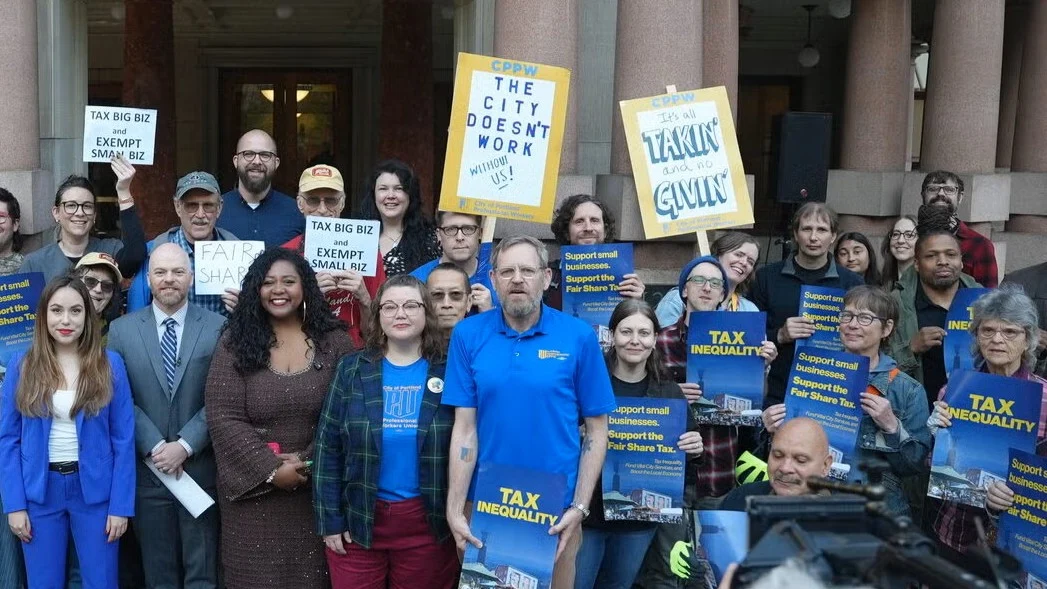
The proposed "Fair Share Tax" aims to refine the original Portland model by introducing a tiered bracket system. This structure is designed to align more closely with federal efforts, specifically the Tax Excessive CEO Pay Act, championed by Senator Bernie Sanders and co-sponsored by Oregon’s own Senator Jeff Merkley.
Under the new proposal, the surtax would trigger at a modest rate for companies with pay ratios between 50 and 75 to 1. The scale would then climb, with the highest bracket reserved for companies whose CEOs earn more than 500 times the median employee salary.
For major corporations—such as McDonald’s, Starbucks, Chipotle, and Wells Fargo—the math is stark. These firms have consistently maintained pay gaps exceeding 500 to 1. The tax is effectively a voluntary one; firms have the agency to avoid the surtax entirely by narrowing their pay gaps, either by raising the wages of their front-line employees or by exercising restraint in the executive suite.
Official Responses and The "Flight" Fallacy
One of the most persistent arguments against the Portland surtax has been the threat of corporate flight. Critics contend that taxing companies based on their internal pay structure will drive businesses to move their operations to more "tax-friendly" jurisdictions.
Proponents, however, dismiss this as a hollow threat. As Councilor Novick noted during the policy’s inception, the tax only applies to profits generated within Portland. If a company like Wells Fargo chooses to close a profitable branch in Portland simply because the tax renders it "slightly less" profitable, they would be acting against their own shareholders’ interests.
Furthermore, the "price hike" argument—the claim that companies will pass the tax burden onto consumers—is viewed with skepticism by local market analysts. In sectors like the service industry, where independent cafes and businesses thrive, market competition prevents large corporations from unilaterally raising prices without losing their customer base to more affordable, local alternatives.
Broader Implications: A Shifting Social Fabric
The implications of the Fair Share Tax extend far beyond the city’s ledger. By design, the policy serves as a moral statement. It acknowledges that extreme inequality is not an inevitable byproduct of a healthy economy, but a result of specific policy choices.
Leveling the Playing Field
A significant component of the new proposal is the inclusion of tax relief for small businesses. Large corporations currently utilize armies of accountants and lawyers to exploit loopholes—such as shifting profits to offshore tax havens—that are entirely inaccessible to small business owners. The Fair Share Tax aims to rebalance this inequity, ensuring that the local corner store is not held to the same fiscal disadvantage as a multinational conglomerate.
Political Popularity
Perhaps most surprisingly to some observers is the broad public support for the measure. National polling data consistently indicates that the concept of taxing companies with extreme pay disparities is not a strictly partisan issue. Approximately 80% of likely voters—including 71% of Republicans and 89% of Democrats—express support for such measures. This consensus suggests that the public appetite for reining in executive excess transcends the current polarized political climate.
Conclusion: The Next Decade of Reform
As the Portland City Council deliberates on the Fair Share Tax, the stakes are high. If adopted, the policy will continue to serve as a laboratory for the nation, proving that cities can act as effective regulators of corporate behavior when federal inaction persists.
The "experiment" of the last decade has yielded a clear lesson: when the public provides the framework, corporations are capable of adjusting their practices. While the tax has not yet fully "fixed" the pay gap, it has created a recurring revenue stream that supports the community and has forced a national conversation on the ethics of compensation.
For Portland, the path forward is clear. By expanding the surtax, the city is not just chasing revenue; it is reinforcing the idea that a stable economy requires a commitment to fairness. As Sarah Anderson noted in her recent testimony, the goal is to embolden similar actions across the country, building the necessary pressure to mend a social fabric that has been frayed by decades of unchecked inequality. The Portland model, having survived a decade of scrutiny and resistance, now stands ready to evolve—and in doing so, it may provide the blueprint for a more equitable American economy.


 Rifan Muazin
 Ammar Sabilarrohman