
 Pevita Pearce
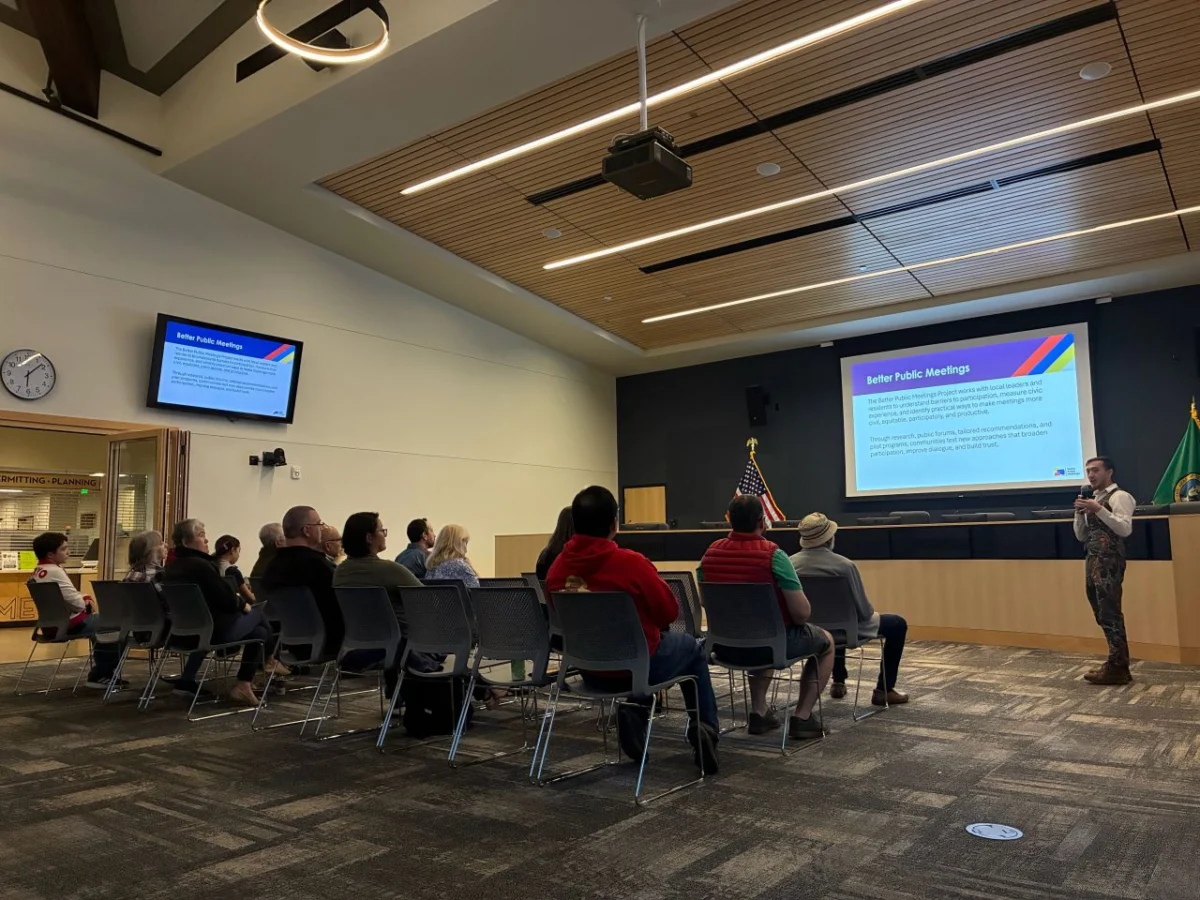
Mountlake Terrace, WA — In the heart of Washington State, Mountlake Terrace is quietly becoming a laboratory for the future of American democracy. Long known for its proactive stance on civic inclusion—evidenced by its community academies, volunteer "ambassador" programs, and vibrant municipal proclamations—the city is now embarking on a radical experiment to redefine the relationship between the governed and the government.
At the center of this transformation is a provocative question: What happens when you invite a high school student to take the mayor’s seat? This inquiry, born from a partnership with the "Better Public Meetings" project, serves as the catalyst for a broader movement to dismantle the traditional, often rigid, structures of local public discourse.
The Genesis of Innovation: The Better Public Meetings Project
Throughout 2026, Mountlake Terrace has been a primary site for the Better Public Meetings project, a high-level initiative funded by the Henry Luce Foundation. This collaborative effort between the National Civic League and the New York-based arts collective Perfect City aims to revitalize the standard public meeting—the bedrock of local governance—making it more inclusive, civil, and productive.
The project is not merely an academic exercise; it is a tactical intervention. Across the United States, seven communities have been selected to participate, each aiming to modernize how city councils, school boards, and neighborhood councils operate under open-meeting or "sunshine" laws. By integrating research-based civic design with artistic frameworks, the project seeks to move beyond the performative aspects of public comment and toward genuine, deliberative democracy.
Chronology of a Civic Transformation
The trajectory of this initiative has been marked by meticulous research and bold community engagement:
- Early 2026: Mountlake Terrace enters a formal partnership with the National Civic League to identify structural barriers to participation.
- Spring/Summer 2026: The League initiates a comprehensive data-gathering phase, utilizing interviews, surveys, and the "Civic Engagement Scorecard."
- October 19, 2026: The findings are presented at a landmark Public Forum at City Hall, featuring an interactive performance led by Aaron Landsman of Perfect City.
- Late 2026 and Beyond: The city shifts from research to the implementation of pilot programs designed to transform public meetings into active "civic onramps."
Data-Driven Insights: Measuring the Pulse of the City
To understand the specific needs of Mountlake Terrace, the National Civic League conducted an exhaustive audit. Researchers interviewed 15 key stakeholders—including municipal staff, elected officials, local journalists, and civic leaders—to provide a qualitative foundation for the study. This was supplemented by a broader quantitative analysis, drawing on responses from 167 residents.
Central to this research was the "Civic Engagement Scorecard." Unlike traditional feedback mechanisms, the Scorecard acts as a real-time "meeting report card." By allowing residents to rate their experiences immediately following a council meeting, the city gained nuanced insight into what fosters productive dialogue and what creates barriers to entry.
The findings were stark: while residents value transparency, the current format of public meetings often acts as a deterrent. The traditional "dais vs. audience" arrangement, while rooted in 19th-century traditions intended to prevent corruption, has inadvertently institutionalized a power imbalance. This physical and social distance, the report suggests, encourages "theatrical" public comment sessions rather than substantive deliberation.
Reimagining the Stage: The Power of Participatory Art
The most significant moment of the October 19th forum was not found in a spreadsheet, but on a stage. Aaron Landsman, founder of Perfect City, facilitated a participatory performance that invited residents and officials to swap roles. By reading actual transcripts from city council meetings across the nation, participants were forced to literally "walk a mile" in the shoes of their political representatives.
The goal was to strip away the artifice of public meetings and expose the underlying human dynamics. Participants moved from the dais to the gallery and vice versa, transforming the sterile environment of City Hall into a theater of empathy.
It was during this exercise that the most unexpected, yet promising, development occurred. An audience member was invited to assume the role of the "mayor." That volunteer was a high school freshman, a young man who had arrived at the forum alone, drawn by nothing more than a flyer he had spotted in the community. His presence on the dais—authoritative, thoughtful, and remarkably composed—served as a potent metaphor for the city’s goals. He didn’t just play the part; he challenged the room to consider how the city could better serve its youngest, often-overlooked constituents.
Official Perspectives: The Path to Institutional Change
The leadership in Mountlake Terrace has met these findings with a remarkable degree of openness. The National Civic League’s report identifies three primary pillars for the city’s path forward:
- Civic Onramps: Converting routine ceremonial celebrations into active entry points for new, diverse participants.
- Deliberative Design: Reorganizing the layout and structure of public meetings to prioritize problem-solving over static, one-way public comment.
- Strategic Partnerships: Strengthening the relationship with local community organizations to reach demographics that have historically been disconnected from municipal affairs.
"The public comment format is a relic of a different era," noted one municipal staffer during the forum. "It ensures that the public can speak, but it doesn’t ensure that they are heard. By shifting the architecture of our meetings, we are shifting the culture of our city."
Implications: A Model for American Democracy?
The implications of the Mountlake Terrace experiment extend far beyond the city limits. If the project succeeds in fostering a more deliberative and inclusive public forum, it could serve as a blueprint for municipalities nationwide that are struggling with rising levels of political polarization and declining civic trust.
The "high schooler as mayor" moment was a microcosm of a larger realization: democracy is not a spectator sport, nor is it a performance to be viewed from the gallery. It is a shared, messy, and vital practice. By inviting citizens—regardless of age or background—to sit at the center of the decision-making process, Mountlake Terrace is testing the hypothesis that people are willing to engage deeply if they are given the right environment to do so.
As the city moves into the implementation phase of its pilot programs, the eyes of the civic engagement community remain fixed on this Washington suburb. The lesson learned thus far is perhaps the most important one for any democratic institution: if a government signals that it is truly ready to innovate, it will find that its citizens are far more capable, and far more ready to participate, than it ever dared to hope.
The future of Mountlake Terrace will not be defined by the proclamations read from the dais, but by the willingness of its leaders and residents to keep sharing the seat. In a landscape often defined by division, the city’s willingness to experiment with the very fabric of its meetings offers a rare glimmer of optimism for the future of local government.

 Jia Lissa
 Raul Delapena Setiawan