

 Iffa Jayyana
By International News Desk
October 24, 2026
Introduction: A New Front in the Occupation
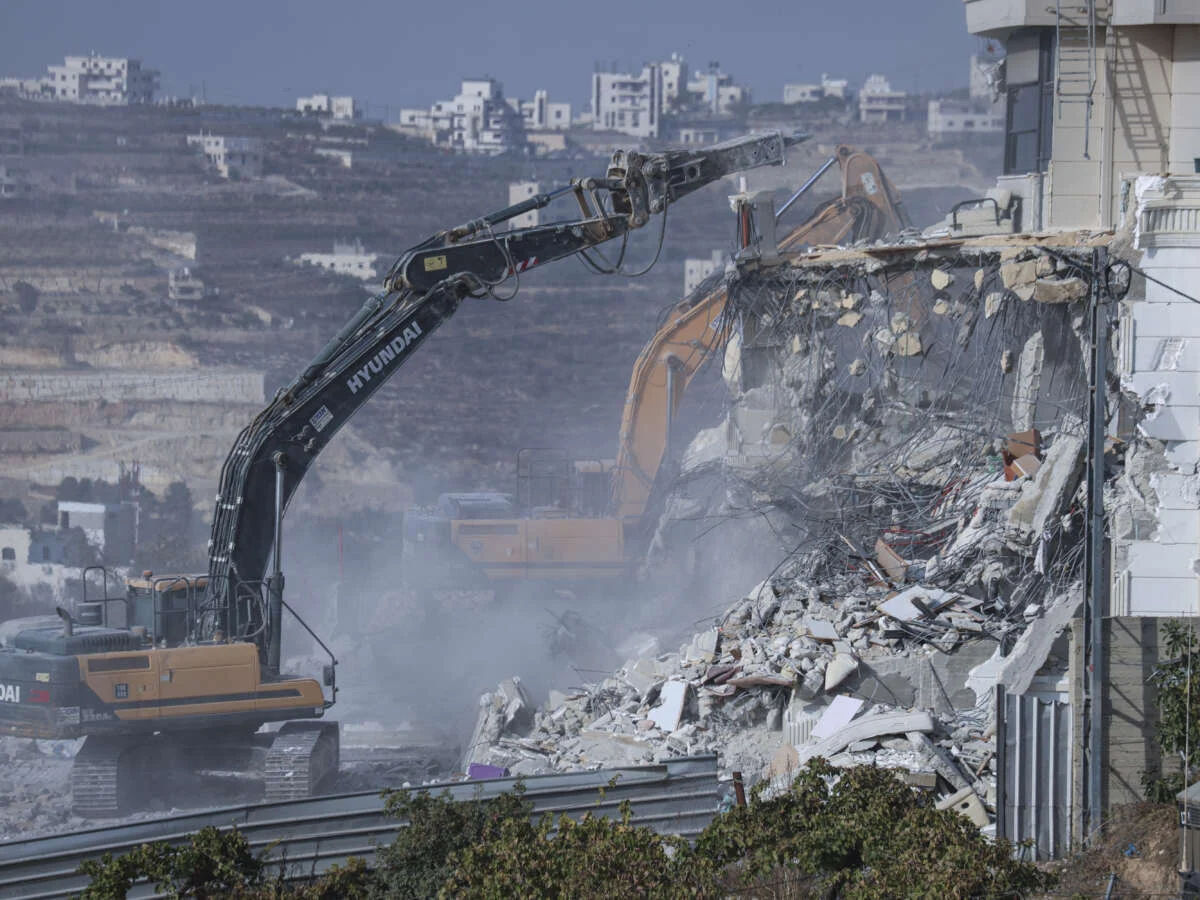
Israeli forces launched a large-scale demolition campaign in the Farsh al-Hawa area of Hebron on Friday, marking a significant and alarming shift in the administration of the occupied West Bank. The operation, which involves the leveling of residential buildings and businesses, follows a fatal resistance attack on an Israeli military checkpoint that resulted in the deaths of two soldiers.
Prime Minister Benjamin Netanyahu, speaking from the site of the attack, characterized the move as a foundational shift in security policy. "First, we will destroy this place and completely transform it, but we will do something that has never been done before," Netanyahu declared. "We will evacuate the residents, go from house to house, remove weapons from there as well, and deal with and destroy all terrorist infrastructure."
The operation has ignited an immediate firestorm of controversy, with human rights organizations and international legal experts characterizing the move as "collective punishment"—a practice strictly prohibited under international humanitarian law.
Chronology of the Escalation
The sequence of events began early Friday morning when Palestinian resistance fighters engaged Israeli military personnel at a checkpoint near Hebron Junction. The ensuing firefight resulted in the deaths of two Israeli soldiers, a development that triggered an immediate, high-level response from the Israeli security cabinet.
By midday, the Israeli Defense Forces (IDF) had mobilized heavy machinery, including multiple excavators, to the Farsh al-Hawa district. Residents were given abrupt orders to vacate their homes, with footage circulating on social media showing families frantically loading personal belongings onto trucks as security forces cordoned off the area.
The pace of the operation was rapid; by late afternoon, several structures had already been reduced to rubble. However, the momentum was halted temporarily in the evening when the Israeli High Court issued an emergency stay. This intervention followed an urgent petition filed by human rights lawyer Mohammed Dahleh on behalf of local property owners, who argued that the demolitions were being conducted without due process and constituted an illegal punitive measure against the civilian population.
Supporting Data: The Humanitarian Context
The events in Hebron are unfolding against the backdrop of a broader, year-long intensification of violence across the Palestinian territories. According to data provided by the United Nations Office for the Coordination of Humanitarian Affairs (OCHA), the situation in the West Bank has reached its most volatile state in decades.
Since October 2023, more than 1,130 Palestinians—including at least 250 children—have been killed by Israeli soldiers and settlers in the West Bank. The humanitarian crisis is compounded by the systematic destruction of agricultural and residential infrastructure. OCHA reports that between September 1 and October 12, 2026, alone, Israeli settlers carried out 199 attacks linked to the olive harvest, resulting in the destruction of over 2,500 trees and the injury of 124 Palestinians.
The scale of destruction in other occupied territories remains a haunting point of reference for critics of the current policy. In Gaza, over 250,000 people have been killed or wounded, with 80% of the strip’s infrastructure rendered uninhabitable. In Lebanon, nearly 40,000 casualties have been recorded, with over a million people displaced in two separate waves of mass migration. The rhetoric used by Israeli officials on Friday—explicitly comparing the Hebron operation to the military campaigns in Gaza and Lebanon—has signaled to many observers that the "Gaza model" of total destruction is being formally exported to the West Bank.

Official Responses and Political Rhetoric
The Israeli political leadership has framed the demolitions as a necessary security measure to restore deterrence. Finance Minister Bezalel Smotrich, who arrived at the scene to oversee the early stages of the operation, stated, "There is no other option but a comprehensive military campaign in Judea and Samaria to dismantle the Palestinian Authority, collect weapons, and eliminate terrorists." Smotrich, like his cabinet colleagues, repeatedly invoked the destruction of Gaza as the standard for the current operation.
Conversely, the reaction from the international community and human rights bodies has been one of sharp condemnation. The Israeli human rights group B’Tselem issued a blistering critique, stating, "Israeli leaders are publicly announcing plans for collective punishment and acts that could constitute war crimes." The organization has called upon the international community to intervene immediately to prevent further displacement.
Lawyer Michael Sfard described the public remarks of ministers like Smotrich as a "direct admission" of collective punishment. Under the Geneva Conventions, the destruction of property for punitive purposes, rather than immediate military necessity, is considered a war crime. The legal arguments currently before the Israeli High Court rest on the assertion that the residents of Farsh al-Hawa are being punished for an act with which they had no involvement, effectively treating them as targets for their geography rather than their actions.
Implications: Annexation and the Electoral Cycle
Political analysts suggest that the timing of this operation is inextricably linked to the upcoming Israeli elections, scheduled for just four days after the incident. The ruling far-right coalition, which includes ministers who have openly advocated for the annexation of the West Bank, is currently struggling to consolidate its voter base.
For the settler movement, which exerts significant influence on the current government, the demolition of Palestinian homes serves a dual purpose: it removes the Palestinian presence from areas targeted for future settlement expansion and signals a "tough on terror" stance designed to capture votes from the nationalist right.
Netanyahu has previously voiced support for the annexation of existing settler colonies, while more radical members of his cabinet, such as Itamar Ben-Gvir and Bezalel Smotrich, have proposed plans to annex as much as 82% to 100% of the West Bank. By turning the West Bank into a combat theater comparable to Gaza, the government is creating a "new reality on the ground" that makes the prospect of a sovereign Palestinian state increasingly untenable.
Conclusion: The Erosion of International Law
The events in Hebron represent more than a tactical military response to an attack; they signify the formal breakdown of the legal and diplomatic norms that have governed the West Bank for nearly sixty years. The shift from "security-focused" operations to the systematic removal of entire neighborhoods mirrors the patterns of ethnic cleansing that observers have long warned about.
As the High Court deliberates on the legality of the demolitions, the families in Farsh al-Hawa remain in limbo, their homes partially destroyed and their future uncertain. For the international community, the challenge is whether to continue to issue diplomatic condemnations or to move toward substantive accountability measures.
As lawyer Mohammed Dahleh noted after his initial court filing, "What we saw today was an attempt to copy the illegal practices used in Gaza, in the heart of the West Bank. They want to wipe out entire areas exactly as they did in Gaza."
With the elections approaching and the military presence in the West Bank at an all-time high, the coming weeks will likely determine whether the Hebron operation is an isolated, albeit brutal, incident, or the beginning of a final, total transformation of the occupied territory. The silence or inaction of global powers in the face of these explicit, high-level admissions of collective punishment may well signal the end of the legal frameworks intended to protect civilian life in conflict zones.

 Rifan Muazin
 Ammar Sabilarrohman