 Raul Delapena Setiawan
In the high-stakes world of social justice advocacy, the gap between research and real-world impact is often a chasm. For over a year and a half, a dedicated coalition of researchers, narrative practitioners, and organizers has been working to bridge that divide. Their objective: to translate complex data about public opinion—specifically regarding the thorny, historically charged issue of reparations—into a practical, actionable framework for communication. The result is a new strategic tool known as the "Belief Arc," a narrative map designed to guide organizations through the incremental process of shifting public consciousness.
As the political climate in the United States reaches historic levels of polarization, the need for precision in narrative strategy has never been more acute. By moving away from "all-or-nothing" messaging, advocates are discovering that social change is not achieved through a single, seismic conversion, but through a series of calculated, incremental shifts in understanding.
The Problem: The Disconnect Between Data and Action
For many advocacy groups, the strategy manual is overflowing with reports, polling data, and message-testing results. Yet, in the trenches of day-to-day organizing, these assets frequently gather dust. As a narrative practitioner, the author of this framework realized that the failure wasn’t in the research itself, but in the lack of a "bridge" between high-level academic insights and on-the-ground execution.
Reparations—defined as the process of a government acknowledging, reckoning with, and providing redress for historical harm—is a prime example of an issue that suffers from public misconceptions and emotional fatigue. While a message might successfully convince an audience that reparations are politically feasible, that same audience might simultaneously reject the premise that slavery has any lingering impact on modern society. This "belief gap" renders the initial argument ineffective.
Without a map to navigate these complexities, organizers often resort to reactive tactics—press releases and social media blasts that lack long-term narrative consistency. The "Belief Arc" was born from the realization that if narrative infrastructure is the system of "roads" that delivers our messages, we need a navigational tool to ensure those messages actually reach their destination.
Anatomy of the Belief Arc: A Three-Part Foundation
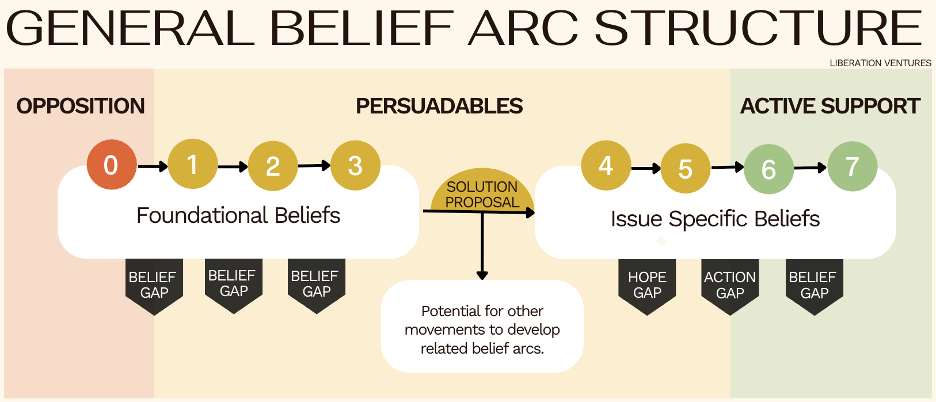
The Belief Arc is not a static document; it is a dynamic, three-part framework designed to track an individual’s cognitive journey from skepticism to active support. It draws from established fields of study, including the "ladders of engagement" used by labor organizers, the "contemplation ladders" utilized in clinical psychology, and the "supporter journeys" foundational to modern donor marketing.

1. Identifying the "Belief Gaps"
At the core of the arc are belief gaps. These are the fundamental points of disagreement that prevent an individual from aligning with a cause. By identifying whether an audience member is struggling with a lack of information, a misconception of history, or a sense of cynicism regarding the feasibility of a solution, organizers can tailor their messaging to address that specific hurdle.
2. Overcoming the "Hope Gap"
The "hope gap" represents the skepticism audiences feel regarding whether a proposed solution can actually work. When an audience believes an issue is too big or too broken to fix, they disengage. The arc helps practitioners craft messages that provide concrete evidence of past successes and potential for future progress, moving the needle from doubt to investment.
3. Closing the "Action Gap"
The final stage is the action gap. This is the transition from passive agreement to active mobilization. Here, the messaging shifts from informative to imperative, providing the audience with the specific tools and encouragement needed to participate in the movement.
Historical Precedent: The Evolution of LGBTQ+ Rights
To understand the efficacy of this model, one need only look back at the campaign for same-sex marriage in the early 2000s. In 2012, while support for same-sex marriage was still under 50% in the U.S., support for intermediate beliefs—such as the legal recognition of relationships and access to employee benefits—was significantly higher.
This was a classic "Belief Arc" in motion. Advocates didn’t force a single, all-encompassing debate about marriage equality from the start. Instead, they moved the public through a sequence of increasingly complex beliefs. By securing support for domestic partner benefits first, they created the cultural and legal infrastructure necessary to eventually win the fight for marriage equality. This suggests that the most successful movements in history have been utilizing "belief arcs" instinctively, even if they hadn’t yet named the phenomenon.
Collaborating for Collective Liberation
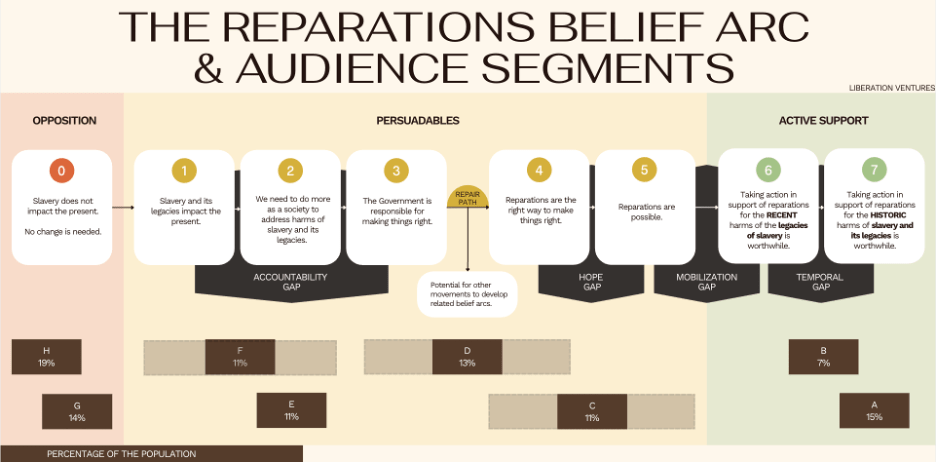
The Reparations Belief Arc, developed in collaboration with organizations such as Voss Research and Strategy, Lake Research Partners, and Get Free, serves as a proof-of-concept for this methodology. It maps eight distinct beliefs—ranging from full opposition to active, informed support—paired with specific demographic audience segments.
This tool offers a unique opportunity for intersectional solidarity. If the climate justice movement, immigrant rights advocates, and the reparations movement all identify a shared need to instill the foundational belief that "history impacts the present," they can coordinate their narrative efforts. When one movement successfully shifts the public consensus on this core belief, every other movement benefits. It transforms the narrative landscape from a fragmented collection of competing interests into a unified, reinforcing ecosystem of liberation.
Tracking Success: Moving Beyond "Vibes"
One of the most persistent criticisms of narrative work is the difficulty of measuring "success." Unlike direct action, which can be tracked through attendance or donations, narrative shifts are often seen as abstract or "soft." The Belief Arc challenges this.
By narrowing the focus to a specific stage of the arc, practitioners can set SMART (Strategic, Measurable, Ambitious, Realistic, Time-bound) goals. For example, an organization might aim to move 60% of a target audience one step up the arc over the course of a campaign. By using annual polling or engagement surveys, this shift can be tracked with statistical precision. It replaces the vague hope of "changing minds" with the clear, analytical goal of moving a specific percentage of the public from one belief tier to the next.
Implications for Future Advocacy
As we look toward the 2026 election cycle and beyond, the implications of the Belief Arc are profound. The current political climate is characterized by an "all-or-nothing" binary, where messaging is often designed to energize the base rather than persuade the undecided. The Belief Arc forces a different approach: one of strategic patience.
Strategic Prioritization
Movements must now deliberate on which stage of the arc to prioritize. Is it more effective to focus on the 33% of the public that does not believe slavery impacts the present, or should resources be directed toward the 11% currently trapped in the "hope gap"? The Belief Arc provides the data-driven framework necessary to make these tough decisions, ensuring that limited funding and energy are applied where they will generate the most movement.
Broadening the Scope
The methodology is already expanding beyond reparations. Current pilot programs are applying the Belief Arc to:
- Transit Infrastructure: Mapping the path from "skepticism of public funding" to "support for mass transit expansion."
- Get Out The Vote (GOTV) Initiatives: Understanding the incremental beliefs that turn a non-voter into a consistent civic participant.
- Climate Advocacy: Shifting the focus from the "apocalypse" to the "solution-oriented" stages of the arc to prevent voter paralysis.
Conclusion: The Infrastructure of Belief
The "Belief Arc" represents a maturation of the narrative advocacy field. It acknowledges that people do not typically experience radical shifts in worldview in a single, transformative moment. Instead, they move along a spectrum, adopting new beliefs as they are exposed to consistent, resonant, and targeted messaging.
In an era of deep fragmentation, the ability to map these journeys is more than just a communications tactic; it is a necessity for the survival and progress of democratic movements. By providing a clear, evidence-based roadmap for social change, the Belief Arc offers organizers a way to stop shouting into the void and start building the incremental, sustainable consensus required to win the future.
As the narrative industry continues to refine these tools, the hope is that this infrastructure will make social justice advocacy not only more impactful but also more resilient—turning the "impossible" fights of today into the standard, accepted realities of tomorrow.


 Pevita Pearce
 Jia Lissa