


 Ammar Sabilarrohman
Four years after the U.S. Supreme Court’s landmark decision in Dobbs v. Jackson Women’s Health Organization dismantled the constitutional right to abortion, a chilling reality has taken hold across the United States. A new comprehensive survey from the Kaiser Family Foundation (KFF) reveals that reproductive-age women are facing an escalating crisis of information, accessibility, and uncertainty. As state-level restrictions become more entrenched, the pathway to reproductive healthcare has become increasingly obscured, leaving millions of women adrift in a legal and medical labyrinth.
The Shrinking Map: A Data-Driven Crisis
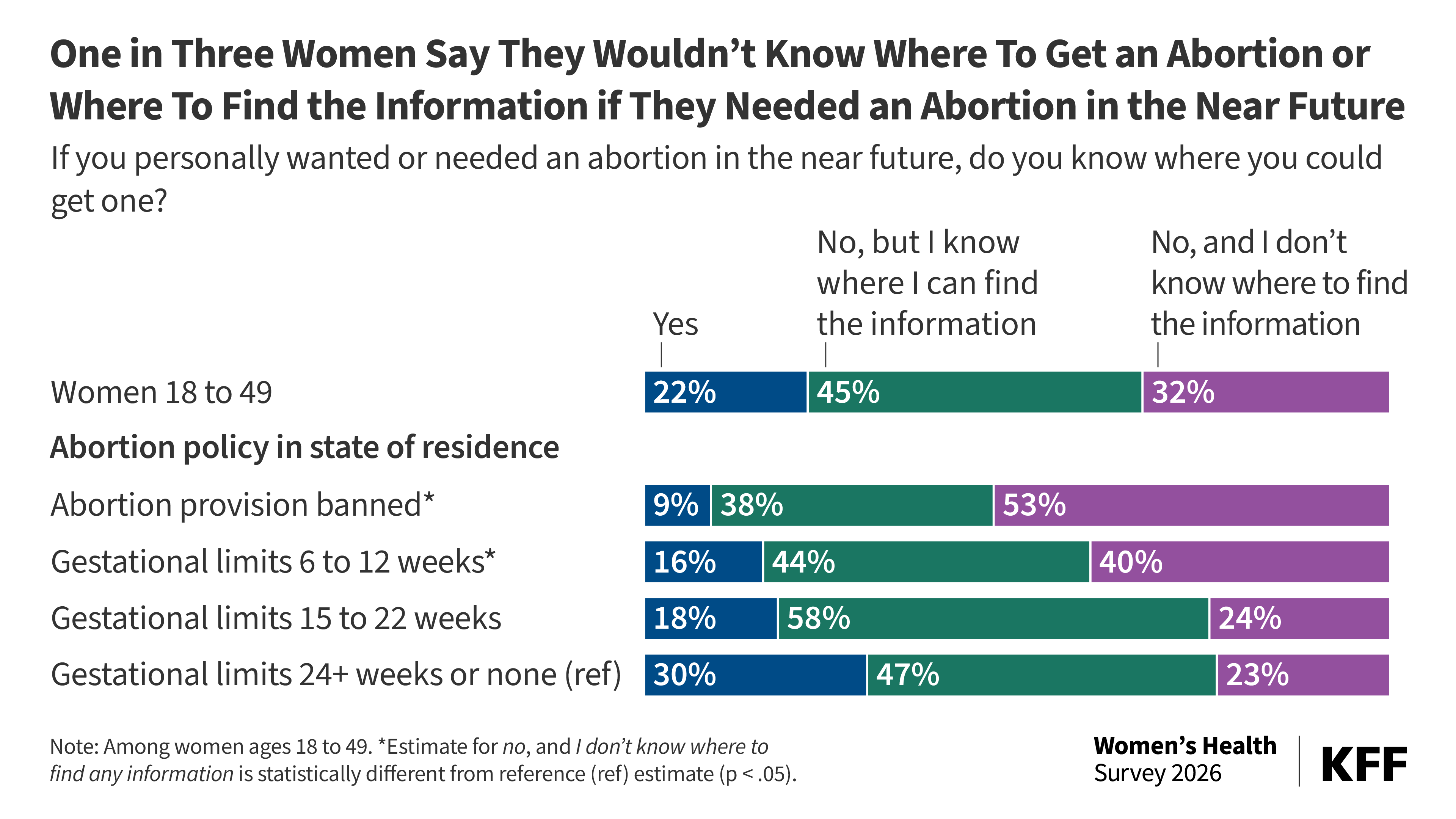
The 2026 KFF Women’s Health Survey paints a stark picture of a nation fractured by geography. The data indicates that the confusion surrounding abortion access is not only persistent but worsening. More than half (53%) of reproductive-age women residing in states where abortion is entirely prohibited report that they would not know where to go or how to find credible information if they required an abortion. This represents a significant jump from the 43% reported in 2024, signaling that despite the passage of time, the "information void" is expanding rather than closing.
The issue is not limited to states with total bans. Even in regions where gestational limits exist—typically between 6 and 12 weeks—40% of women express the same profound lack of knowledge regarding their options. On a national level, one in three (32%) women of reproductive age feel similarly ill-equipped to navigate the system, a marked increase from the one-in-four (26%) figure recorded just two years ago.
A Chronology of Constraint: The Four-Year Arc
To understand the current state of reproductive health, one must look at the timeline of the post-Dobbs era.
- June 2022: The Supreme Court issues the Dobbs decision, overturning Roe v. Wade and returning the authority to regulate or ban abortion to individual states. The immediate aftermath sees a wave of "trigger laws" go into effect, abruptly shuttering clinics in over a dozen states.
- 2023–2024: The focus shifts to the legal battles surrounding medication abortion, particularly the accessibility of mifepristone. Public confusion begins to mount as conflicting lower-court rulings create a state of uncertainty for providers and patients alike. KFF data from 2024 establishes the first baseline for the "information gap," finding that 43% of women in banned states were already lost regarding where to seek care.
- 2025: Legislative efforts in various states shift toward enforcing existing bans and monitoring digital footprints. Fears regarding the privacy of medical records and the legality of interstate travel begin to dominate public discourse.
- 2026: The current KFF survey confirms that the normalization of these restrictions has not led to increased public awareness. Instead, it has fostered a climate of fear and misinformation, where the digital frontier of telehealth—once thought to be a universal solution—remains largely misunderstood or inaccessible to those who need it most.
The Telehealth Paradox
The rise of medication abortion via telehealth was widely heralded as a transformative development that could bypass the physical closure of clinics. However, the KFF survey suggests a massive disconnect between the availability of this technology and public awareness of its legality.
While 68% of reproductive-age women are aware that medication abortion pills exist, the granular knowledge of how to access them is strikingly low. Only 18% of women nationwide are aware that they can legally obtain these medications online within their state. In states with strict abortion-provision bans, that number plummets to a mere 8%.
The majority of women (71%) are either entirely unsure of the process or have never heard of medication abortion as a viable, accessible option. Furthermore, 11% of women operate under the mistaken belief that medication abortion is explicitly prohibited in their state, even when legal avenues might exist. This "knowledge gap" acts as an effective barrier, potentially denying women access to safe, FDA-approved care simply because they fear legal repercussions or lack the digital literacy to navigate the online healthcare marketplace.
Personal Hardship and the Ripple Effect
The human cost of these policies is becoming increasingly visible. The 2026 survey highlights that 12% of reproductive-age women now report that they—or someone they know personally—have faced tangible difficulties in accessing an abortion due to state-level restrictions. This is a 50% increase from the 8% reported in 2024.
The obstacles cited are practical and often insurmountable: the exhausting financial and logistical burden of traveling to another state, the sheer lack of knowledge regarding where to go, and the prohibitive costs associated with out-of-state travel and procedure fees.
The psychological toll is equally significant. A majority of women (59%) express deep concern that current abortion-provision bans will compromise the safety of future pregnancies—whether for themselves or for loved ones. This fear transcends typical political divides, with majorities across most demographics—excluding only rural and self-identified Republican women—acknowledging that the legal environment has made pregnancy itself a higher-stakes proposition.
Implications for Public Health and Policy
The implications of the 2026 KFF findings are profound for the medical community and policymakers alike. The primary concern is the delay in care. When patients are unsure of their options, they are more likely to delay seeking services, which in turn moves them further along in their pregnancy, increasing the physical risks of the procedure and the cost of the care required.
The Erosion of Reproductive Autonomy
Public health experts warn that the erosion of information is a secondary mechanism of restriction. By creating a climate where the legality of care is opaque, states effectively deter individuals from seeking help even if they have a legal right to it. This has created a "chilling effect" where clinics and advocacy groups find it increasingly difficult to provide outreach, fearing that dissemination of information could be construed as "aiding and abetting" under state statutes.
The Divide in Health Literacy
There is a clear socioeconomic and geographic divide in health literacy. Women in rural areas and those in states with the most restrictive laws are the most likely to report being "in the dark." This suggests that current efforts to inform the public—whether through government health portals or private advocacy—are failing to reach the populations most at risk.
Moving Toward a Uncertain Future
As the 2026 midterms approach, the KFF survey underscores that reproductive health remains a central, albeit highly complex, issue for American women. The data suggests that the "post-Roe" era has not settled into a new normal, but rather into a state of chronic, high-stakes confusion.
For providers, the mandate is clear: there is a desperate need for clear, accessible, and legally vetted information campaigns that can reach women in "information deserts." For policymakers, the findings serve as a reminder that legislation written in statehouses has real-world consequences that ripple through the daily lives of citizens—many of whom are not merely dealing with political ideology, but with the immediate, logistical reality of managing their own reproductive health.
The gap between the legal status of abortion and the public’s understanding of that status is, in itself, a significant public health barrier. As long as that gap remains, the promises of telehealth and the legal rights that remain in various jurisdictions will continue to be out of reach for the very people they were intended to support.
Methodology Note: The 2026 KFF Women’s Health Survey was conducted between March 11 and April 14, 2026. The study utilized a nationally representative sample of 3,538 women between the ages of 18 and 49. The methodology ensures that the findings reflect the experiences of women across diverse geographic, socioeconomic, and political backgrounds, providing a comprehensive look at the state of reproductive healthcare in the United States four years after the overturning of Roe v. Wade.

 Neng Nana

 Layla Zulfa






