



 Pevita Pearce
Main Facts: The Rise of Specialized Abrasive Solutions
In the world of metal fabrication, woodworking, and automotive restoration, the "last mile" of a project—the finishing and detailing—often proves to be the most labor-intensive. While heavy-duty stationary belt grinders have long been the workhorses of industrial shops, a significant shift toward portability and specialization has redefined how professionals and hobbyists approach sanding in tight spaces.
A portable belt sander, often referred to in its smaller forms as a "finger sander" or "power file," represents a critical bridge between the brute force of a stationary machine and the painstaking slowness of manual hand-sanding. These tools are designed to bring the abrasive to the workpiece, a reversal of the traditional workshop workflow where the workpiece must be maneuvered around a fixed machine.
According to recent industry trends, the demand for compact, high-torque sanding tools has surged, driven by the growth of the "maker" movement and the increasing complexity of architectural metalwork. Key features of these modern tools include adjustable sanding arms, variable speed controls, and specialized tracking systems that ensure the belt remains centered even under significant lateral pressure. For round stock, the emergence of the pipe belt sander has revolutionized the finishing of railings and tubes, utilizing a flexible belt geometry that "wraps" around the material to provide consistent contact across curved surfaces.
Chronology: From Industrial Behemoths to Precision Handhelds
The history of abrasive tools is a narrative of miniaturization and democratization.
The Early Industrial Era
In the early 20th century, belt sanding was almost exclusively a stationary affair. Large, cast-iron machines occupied significant floor space in factories. These machines were efficient for flat boards but were virtually useless for complex geometries or large, immovable structures like ship hulls or architectural frames.
The Mid-Century Portability Boom
Following World War II, the advancement of small electric motors allowed for the first generation of portable power tools. The 1950s and 60s saw the introduction of the standard handheld belt sander—a heavy, rectangular tool designed for stripping floors and flattening large panels. However, these tools still struggled with corners, internal angles, and narrow channels.
The 1990s: The Birth of the Power File
The 1990s marked the introduction of the "narrow-belt" portable sander. Inspired by the need for precision in automotive repair and weld cleanup, manufacturers began producing tools with arms as narrow as 10mm. This allowed technicians to reach into engine bays and furniture joints that were previously inaccessible to power tools.
2010 to Present: The Era of Specialization and Battery Tech
Over the last decade, brands like Vevor and other industrial tool manufacturers have refined these designs, introducing variable-speed electronics and specialized attachments like the pipe belt sander. The current era is defined by the integration of brushless motors and high-capacity lithium-ion batteries, which have removed the "umbilical cord" of the power outlet, allowing for high-intensity sanding on remote construction sites and in large-scale metal installations.
Supporting Data: The Mechanics of Efficiency
To understand why portable belt sanders have become indispensable, one must look at the technical metrics that govern their performance.

Surface Feet Per Minute (SFPM)
The efficiency of a belt sander is measured in Surface Feet Per Minute (SFPM). A high-quality portable unit typically operates between 1,000 and 3,200 RPM. On a variable-speed unit, this allows the operator to adjust the "bite" of the abrasive. For example, stainless steel requires a slower speed to prevent overheating and discoloration (bluing), whereas wood can often be sanded at higher speeds to prevent the belt from clogging with resin.
Abrasive Contact and Pressure
Research into ergonomic tool design suggests that the "contact patch"—the area where the belt meets the material—is crucial for finish quality. Portable belt sanders utilize a "tracking adjustment" knob. If a belt is misaligned by even 2 millimeters, the efficiency of the tool drops by 15-20% due to uneven wear and increased friction against the tool housing.
The Pipe Sander Advantage
The pipe belt sander is a marvel of geometry. Unlike a flat sander, which touches a tube at a single tangential point, a pipe sander’s pulleys are arranged to allow the belt to slacken and wrap around up to 180 degrees of the pipe’s circumference. This increases the contact area by over 500% compared to a standard flat sander, drastically reducing the time required to achieve a uniform satin or mirror finish on round stock.
Official Responses and Expert Perspectives
Industry experts emphasize that the choice of tool is often a safety and health consideration as much as a mechanical one.
Technical Directors at Abrasive Manufacturing Firms note that the shift to portable tools has reduced the incidence of "over-reaching" injuries. "When a worker tries to force a 50-pound workpiece into a stationary grinder, the risk of musculoskeletal strain or loss of control is high," says Marcus Thorne, a veteran tool consultant. "Portable units allow the worker to maintain a stable, ergonomic stance, which is the first line of defense in workshop safety."
Environmental Health and Safety (EHS) Professionals have also weighed in on the dust management capabilities of modern portable units. While stationary machines have massive vacuum systems, modern portable sanders are increasingly equipped with HEPA-compatible dust ports. Experts argue that capturing dust at the source—the point of contact—is significantly more effective than general room filtration, especially when working with hazardous materials like lead paint or certain treated hardwoods.
Manufacturers like Vevor have responded to market demands by bundling tools with extensive abrasive kits. Their 1100W pipe belt sander models, for instance, often include up to 50 belts of varying grits. This reflects an industry-wide recognition that the tool is only as effective as the consumable abrasive it carries.
Practical Applications: Beyond the Basics
Weld Remediation and Fabrication
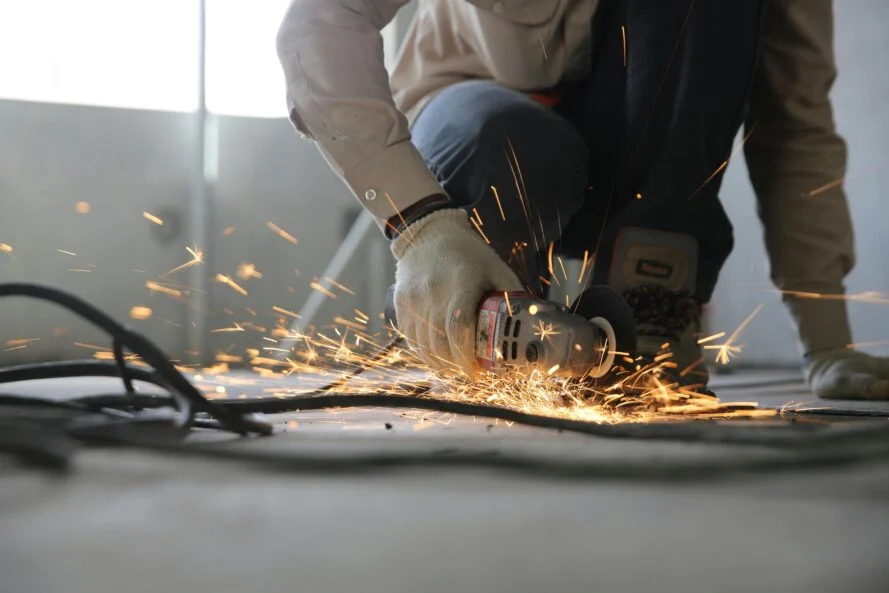
In metal fabrication, the "grind-back" of a weld is often the most visible part of the job. A portable belt sander allows the operator to "feather" the edges of a weld, blending the bead into the parent metal without creating the "flat spots" common with angle grinders.
Restoration and Rust Removal
For automotive restorers, the ability to reach inside a wheel well or behind a chassis bracket is the difference between a thorough restoration and a "surface-only" job. The narrow arm of a portable sander can strip rust from deep pits that a wire brush would simply skip over.

Furniture and Trim Work
In woodworking, these tools are used for "scribing"—the process of fitting a straight piece of wood to an uneven wall. The high-speed belt allows for rapid material removal with the precision of a hand plane, but with significantly less physical effort.
Implications: The Future of the Workshop
The proliferation of high-quality, affordable portable belt sanders has several long-term implications for the manufacturing and DIY sectors.
- Lowering the Barrier to Entry: Professional-grade finishing, once the province of shops with five-figure equipment budgets, is now accessible to small businesses and home enthusiasts. This has led to a rise in boutique metalwork and custom furniture businesses.
- Decentralization of Production: As tools become more portable and powerful, more fabrication can happen on-site rather than in a centralized factory. This reduces transport costs and allows for real-time adjustments during architectural installations.
- Sustainability and Repair: The ease of rust removal and surface refinishing encourages the repair of existing metal structures (like railings and gates) rather than their replacement, contributing to a more circular economy in the construction and maintenance sectors.
Final Verdict: Choosing the Right Tool
Before investing in a portable belt sander, users must audit their specific needs. If the primary task involves flat surfaces and edge-squaring, a standard wide-belt portable unit is the most efficient choice. However, for those dealing with intricate joinery, metal frames, or "blind" sanding areas, a narrow-arm power file is the superior option.
For professionals working with railings, scaffolding, or automotive exhaust systems, the pipe belt sander is not merely an alternative—it is a necessity. The ability to wrap the abrasive around a curve ensures a level of finish consistency that is physically impossible to achieve with a flat tool.
As the industry moves toward more ergonomic, variable-speed, and cordless designs, the portable belt sander will continue to be the cornerstone of precision finishing, proving that in the modern workshop, the most powerful tool is often the one that fits in the smallest space.
FAQs
What are the primary safety concerns when using a portable belt sander on metal?
The primary concerns are sparks and heat. Unlike wood, metal sanding generates incandescent sparks that can ignite sawdust or flammable vapors. Additionally, the metal can become hot enough to cause burns; variable speed settings help manage this heat buildup.
How often should I change the sanding belt?
A belt should be changed as soon as it shows signs of "glazing" (clogging with material) or when the cutting speed noticeably decreases. Using a worn belt requires more pressure, which increases the risk of the tool slipping or the motor overheating.
Can I use a wood-sanding belt on stainless steel?
While the physical dimensions might match, the abrasive material matters. Wood belts often use aluminum oxide, while stainless steel is best handled with zirconia or ceramic abrasives, which stay sharp longer and handle the heat generated by metal grinding more effectively.
Is a cordless portable belt sander as powerful as a corded one?
With modern brushless motor technology, the power gap has narrowed significantly. However, for continuous, high-intensity industrial work, corded models are still preferred to avoid the downtime associated with battery charging and the slight "voltage sag" that can occur under heavy loads.


 Jia Lissa

 Suro Senen