




 Suro Senen
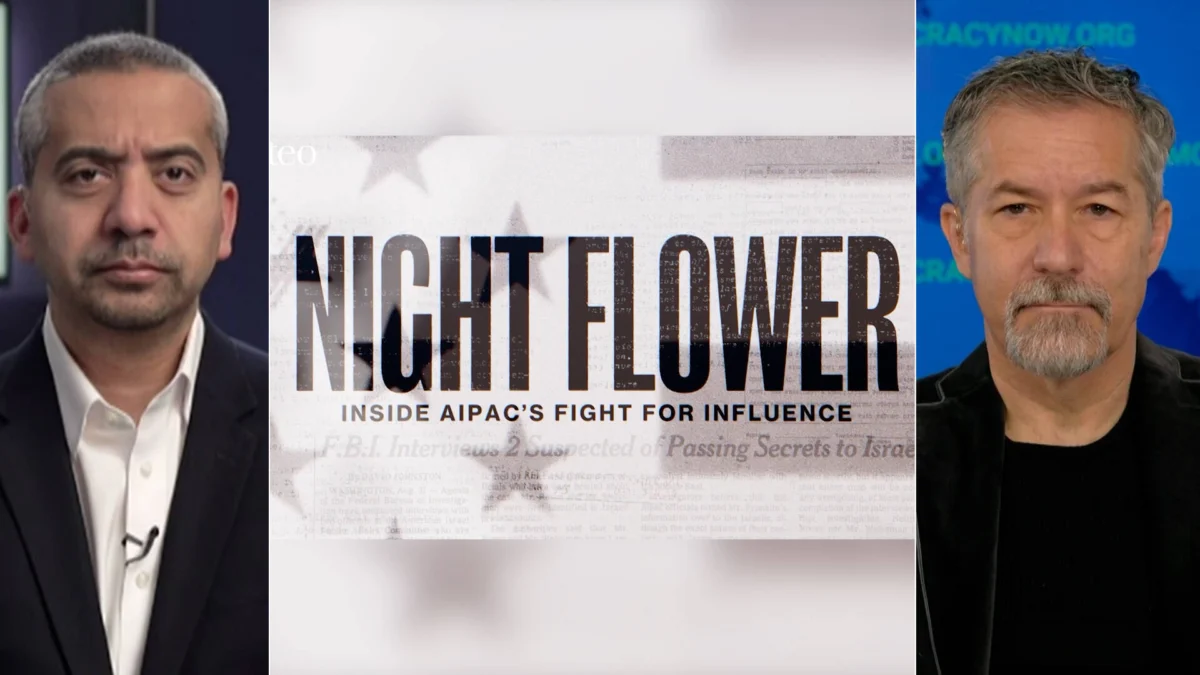
In the landscape of American political lobbying, few organizations command as much respect, fear, and scrutiny as the American Israel Public Affairs Committee (AIPAC). Long considered the gold standard of special-interest advocacy, the group has recently found itself at the center of a burgeoning storm regarding its transparency, its funding, and its fundamental legal status. A new documentary produced by the media outlet Zeteo, titled Night Flower: Inside AIPAC’s Fight for Influence, has reignited a decades-old debate: Does AIPAC operate as a domestic advocacy group, or is it, in practice, a foreign agent for the Israeli government?
Directed by Dion Nissenbaum, a former Wall Street Journal foreign correspondent and two-time Pulitzer Prize finalist, the film pulls back the curtain on the inner workings of an organization that has historically preferred to operate in the shadows. The title itself—Night Flower—refers to a quote from a former AIPAC director who described the lobby as a plant that "blossoms in the darkness and shrivels in the light." As the 2024 election cycle sees unprecedented spending by AIPAC-affiliated groups, the demand for "sunlight" has never been louder.
Main Facts: The Central Allegations of "Night Flower"
The core of the Zeteo documentary revolves around the Foreign Agents Registration Act (FARA). Enacted in 1938, FARA requires individuals and organizations acting as agents of foreign principals in a political or quasi-political capacity to make periodic public disclosure of their relationship with the foreign principal, as well as activities, receipts, and disbursements in support of those activities.
The documentary posits that AIPAC’s coordination with the Israeli government is so deeply entrenched that it bypasses the threshold of mere "shared interests" and enters the territory of "agency." According to Nissenbaum, the film features testimony from multiple sources—including former staffers—who describe a relationship with the Israeli government that is not just close, but directed.
"It says that you have to register under this law if you are acting at the request of a foreign government," Nissenbaum explained during a recent interview. "And we talked to numerous people who showed us several examples of how AIPAC is acting at the request of Israel."
The film’s most explosive revelation comes from an anonymous former AIPAC staffer who remained with the organization through the aftermath of the October 7 Hamas attacks. This whistleblower describes an "all-staff meeting" where leadership allegedly instructed employees to "hold the line" despite the "brutal" and "bloody" images of dead women and children that would inevitably emerge from Gaza. This directive, the staffer suggests, was not a domestic policy decision but a strategic alignment with the Israeli military’s objectives.
Chronology: From Espionage Scandals to Modern Election Interference
To understand the current controversy, one must look at the historical trajectory of AIPAC’s relationship with the U.S. Department of Justice (DOJ). The question of whether AIPAC should register as a foreign agent is not new; it has haunted the organization for over sixty years.
- 1962: The Kennedy administration’s DOJ ordered the American Zionist Council (the precursor to AIPAC) to register as a foreign agent. To avoid this, the organization reorganized and rebranded as AIPAC, claiming to be an American-funded domestic lobby.
- 2004-2005: AIPAC was rocked by an espionage scandal involving two high-ranking officials, Steve Rosen and Keith Weissman. They were accused of passing classified U.S. national defense information to Israeli embassy officials. While the charges were eventually dropped in 2009, the case provided a rare glimpse into the "open channel" between AIPAC and the Israeli embassy.
- 2021-2022: AIPAC made a seismic shift in its operational strategy by launching its own political action committees (PACs), including the United Democracy Project (UDP). This allowed the group to spend millions of dollars directly on U.S. elections for the first time in its history.
- October 7, 2023, and Beyond: Following the Hamas attacks and the subsequent Israeli invasion of Gaza, AIPAC intensified its efforts to marginalize critics of Israel within the Democratic Party, spending record sums to unseat incumbents like Representatives Jamaal Bowman and Cori Bush.
Supporting Data: The Power of the Purse
The influence of AIPAC is best measured by its financial footprint. In the 2024 election cycle, AIPAC has emerged as one of the largest sources of "dark money" in Democratic primaries. The United Democracy Project, AIPAC’s super PAC, has reportedly funneled over $100 million into various races to ensure that pro-Israel candidates prevail over those who have called for a ceasefire or conditioned military aid to Israel.
Critics argue that this level of spending, combined with the organization’s alleged coordination with a foreign power, creates a distortion in American democracy. David Laufman, who formerly oversaw FARA enforcement at the DOJ under both the Obama and Trump administrations, notes in the film that registration would require AIPAC to disclose:
- Every meeting and communication with Israeli government officials.
- Detailed financial information regarding where their money comes from and how it is spent.
- Communications with members of Congress and the Executive Branch.
"The mere alignment of interests, without more, is not enough [to trigger FARA]," Laufman says. "But if there is credible information that AIPAC engages in… activities at the request of the Israeli government, that’s different."
The documentary also highlights the testimony of Keith Weissman, the former staffer at the center of the 2004 espionage case. Weissman admits on camera that he passed sensitive information to the Israeli embassy, describing the relationship as "routine." He recalls that every time AIPAC staff traveled to Israel, they would meet directly with the Prime Minister, including Benjamin Netanyahu, to coordinate messaging.
Official Responses and the "Double Standard"
AIPAC has consistently denied that it acts as a foreign agent. Their official stance is that they are a grassroots organization of American citizens who exercise their First Amendment rights to support a strong U.S.-Israel relationship. They argue that their funding comes entirely from American donors and that their policy positions are determined independently.
However, the documentary—and its executive producer Mehdi Hasan—points to a glaring "double standard" in how the U.S. government applies FARA. Hasan notes that Republicans in Congress have frequently called for outlets like Al Jazeera (funded by Qatar) or activist groups like CodePink (accused of ties to China) to register as foreign agents.
"Isn’t it interesting that Republicans in Congress want everyone to register as a foreign agent except AIPAC?" Hasan asks. "AIPAC, which happily goes to visit Benjamin Netanyahu all the time… Keith Weissman says he passed classified information from the U.S. government to the Israeli Embassy… That gets no investigation from Congress? That gets no investigation from the Department of Justice?"
The DOJ has remained largely silent on the issue of AIPAC’s registration, leading to accusations that the organization is "untouchable" due to its deep ties to leadership in both the Democratic and Republican parties.
Implications: A Crossroads for U.S. Politics
The release of Night Flower comes at a pivotal moment. The internal cohesion of the Democratic Party is fracturing over the Biden administration’s support for Israel’s actions in Gaza. As younger generations of Americans become increasingly critical of Israel’s policies, AIPAC’s traditional "bipartisan" shield is beginning to crack.
There are three major implications for the future of AIPAC and U.S. foreign policy:
1. Legal and Regulatory Pressure
If a future administration or a reconstituted DOJ decides to act on the evidence presented by whistleblowers, AIPAC could be forced to register under FARA. This would effectively end the "night flower" era of the organization, as the resulting transparency would allow the public to see exactly how much influence the Israeli government exerts over specific pieces of U.S. legislation.
2. The Erosion of Bipartisanship
For decades, AIPAC’s power rested on its ability to claim it represented a consensus view. However, by aggressively targeting progressive Democrats and aligning itself with the right-wing Netanyahu government, AIPAC is increasingly viewed as a partisan actor. Representative Alexandria Ocasio-Cortez notes in the film that "in terms of public consciousness and awareness, they are losing power."
3. The Generational Shift
The documentary underscores a growing divide between older AIPAC leadership and a younger generation of Americans—including Jewish Americans—who view the lobby’s tactics as "toxic." The anonymous staffer’s decision to speak out suggests that even within the organization, there is a sense of moral crisis regarding the "blind" support of Israeli military policy.
Conclusion
Night Flower: Inside AIPAC’s Fight for Influence serves as a provocative challenge to the status quo in Washington. By framing the AIPAC debate through the lens of FARA and transparency, Dion Nissenbaum and Zeteo have moved the conversation beyond the typical "pro-Israel vs. pro-Palestine" dichotomy. Instead, they have raised a fundamental question about the integrity of the American political system: In a democracy, should a group with such profound influence over foreign policy be allowed to operate without the same level of disclosure required of other foreign-linked entities?
As Mehdi Hasan concludes, "A night flower blossoms in the dark and shrivels in the light. We’re trying to put some sunlight onto AIPAC." Whether that sunlight leads to meaningful reform or is once again blocked by the organization’s formidable political wall remains to be seen.


 Nana Wu

 Asro






