


 Asep Darmawan
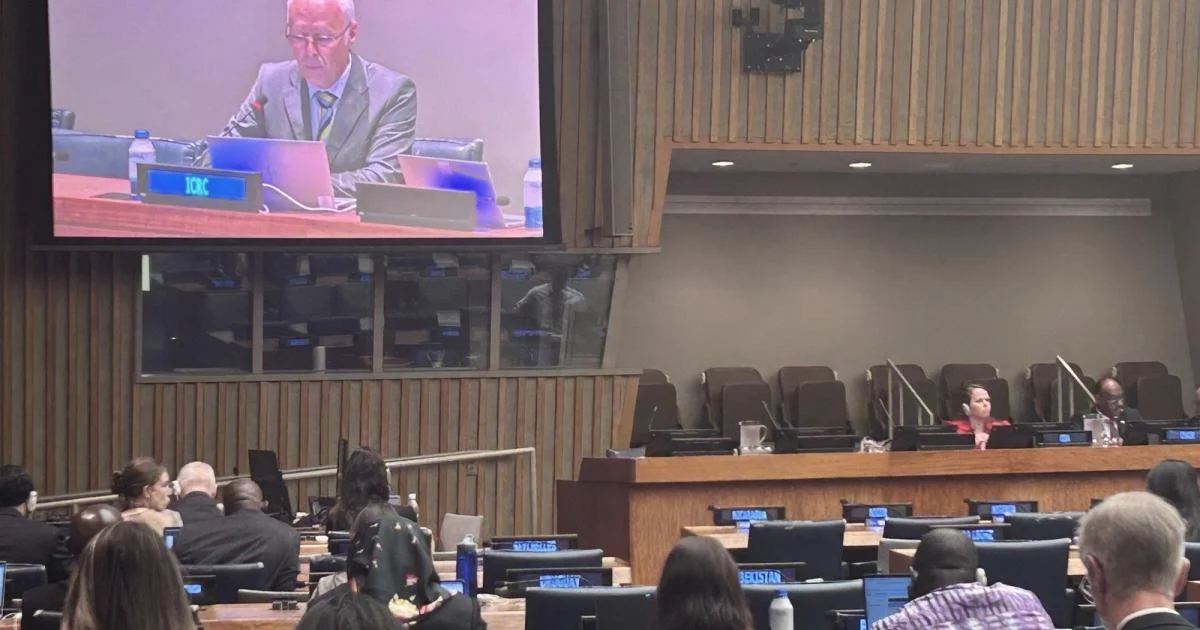
UNITED NATIONS, NEW YORK — As global geopolitical friction reaches levels not seen in decades, the International Committee of the Red Cross (ICRC) has issued a sobering warning to the international community: the mechanisms designed to mitigate the brutality of war are no longer a "peacetime luxury," but a fundamental necessity for survival.
During the 81st session of the United Nations General Assembly’s First Committee, Laurent Gisel, Head of the Arms and Conduct of Hostilities Unit at the ICRC, delivered a stark message. Speaking on behalf of an organization that witnesses the visceral reality of conflict daily, Gisel argued that disarmament and non-proliferation are the primary bulwarks against the total collapse of international humanitarian law (IHL).
The Human Cost of Modern Warfare
The ICRC’s intervention serves as a grim reminder that behind the dry language of treaties and diplomatic committees lie the mangled landscapes of modern conflict. From the indiscriminate remnants of cluster munitions to the encroaching shadows of artificial intelligence in weaponry, the cost of failing to act is paid in civilian lives.
Gisel emphasized that the First Committee’s mandate is more critical now than at any point in the post-Cold War era. With major power competition intensifying, the temptation to abandon arms control in favor of "strategic readiness" is high. However, the ICRC maintains that the protective value of disarmament treaties is at its peak precisely when the threat of war is greatest.
Chronology of Progress and Persistent Stagnation
Despite the prevailing atmosphere of skepticism toward multilateralism, the ICRC highlighted a series of recent milestones that prove political will can still translate into humanitarian protection.
- 2025–2026 Milestone Accedence: The Anti-Personnel Mine Ban Convention saw significant growth, with Lebanon’s accession in May 2026—a move made even more poignant by the fact that it occurred amidst active armed conflict. This followed the commitments made by the Marshall Islands and Tonga in 2025.
- The Arms Trade Treaty (ATT): Since 2020, 12 additional states have joined the ATT, reinforcing a global standard meant to curb the reckless proliferation of conventional arms.
- EWIPA Declaration: In November 2025, the second international conference on the Political Declaration on Explosive Weapons in Populated Areas (EWIPA) saw a reaffirmation of state commitments, marking a shift toward recognizing the catastrophic impact of urban warfare.
- Cluster Munitions: The Third Review Conference of the Convention on Cluster Munitions, held last month in Laos, produced a robust condemnation of the use of such weapons by any actor, under any circumstances, closing ranks against one of the most insidious remnants of war.
However, these gains stand in stark contrast to the failures in the nuclear arena. The 2026 NPT Review Conference concluded in May without a consensus document, leaving the world’s most destructive weapons without a clear path toward reduction, even as the risk of their use hits a multi-decade high.
The Nuclear Precipice
The ICRC’s assessment of the nuclear landscape is blunt: nuclear weapons represent the only category of mass destruction that has yet to be comprehensively eliminated. Gisel noted that the failure of the NPT Review Conference to reach an agreement is a failure of collective security.
Yet, the ICRC sees a narrow window for recalibration. With the First Review Conference on the Treaty on the Prohibition of Nuclear Weapons (TPNW) scheduled for December, the international community faces a choice: continue the trend of rhetorical deadlock or begin the difficult, granular work of disarmament. The ICRC has made it clear that they will continue to press this issue, arguing that the mere existence of these arsenals creates a "catastrophic risk" that no state can unilaterally manage.
Autonomous Weapons: The Frontier of Ethical Warfare
Perhaps the most pressing concern raised by the ICRC is the rapid development of autonomous weapon systems (AWS)—machines capable of selecting and engaging targets without meaningful human intervention.
The Technological Imperative
New technologies, particularly the integration of AI into military hardware, are compounding the devastation of conflict. The ICRC warns that these systems do not merely increase the scale of destruction; they fundamentally alter the accountability structure of war. When a machine determines life-or-death outcomes, the speed and scale of potential IHL violations could outpace any human ability to intervene.
The Path to Regulation
In a rare moment of diplomatic alignment, the CCW (Convention on Certain Conventional Weapons) Group of Governmental Experts on Lethal Autonomous Weapons Systems reached a consensus on their final report last month. States representing diverse strategic interests managed to agree on the core elements of an instrument to regulate these systems.
Gisel signaled that the time for debate has passed and the time for negotiation has arrived. The ICRC, joined by the UN Secretary-General, has issued a joint call for the upcoming CCW Review Conference to initiate formal negotiations on a new Protocol. The movement is gaining momentum: over 70 states, including the African Group, have now explicitly called for a binding legal framework.
The ICRC’s specific requirements for this framework include:
- Prohibition of Unpredictable Systems: Weapons that cannot be sufficiently controlled or predicted must be banned.
- Prohibition of Anti-Personnel Targeting: Systems designed to target human beings directly must be outlawed.
- Strict Limits: Imposing rigorous legal boundaries on all other autonomous technologies to ensure the "future of warfare is governed by humans, not machines."
Supporting Data and Strategic Implications
The ICRC’s advocacy is backed by the "Global Initiative to Galvanize Political Commitment to International Humanitarian Law." The initiative’s recent outcome document explicitly links disarmament to the broader goal of peace. It posits that disarmament is not merely a technical exercise in counting missiles or landmines; it is a vital confidence-building measure that reduces the risk of unintended escalation.
The implications for international law are profound. By embedding disarmament into the framework of IHL, states are acknowledging that the "conduct of hostilities" cannot be divorced from the "capacity for hostilities." If states continue to invest in weapons systems that are inherently indiscriminate or incapable of human-level legal judgment, the laws of war will become unenforceable, eventually rendering the Geneva Conventions a relic of a more "human" era of conflict.
Official Responses and the Road Ahead
The response from the international community remains a mixture of support and hesitation. While the coalition supporting a treaty on autonomous weapons is growing, powerful military actors remain wary of constraints that could limit their technological edge.
The ICRC’s stance is one of firm moral and legal insistence. They argue that the "humanitarian disarmament" movement is one of the greatest achievements of 21st-century multilateralism, proving that even in an era of fractured alliances, states can coalesce around the protection of the innocent.
As the 81st session of the First Committee continues, the ICRC’s role will be to serve as the bridge between technical discourse and human reality. They have positioned themselves not just as a watchdog, but as a facilitator, offering the expertise required to turn political resolve into binding protocols.
Conclusion: A Call for Human Stewardship
In his concluding remarks to the Committee, Gisel reiterated that disarmament is the bedrock upon which the hope for a stable peace is built. The ICRC’s presence at the UN is a reminder that while the tools of war are becoming increasingly automated and detached from human agency, the responsibility for those tools remains—and must always remain—with the states that manufacture and deploy them.
The message to the delegates was clear: the international community stands at a crossroads. It can choose to drift into a future of unchecked technological warfare, or it can reaffirm the principle that even in the darkest of times, human ingenuity should be used to protect life, not to accelerate its extinction. The ICRC stands ready to guide that transition, provided that states are willing to take the first step toward meaningful, binding action.

 Reynand Wu
 Layla Zulfa






