




 Lina Irawan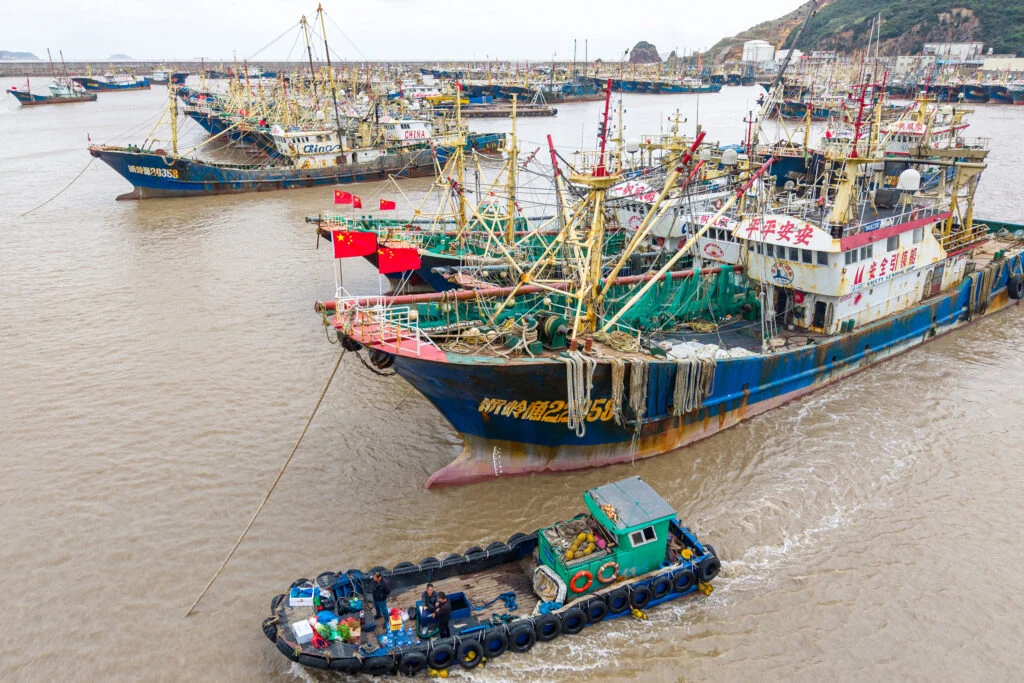
For the migrant laborers working the decks of China’s distant-water fishing fleet, the ritual is as gruesome as it is routine. In the vast, lawless expanses of the Indian Ocean, a shark is hauled onto a rusted deck, its gills pumping rhythmically against the salt-crusted metal. Before the animal has ceased its violent, instinctive writhing, the razor-sharp blade descends. The fins—the source of the vessel’s most lucrative illicit cargo—are severed. The still-living creature is then cast back into the abyss, left to sink into a slow, suffocating death.
This is not an accidental byproduct of industrial fishing. It is a calculated, intentional operation that feeds a half-a-billion-dollar global supply chain. While the practice is widely condemned and technically restricted, it remains a pillar of a shadowy industry that operates with the tacit support of Beijing, all while expertly concealing its tracks from international port inspectors.
The Push for Accountability: A Legal Challenge
This month, the Center for Biological Diversity (CBD) took a decisive step to break this cycle of impunity. The nonprofit, which specializes in the protection of endangered species, filed a formal petition urging the U.S. government to consider sanctions against China. The core of the argument is that China’s current maritime practices fundamentally fail to meet American shark conservation standards.
The statistics are staggering: shark populations have plummeted by more than 70 percent since 1970. Today, over one-third of all shark and ray species are teetering on the brink of extinction. Yet, the Chinese-flagged fleet—the largest in the world—continues to harvest thousands of these apex predators annually, discarding the carcasses to maximize space for high-value fins.
If the National Marine Fisheries Service (NMFS) determines that China has violated the U.S. Moratorium Protection Act, the implications could be seismic. Under such a finding, the President would possess the authority to ban the import of all Chinese seafood—a trade sector valued at roughly $1.5 billion.
"Losing sharks wouldn’t just be an ecological disaster; it would be a profound moral failure," says Alex Olivera, a senior scientist at the Center for Biological Diversity. "Sharks have survived for hundreds of millions of years, and it would be a tragedy if they disappeared in a few decades because governments failed to enforce basic conservation rules."
A Chronology of Decline and Deception
The history of shark exploitation is a narrative of human convenience pitted against evolutionary resilience. Sharks are biologically ill-equipped for the intensity of modern industrial fishing: they grow slowly, mature at a late age, and produce very few offspring. Despite these vulnerabilities, an estimated 80 million sharks are killed annually, either as direct targets or as "bycatch"—unintended victims of long-line fishing and massive nets.
2000: The U.S. Leads the Way
The United States set the global standard for conservation in 2000 by outlawing the practice of finning in its waters. The logic was simple: to prevent the practice, vessels must land sharks with their fins "naturally attached." This ensures that the entire carcass is accounted for and discourages the wasteful removal of fins while at sea.

2014–2021: The DNA Evidence
DNA analysis of fins imported into Hong Kong—the world’s primary clearinghouse for shark products—revealed a damning reality. Researchers identified at least four species listed under the Convention on International Trade in Endangered Species (CITES), including scalloped hammerheads, great hammerheads, and oceanic whitetips.
2022–2026: The Whistleblowers Speak
Interviews conducted by the Environmental Justice Foundation (EJF) provided the most intimate, harrowing look yet into the state of the fleet. In 2024 and 2026, researchers spoke with crew members on Chinese distant-water vessels in the Southwest Indian Ocean and the Southeast Pacific. The findings were chilling: 80 percent of those interviewed reported participating in shark finning.
One Indonesian deckhand working on a Chinese squid jigger in 2022 recounted the routine: "When sharks got entangled, they were lifted, and the fins were cut off. Most of the Chinese crew swallowed the bone marrow right away, while the fins were sun-dried."
The "Math Game" of Enforcement
The primary obstacle to global conservation is the loophole in Chinese regulations. While China has officially banned "finning" in name, it permits fishers to land shark fins so long as they do not exceed a specific percentage—usually five percent—of the shark’s total body weight.
Conservationists and scientists argue that this ratio-based policy is a mathematical fiction that is effectively impossible to enforce. "Once the fins are separated from the bodies, inspectors have a nightmare of a time figuring out which fin belongs to which shark," Olivera explains. "It turns real enforcement into a math game rather than a secure chain of custody."
Because the fins are often separated, processed, and frozen in hidden compartments before a ship ever reaches port, the ability of inspectors to identify protected species or cross-reference bodies with fins is non-existent.
The Human Toll of the High Seas
The ecological devastation of shark finning is inextricably linked to human rights abuses. The same vessels that treat marine life with systemic cruelty are frequently hotspots for forced labor, physical violence, and inhumane working conditions.
Laborers, often trapped on the high seas for months or years at a time, report being coerced into a variety of illegal activities. Beyond the finning of sharks, crews are often ordered to harpoon seals for their fur or hunt false killer whales for the souvenir market. The isolation of these vessels acts as a shield, allowing captains to maintain control through threats and violence while avoiding the oversight of any national or international authority.

Official Responses and Diplomatic Silence
When approached for comment regarding the CBD’s petition, a spokesperson for the Chinese Embassy in Washington provided a boilerplate defense. "China is deeply committed to science-based conservation and sustainable use of international fisheries resources," the representative stated, emphasizing the nation’s adherence to "rigorous vessel monitoring" and participation in regional fisheries management organizations.
However, the embassy notably sidestepped the core issues of the petition. When pressed on the specifics of shark finning, the threat of sanctions, or the allegations of worker abuse, the spokesperson claimed they were "not familiar with the specific situation." This silence is indicative of a broader strategy: avoid addressing the specific, evidence-backed allegations of the fin trade while maintaining a public-facing stance of environmental responsibility.
The Moral and Ecological Implications
Heidy Martínez, a shark scientist and communicator, believes the crisis is fueled by a profound failure to value the shark as a living organism. "It really shows how much we view these ancient, majestic animals as a commodity," Martínez notes. "Sharks fall under the class of fish, and because of this, they communicate their experience to us differently than marine mammals. We find it easier to relate to dolphins because they have human-like eyes, but it’s harder to connect with the shark."
This disconnect has allowed the industry to paint shark finning as an abstract trade issue rather than a wildlife crime. Yet, the data is unequivocal. As the Shark Trust points out, 100 percent of shark species are now impacted by overfishing. For 67 percent of those species, overfishing is the single greatest threat to their survival.
Conclusion: Making Conservation Real
The Center for Biological Diversity’s petition is a demand for structural change. By leveraging the U.S. Moratorium Protection Act, the organization hopes to force a binary choice upon the Chinese government: either adopt the "fins naturally attached" standard that the rest of the developed world follows, or face the closure of a massive, lucrative market.
"If China refuses to adopt comparable protections, then the U.S. should use the tools Congress provided, including import restrictions," says Olivera. "The point of the petition is to make shark conservation standards real, not optional."
As the international community grapples with the decline of ocean health, the case of the Chinese distant-water fleet stands as a microcosm of the larger crisis. It is a story of greed, outdated regulatory loopholes, and the slow, agonizing disappearance of species that have outlived the dinosaurs. Whether the U.S. government chooses to wield its economic influence remains to be seen, but for the millions of sharks dying on the decks of these vessels, the clock is running out.
"The level of demand we place on the ocean simply cannot continue," concludes Martínez. "Shark finning is part of that larger story—a reflection of just how deeply we have exploited our oceans."


 Rifan Muazin
 Layla Zulfa