




 Sagoh

The tenure of Katie Zacharia as White House Press Secretary will likely be remembered not for its substance, but for its brevity—a 14-minute briefing that has already secured its place in the annals of political absurdity. In a modern era defined by rapid-fire news cycles and the erosion of traditional institutional decorum, Zacharia’s appointment and subsequent departure represent a singular moment of administrative chaos. Her time in office, lasting roughly half the duration of Anthony "The Mooch" Scaramucci’s infamous 11-day stint, has triggered a national debate over meritocracy, the vetting processes of the current executive branch, and the broader implications of a communications strategy predicated on loyalty over competence.
A Chronology of a Short-Lived Career
The trajectory of Katie Zacharia from right-wing media obscurity to the podium of the White House Press Briefing Room was as dizzying as it was brief. Born Kate Sharon Black in 1984, Zacharia’s background—spanning from her upbringing in Cambria, California, to her later career as a vocal commentator on issues ranging from border security to the "Stop the Steal" movement—was characterized by an unwavering alignment with the MAGA movement.
Her path to the West Wing was not through traditional diplomatic or communications channels, but through a calculated effort to gain the notice of the President. Sources close to the transition team suggest that Zacharia purposefully timed her television appearances on right-wing networks to coincide with hours she knew the President would be monitoring the news. After the departure of Karoline Leavitt, the search for a successor had hit a wall; internal vetting processes reportedly disqualified several candidates who had previously voiced even mild criticisms of the President.
When Zacharia took the podium, the expectations were mixed. However, her opening statement—a disjointed, inflection-heavy address covering everything from a "historic one-day war" to the booming economy—quickly devolved into a series of stammering non-sequiturs. When pressed on the situation in Ukraine, she famously retreated to the phrase, "I’ll have to get back to you on that," effectively signaling the end of her credibility as the administration’s primary spokesperson. Within 14 minutes, the briefing concluded, and by the following day, reports confirmed that she was "transitioning" out of the role.
Supporting Data and the "Zacharia" Metric
The fallout from the briefing provided a treasure trove of data for political analysts and internet satirists alike. The speed of her departure necessitated a new unit of measurement in political science circles. Wikipedia’s "List of Humorous Units of Measurement" was updated to include the "Zacharia," defined as a fractional unit of a "Scaramucci."
Mathematically, the comparison is stark: if a Scaramucci represents 11 days of tenure, a Zacharia amounts to roughly 0.00088 Scaramuccis. This new unit has sparked heated, if tongue-in-cheek, discourse among political junkies regarding the metrics of professional longevity in the current administration.
Beyond the math, the public reaction focused heavily on the disparity between her claimed credentials and her performance. Zacharia had frequently touted her background in international transaction law and her status as an attorney. However, post-briefing investigations by various media outlets revealed that these claims were largely exaggerated; records indicated she had failed the bar exam, and her experience in China was closer to a short-term internship than a legal career. This revelation, juxtaposed against her performance, turned her into a viral punchline, with critics noting that many common household items, such as the produce in a standard refrigerator, had a longer shelf life than her career as the voice of the executive branch.
Official Responses and the Culture of Silence
The official reaction from the White House was predictably muted, bordering on the surreal. Despite the widespread consensus that the briefing was a "train wreck," the official line remained defiant. A statement issued by the administration claimed, "She will be remembered as one of the all-time greats," a sentiment that observers interpreted as a desperate attempt to frame failure as success.
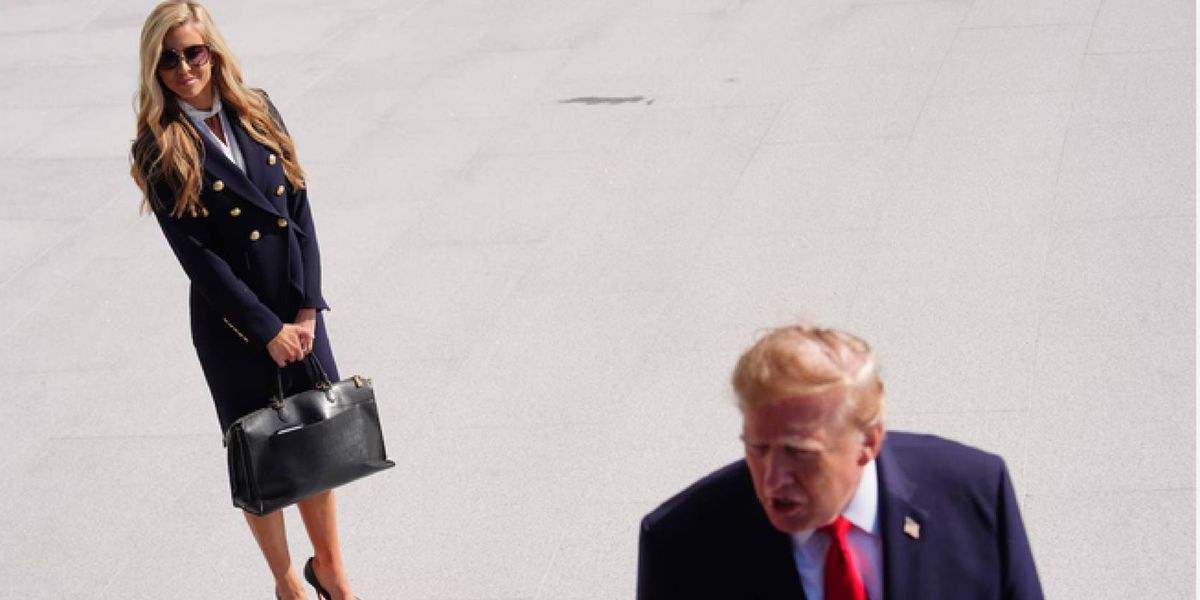
Conversely, the President offered a characteristically detached assessment: "I told her, ‘If I were you, I’d reconsider.’" This comment underscored the capricious nature of the current administration, where staff are frequently treated as disposable assets rather than public servants.
Strategic analysts, such as Democratic strategist Mike Nellis, provided a more clinical take. Nellis argued that Zacharia was not fired for lying—which is often viewed as a requirement for the role—but for being a "bad liar." The distinction is crucial: in an environment where the truth is frequently treated as malleable, the primary function of a press secretary is to deliver falsehoods with enough confidence to avoid immediate public derision. Zacharia failed not at the deception, but at the execution of it.
The Implications of "MAGA Meritocracy"
The Zacharia episode raises profound questions regarding the state of American governance. Critics have pointed out a disturbing trend: the rapid churn of female officials within the administration, all of whom are being replaced by men. When contrasted with the relative stability of male officials—some of whom have faced their own scandals and professional failures yet remain in their posts—a pattern of systemic instability and bias emerges.
This "MAGA meritocracy," as it has been mockingly termed, appears to favor ideological obsequiousness over professional qualification. The vetting process, which excludes any individual who has shown the capacity for independent thought or past critique of the President, inevitably leads to the appointment of individuals who are ill-equipped for the demands of high office. The result is a White House that is increasingly disconnected from the realities of governance, prioritizing the "optics" of loyalty over the functional requirements of the state.
Furthermore, the public discourse surrounding the event highlights a deepening sense of cynicism. When citizens compare the tenure of a cabinet-level official to the lifespan of a head of lettuce, it signals that the dignity of the office has been effectively hollowed out. The fact that the President continues to hold the support of a base that ignores these indicators of instability suggests that the traditional mechanisms of political accountability—such as the "judgment" of the press or the scrutiny of voters—may be losing their efficacy in the face of a highly polarized information environment.
The Future of the Podium
As the administration looks for yet another replacement, speculation has turned toward a variety of personalities, ranging from serious political commentators to, in the case of The Borowitz Report, disgraced politicians like George Santos. The joke, while dark, carries a kernel of truth: when the criteria for success are so poorly defined, the office becomes a stage for performative chaos rather than a tool for public information.
The Zacharia episode will likely fade from the headlines as the next cycle of scandals takes hold, but it leaves behind a legacy of caution. It demonstrates the danger of a political culture that prizes the "look" of an administration over the substance of its policy. For the American public, the question remains: if the individuals tasked with explaining the actions of the most powerful office in the world are incapable of navigating a 14-minute briefing, what does that imply for the long-term stability of the government itself?
As Zacharia herself noted in her parting posts—which still frame the President as "kind, wonderful, and gracious"—there is a deep, almost cult-like adherence to the leader that persists regardless of professional humiliation. Whether this level of blind devotion is enough to sustain an administration in the long term remains to be seen. For now, the "Zacharia" remains a unit of measurement, a reminder of a moment when the speed of incompetence outpaced the speed of governance, leaving the nation to wonder who—or what—will be "whooshed" out of the White House next.


 Iffa Jayyana

 Ammar Sabilarrohman




