



 Iffa Jayyana
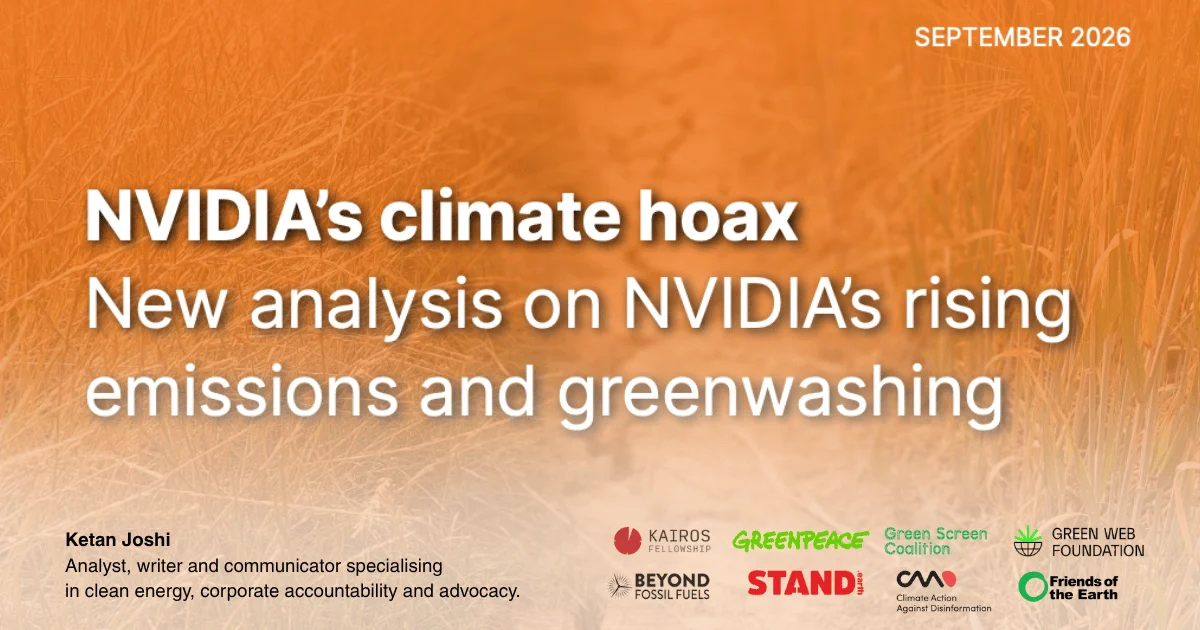
AMSTERDAM – NVIDIA, the undisputed titan of the modern technological age, currently sits at the pinnacle of global market capitalization. Its graphics processing units (GPUs) have become the "picks and shovels" of the gold rush that is generative artificial intelligence. However, as the company’s valuation continues to defy gravity, a scathing new report released by a coalition of international civil society groups suggests that NVIDIA’s meteoric rise is being fueled by a strategy of aggressive environmental obfuscation.
The report, titled NVIDIA’s Climate Hoax, presents a stark counter-narrative to the company’s polished public image, alleging that the tech giant is utilizing sophisticated greenwashing tactics to conceal the staggering carbon footprint generated by its supply chains and the subsequent energy-hungry infrastructure required to house its chips.
The Core Allegation: A 725% Spike in Indirect Emissions
The central finding of the analysis, spearheaded by analyst Ketan Joshi and supported by a consortium including Greenpeace, Beyond Fossil Fuels, and Friends of the Earth, is a dramatic surge in NVIDIA’s Scope 3 emissions. Scope 3 emissions encompass all indirect greenhouse gas impacts outside the immediate operational boundaries of the company—specifically, those generated by the manufacturing of raw materials and, crucially, the energy consumed by the products NVIDIA sells to its customers.
According to the data compiled between 2020 and 2026, NVIDIA’s Scope 3 emissions have ballooned by 725%. When factoring in the estimated power consumption of the chips currently flooding the market, researchers estimate that undisclosed emissions from the use of these sold chips could reach a staggering 21 million tonnes of carbon dioxide equivalent in 2025 alone.
For a company that touts its hardware as the engine for human progress, these figures suggest that the "AI revolution" carries a heavy, often hidden, carbon cost that the company has failed to adequately address or mitigate.
Chronology: The Evolution of the AI Boom and the Environmental Toll
To understand the scale of the current controversy, one must look at the timeline of NVIDIA’s ascent and the concurrent rise of environmental scrutiny:
- 2020–2022: The Incubation Phase. As the world shifted to remote work and digital infrastructure during the pandemic, demand for data center capacity soared. NVIDIA began its rapid transition from a gaming-focused hardware producer to the backbone of the AI industry. During this period, emissions reporting remained largely focused on direct operational impacts, leaving the massive "downstream" energy consumption of their GPUs in the shadows.
- 2023: The Generative AI Inflection Point. The public release of large language models sparked an unprecedented arms race among tech giants. NVIDIA’s market power became absolute, with the data center segment accounting for the overwhelming majority of its revenue.
- 2024–2025: The Efficiency Mirage. As public pressure mounted regarding the environmental impact of AI, NVIDIA began championing "energy efficiency" and "demand response" as core pillars of its sustainability strategy. Critics argue these claims were designed to distract from the reality that the total absolute energy demand was growing exponentially, regardless of how efficient individual chips became.
- 2026: The Reckoning. The release of the Climate Hoax report marks a turning point, moving the debate from abstract sustainability goals to concrete, audited emissions disclosures that paint a picture of systemic environmental misalignment.
Deconstructing the "Green" Rhetoric
The report identifies three primary pillars of what it describes as NVIDIA’s greenwashing strategy. By debunking these, the coalition argues that the company is actively misleading investors and the public.
1. The "Net Benefit" Fallacy
NVIDIA frequently positions AI as a primary tool for solving the climate crisis. However, the report contends that this narrative ignores the immediate, real-world emissions generated by the manufacturing and operation of AI infrastructure. While AI could theoretically optimize power grids, the carbon debt incurred by the massive compute power required to train and run modern models far outweighs these potential efficiency gains in the short term.
2. Misrepresented Demand Response
The company often touts "demand response" for data centers—a practice where data centers adjust their energy consumption during peak times—as a solution for integrating renewable energy. Analysts argue that this is a smokescreen. In practice, data centers are increasingly being tethered to fossil-fuel-heavy grids to meet the relentless, 24/7 power demands of AI servers. A glaring example cited in the report is NVIDIA’s collaboration with a data center project in Ohio, which is reportedly slated to be powered by one of the largest gas-fired power plants in the United States.
3. The Efficiency Paradox
NVIDIA heralds the energy efficiency of its H100 and newer chips as evidence of progress. Yet, this ignores the "Jevons Paradox": as chips become more efficient, companies simply install more of them. The total energy draw of global data centers continues to climb, rendering individual hardware efficiency gains negligible in the face of the massive scale-up of AI capacity.
The Human Cost: "Tech Colonialism"
Beyond the raw emissions data, the report raises profound ethical concerns regarding the global distribution of AI’s impacts. Xueying Wu, a campaigner for Greenpeace International, describes the current state of affairs as "tech colonialism."
"NVIDIA is monopolizing the profits of AI while offloading its ecological impacts onto the Global Majority," Wu stated. The report highlights that while the financial benefits of the AI bubble are concentrated within a few wealthy nations and a handful of corporations, the physical burdens—water depletion for cooling, energy strain on local grids, land use, and the toxic legacy of e-waste—are disproportionately felt by lower-income nations and local communities.
Implications for the Future of AI
The implications of this analysis extend far beyond NVIDIA’s corporate reputation. The findings suggest that the current trajectory of the tech industry is fundamentally at odds with global climate targets, such as those set by the Paris Agreement.
The Financial Stability Risk
The coalition warns that NVIDIA and other tech giants are inflating an "AI bubble" that gambles not just with the environment, but with global financial stability. By concentrating vast amounts of power and capital into a sector that is inherently vulnerable to energy supply shocks and tightening environmental regulations, these companies may be creating a systemic risk that shareholders have yet to fully price in.
A Demand for Radical Transparency
The report concludes with a series of demands aimed at forcing NVIDIA to move beyond marketing-led sustainability. These include:
- Full Disclosure: Providing transparent, audited reporting of Scope 3 emissions that account for the full lifecycle of their chips, from mineral extraction to end-of-life disposal.
- Decoupling Growth from Carbon: Implementing a strategy that proves growth in AI capacity does not result in a net increase in fossil fuel consumption.
- Direct Renewable Investment: Moving away from reliance on fossil-fuel-backed power grids and investing directly in local, renewable energy infrastructure in the regions where their chips are manufactured and utilized.
Conclusion
NVIDIA stands at a crossroads. As the company continues to shape the future of human intelligence, it faces a mounting crisis of its own making: the realization that the digital infrastructure powering the future is built upon a foundation of carbon-intensive, environmentally extractive practices.
Whether NVIDIA will continue to defend its position with "green" marketing rhetoric or pivot toward the radical transparency and structural changes demanded by environmental advocates remains to be seen. What is clear, however, is that the era of viewing AI development as a "climate-neutral" endeavor is over. The "Silicon Shadow"—the hidden environmental cost of our digital ambition—is now part of the global discourse, and the world is no longer taking the industry’s claims at face value.
Supporting Data and References
- Manufacturing Impact: Research from Greenpeace East Asia titled Nvidia’s Green Illusion documents how the company shifts its footprint onto suppliers in East Asia who remain heavily reliant on coal and gas.
- Financial Concentration: NVIDIA’s Q2 FY27 financial results reveal that 92.5% of its revenue is tied to the data center segment, confirming that the company’s entire value proposition is tethered to the explosive—and energy-intensive—demand for generative AI hardware.
- UN Findings: A study by the United Nations University, referenced in the report, confirms that the expansion of AI is exacerbating environmental injustice, creating a "compute divide" where the ecological costs of data centers are exported to vulnerable populations.
For further information on the full analysis, visit the Greenpeace official repository.

 Basiran

 Nila Kartika Wati