



 Lina Hope
In the hyper-competitive digital landscape of 2026, where organic reach on major social media platforms continues to decline, nonprofits are facing an existential crisis regarding visibility. As algorithms prioritize paid content and personal connections over organizational posts, the traditional "broadcast" model of digital marketing is failing. However, a massive, untapped resource remains dormant within most nonprofit databases: the existing donor base.
According to recent industry data, 52% of online donors are willing to serve as social media ambassadors, dedicating 1-2 hours per month to championing their favorite causes. Despite this overwhelming willingness to engage, only 9% of nonprofits have formalized programs to harness this volunteer energy.
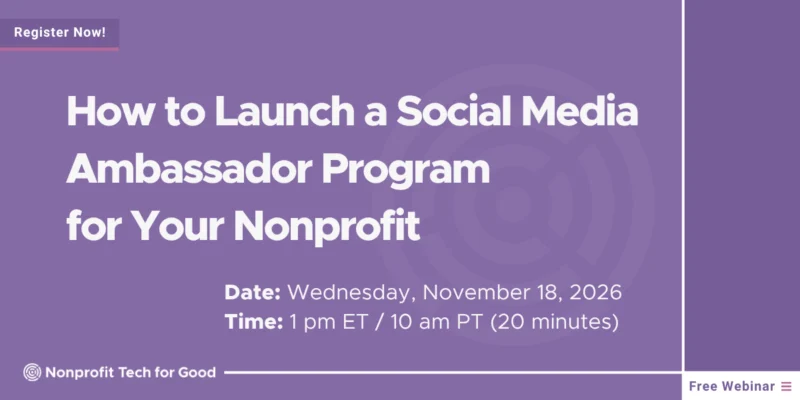
To bridge this critical gap, Heather Mansfield, founder of Nonprofit Tech for Good, is hosting a high-impact, 20-minute webinar on Wednesday, November 18, 2026. This session aims to provide actionable strategies for organizations looking to convert passive supporters into active digital advocates.
Main Facts: Addressing the Engagement Gap
The core objective of this upcoming webinar is to demystify the process of building an ambassador program. For many nonprofit managers, the idea of "managing" a volunteer social media army feels daunting. However, the data suggests that the barriers are often psychological rather than logistical.
- Event: "How to Launch a Social Media Ambassador Program for Your Nonprofit"
- Presenter: Heather Mansfield, a globally recognized expert in digital strategy for the nonprofit sector.
- Date: Wednesday, November 18, 2026.
- Time: 1:00 PM ET / 10:00 AM PT.
- Format: A condensed, 20-minute "mini-webinar" designed for busy professionals.
- Cost: Free.
- Accessibility: The session will be recorded and distributed to all registrants, ensuring that time zone differences or scheduling conflicts do not prevent staff from accessing the training.
The webinar will focus on the "why" and "how" of mobilization. By leveraging the social capital of donors, nonprofits can circumvent the restrictive algorithmic bottlenecks that currently suppress the reach of official organizational accounts.
Chronology: The Evolution of Digital Advocacy
The shift toward ambassador-led advocacy didn’t happen overnight. It is the result of a decade-long evolution in how social platforms function.
2015–2018: The Golden Age of Organic Reach
In this era, nonprofits could reach a significant percentage of their followers simply by posting quality content. The "broadcast" method—posting updates, photos, and calls to action—was sufficient to drive donations and awareness.
2019–2023: The Algorithmic Pivot
As platforms like Facebook, Instagram, and LinkedIn pivoted toward paid advertising models, organic reach for pages plummeted. Nonprofits found that even with high-quality content, they were lucky to reach 1–2% of their own followers. This period marked the beginning of the "pay-to-play" reality in the social sector.
2024–Present: The Rise of the Peer-to-Peer Advocate
Recognizing that algorithms prioritize content from individuals over content from brands, the sector began to pivot. The current era is defined by the "ambassador" model. By shifting the burden of communication from the organization to the individual supporter, nonprofits can reach the inner circles of their donors—a demographic that is inherently more trusting and more likely to convert.
The upcoming November 18th webinar is the latest milestone in this timeline, providing the necessary framework for organizations to formalize this transition.
Supporting Data: Why Donors Are Ready
The primary argument for launching an ambassador program is not just convenience—it is data-driven. The 52% statistic mentioned by Nonprofit Tech for Good is a powerful indicator of the current donor mindset.
The Trust Factor
Psychological studies in the nonprofit sector consistently show that donors trust their peers more than they trust official institutional voices. When a friend shares a fundraising campaign, it acts as a "social proof." The donor isn’t just looking at a mission statement; they are looking at a personal endorsement from someone they respect.
The Time Investment Myth
Many nonprofits fear that an ambassador program requires full-time management. However, the data reveals that the average donor is willing to contribute only 1–2 hours per month. This is a "micro-volunteering" opportunity. It does not require a complex HR structure; rather, it requires a clear, repeatable system for sharing content.
The Reach Multiplier
If an organization has 1,000 followers, a post might reach 20 people. If those same 1,000 followers each have an average of 200 friends, and even just 50 of those followers act as ambassadors, the potential reach grows from 20 to 10,000. This exponential growth is the only viable path to meaningful scale in a saturated digital market.
Official Perspectives: The Expert View
Heather Mansfield, who has spent over a decade analyzing the intersection of technology and philanthropy, argues that the lack of ambassador programs is a missed opportunity for organizational sustainability.
"We are currently in a landscape where traditional digital outreach is yielding diminishing returns," Mansfield notes. "Organizations that continue to rely solely on their own channels are essentially shouting into a void. The most successful nonprofits in 2026 will be those that empower their base to speak on their behalf."
Mansfield’s approach emphasizes the "20-minute" constraint. In an industry where staff burnout is at an all-time high, the training is designed to be high-impact and low-commitment. The philosophy is simple: provide ambassadors with the tools—pre-written copy, high-quality images, and clear instructions—and let them do the heavy lifting.
Implications: What This Means for Your Organization
If your organization is currently among the 91% without an ambassador program, the implications of continuing on your current path are significant.
1. Declining Donor Acquisition
Without a strategy to penetrate the personal networks of your supporters, your donor acquisition costs (DAC) will likely continue to rise as you rely more heavily on paid advertising to fill the gap left by low organic reach.
2. Stagnant Audience Growth
Social media platforms are designed to connect individuals. When organizations fail to facilitate peer-to-peer connection, they remain outsiders in the digital ecosystem. An ambassador program changes the identity of your organization from an "entity" to a "community."
3. The Shift to "Micro-Advocacy"
The future of fundraising is not just about the transaction; it is about the involvement. An ambassador program allows donors to feel like partners in the mission. This increased sense of ownership leads to higher donor retention rates, as people are statistically more likely to continue supporting a cause they actively advocate for.
How to Prepare for the November 18th Webinar
To get the most out of the upcoming training, nonprofit staff should consider the following steps before the session:
- Audit your existing database: Identify your most engaged donors—those who already share your posts or interact with your content.
- Review your current social presence: Identify which platform (Facebook, Instagram, LinkedIn, etc.) is the most conducive to your mission.
- Prepare questions: The webinar will cover the "how-to," but attendees should come prepared to ask about the specific challenges of managing ambassador expectations, communication cadences, and content creation.
Registration and Logistics
Interested participants can register via the official GoToWebinar link. As a reminder, the session is free of charge.
The organizers have also provided a system check tool to ensure all technical requirements are met prior to the event. For those unable to attend the live session, registration is still encouraged; the recording will be delivered to the registrant’s inbox within 24 hours of the webinar’s conclusion, providing a permanent reference for staff looking to implement these strategies in the new year.
In conclusion, the social media landscape is not shrinking; it is changing. By moving from a model of individual broadcasting to one of collective advocacy, nonprofits can reclaim their reach, deepen donor relationships, and secure the financial future of their organizations. The tools are available, the donors are willing, and the time to start is now.

 Iffa Jayyana
 Suro Senen






