

 Neng Nana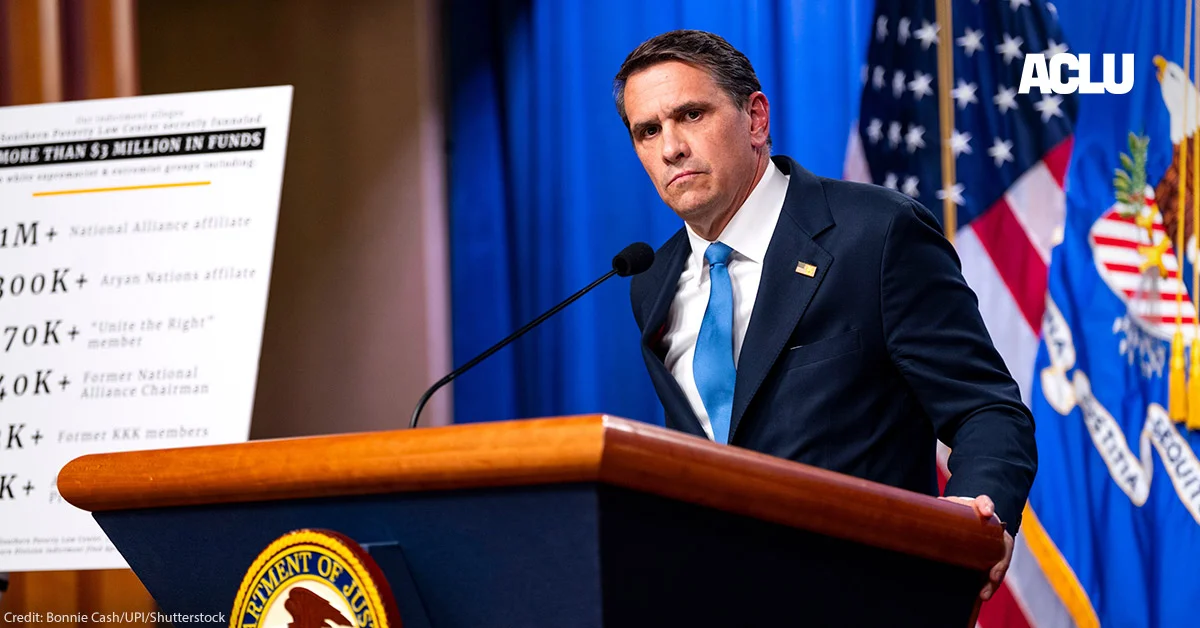
By Mike Zamore, National Director of Policy & Government Affairs, ACLU
May 20, 2026
In an escalating campaign that civil liberties advocates describe as an unprecedented abuse of executive authority, the Trump administration has set its sights on the Southern Poverty Law Center (SPLC). The move, characterized by the Department of Justice (DOJ) as a probe into alleged illicit activities, is being viewed by legal scholars and human rights organizations as a calculated effort to dismantle one of the nation’s most prominent civil rights watchdogs. This development marks a dangerous inflection point in the administration’s broader strategy to punish dissent and suppress organizations that hold the government accountable.
The Targeting of a Civil Rights Icon
For decades, the Southern Poverty Law Center has served as a critical bulwark against domestic extremism, racism, and systemic injustice in the American South. The organization’s work—ranging from high-profile litigation against white supremacist groups to educational initiatives—has historically been recognized by federal law enforcement, including the FBI, as a vital resource in understanding and countering hate-based violence.
However, the current administration has reframed the SPLC’s investigative work as a "con" designed to propagate left-wing agendas under the guise of civil rights advocacy. By leveling these allegations, the DOJ has initiated a formal inquiry that seeks to delegitimize the organization’s long-standing research into right-wing extremism. Critics argue that the prosecution is not rooted in evidence of wrongdoing but is instead a "manufactured outrage" designed to neutralize a powerful political opponent.
A Chronology of Escalating Hostility
The current indictment against the SPLC did not occur in a vacuum; it is the culmination of years of mounting friction between the White House and the non-profit sector.
- Early 2025: The administration began signaling a shift in DOJ priorities, focusing on "anti-government" activity within the non-profit sector.
- Late 2025: Rhetoric from the White House began to focus specifically on "donor-advised" transparency, with the SPLC being singled out in press conferences by high-ranking officials.
- April 2026: Financial pressure mounted as major financial institutions, including Fidelity, Vanguard, and Schwab, began restricting customer donations to the SPLC, citing the "ongoing government investigation" as a risk management issue.
- May 2026: The Department of Justice officially moved forward with the current legal strategy, effectively freezing certain operations and forcing the organization into a defensive legal posture.
This timeline reflects a deliberate strategy: the government identifies a target, uses its regulatory and prosecutorial power to create a "chilling effect," and relies on private-sector allies to dry up the organization’s resources.
The Economics of Repression: Why Convictions Don’t Matter
A central feature of this administrative strategy is the recognition that the government does not need to win a conviction to achieve its desired outcome. In the American legal system, the process is the punishment.
Legal defense is prohibitively expensive and time-consuming. By forcing a high-profile organization to divert its resources toward a protracted legal battle, the administration effectively sidelines the SPLC’s advocacy work. This "war of attrition" is a hallmark of authoritarian-leaning governance. Even if the SPLC is eventually exonerated—a common outcome in cases involving peaceful protesters and political observers—the administrative and financial toll will have already served the White House’s primary objective: silence.
Furthermore, the involvement of major financial institutions like Fidelity, Vanguard, and Schwab signals a new, dangerous precedent. By treating a government investigation as a reason to blacklist an organization, these entities have inadvertently become arms of state censorship. The chilling effect is palpable; other organizations are now watching, calculating the risks of criticizing the administration, and often deciding to self-censor to avoid becoming the next target.
A Pattern of Systemic Weaponization
The attack on the SPLC is merely one facet of a broader pattern of government overreach. The Trump administration has consistently utilized federal agencies to punish perceived political enemies:
- The FCC’s Regulatory Threats: The Federal Communications Commission has repeatedly threatened media companies with license reviews for airing content critical of administration policies.
- Deportation as a Political Tool: There have been documented instances where the administration has targeted green card holders for their exercise of First Amendment rights, attempting to use immigration status as a weapon against speech.
- Grants and Research Suppression: The National Institutes of Health (NIH) and other grant-making bodies have been directed to withhold funding from research institutions that address "prohibited" topics such as gender identity and systemic racism.
- The War on the Press: Media outlets that refuse to parrot the administration’s messaging have been systematically excluded from the Pentagon and White House press briefings, effectively cutting off the public’s access to information.
This systematic weaponization of the state is not a bug in the current system; it is a feature of an administration that views democratic checks and balances as obstacles rather than safeguards.
Official Responses and Legal Precedents
While the administration claims these actions are necessary to "uphold the rule of law" and protect the public from "extremist rhetoric," the ACLU and other legal watchdog groups maintain that these actions are unlawful.
The ACLU’s historical defense of free speech provides a clear counter-argument. Just two years ago, in National Rifle Association v. Vullo, the Supreme Court issued a unanimous 9-0 ruling in favor of the NRA, preventing the state of New York from using its regulatory power to coerce companies into cutting ties with a political advocacy group. That case established that the government cannot use the threat of regulatory action to stifle the speech of its opponents. The current administration’s treatment of the SPLC mirrors the very tactics that the Supreme Court struck down in that landmark case, suggesting a blatant disregard for established constitutional law.
The Broader Implications for Democracy
The implications of this crusade extend far beyond the SPLC. Democracy is often described as a "tug-of-war" between competing visions. For this mechanism to function, the field of play must remain level. A free press, a robust civil society, and the right to organize are the essential components of a functioning Republic.
When the executive branch uses its power to "yank" that rope away from those who do not "toe the line," it creates a society defined by fear rather than participation. If the government can successfully dismantle an organization as large and influential as the SPLC, no smaller or less-resourced group is safe.

The strategy is simple: coerce compliance through the threat of financial ruin. If an organization speaks out, it faces a audit; if it protests, it faces an investigation; if it researches, it faces a grant termination. This cycle forces organizations to choose between their mission and their survival.
Conclusion: A Line in the Sand
The attack on the Southern Poverty Law Center is a direct assault on the American democratic project. We are witnessing a fundamental shift in how the government interacts with its citizenry—moving from a model of service to a model of control.
If we value our freedom, we must draw a line. The citizenry must demand accountability from Congress, which has the power to check these administrative abuses. We must hold private-sector actors accountable for their roles in enabling censorship, ensuring that there is a steep reputational and financial cost to those who act as arms of the state.
We have a right to a government of, by, and for the people. When that government turns its back on its own citizens and begins to treat dissent as a crime, it is the duty of every American to stand in opposition. To protect our rights, to protect our future, and to protect the very concept of a free society, we must stand with the Southern Poverty Law Center. The defense of one is the defense of all.

 Lina Hope