




 Reynand Wu

By Gregory Parent, Director of CARE’s Economic Evaluation Unit
October 6, 2026
For decades, the global development and humanitarian sectors have operated under a relatively static premise: donors provide capital, and organizations deliver results. The fundamental question—"What does a single dollar of aid actually buy?"—has long been answered through isolated, project-specific cost studies. While this provided snapshots of efficacy, it rarely offered a panoramic view of organizational efficiency.
Today, that approach is undergoing a radical transformation. As global aid budgets shrink in the face of escalating humanitarian crises, the pressure on international NGOs has shifted from mere accountability to rigorous efficiency. It is no longer enough for a program to be effective; it must be affordable and scalable.
At CARE, we have spent the last fiscal year stress-testing a 121-country portfolio, analyzing over 500 projects to answer the most critical question a donor can ask: How do we maximize the impact of every dollar entrusted to us?

The New Metric: Beyond "Does it Work?"
For twenty years, the sector focused on a singular query: "Does this intervention work per dollar?" While the Dioptra Consortium and other bodies have provided valuable cost-per-outcome data, the landscape has fundamentally changed. Today, the question is: "Can this model survive without us?"
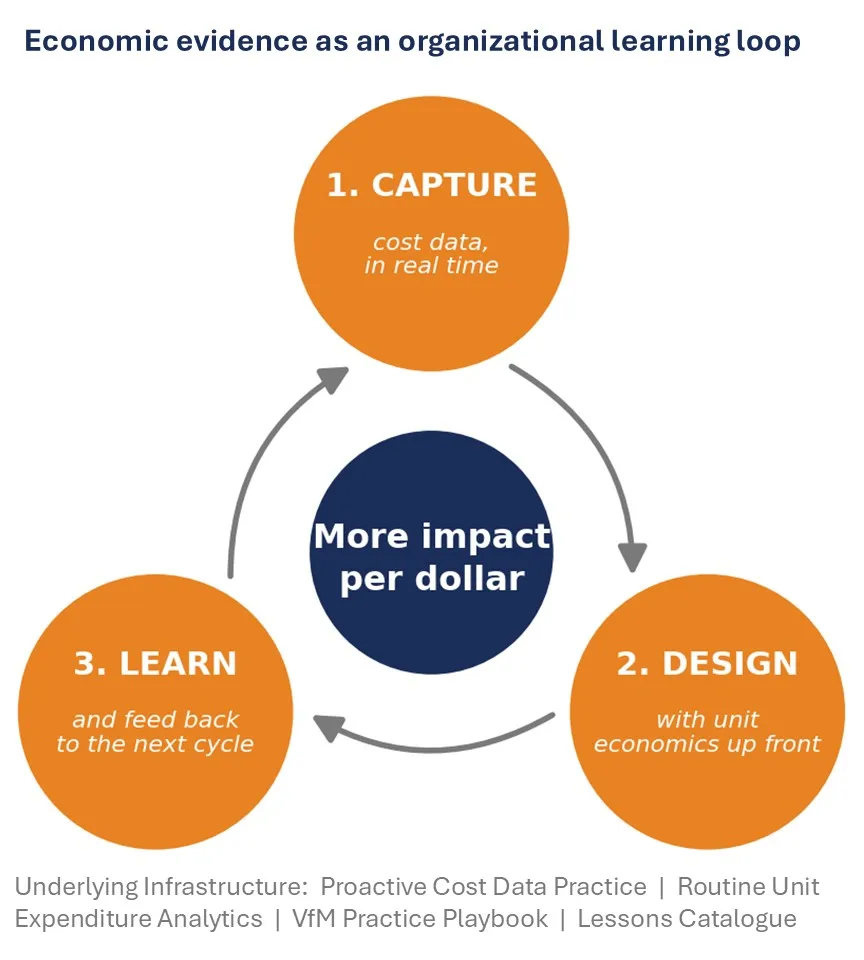
Philanthropy is, by definition, finite. A program is only truly successful if it can eventually be absorbed by a government ministry or sustained through market mechanisms. If a project is too expensive to replicate, it is, in the long term, a failure. Consequently, our Economic Evaluation Unit is moving beyond standard accounting. We are treating cost-effectiveness as a primary design tool. Every financial figure we produce is now indexed against a future reality where philanthropy exits and local systems take over.
Chronology: Building the Economic Evidence Loop
The journey to this level of data maturity was not an overnight shift but a systematic integration of financial and operational intelligence.
- Late 2025: CARE formally establishes the Economic Evaluation Unit (EEU). The mandate is clear: bridge the gap between financial reporting and program design.
- Early 2026: Initiation of the portfolio-wide analytics project. The goal: harmonize data across 500+ projects to identify trends that were previously invisible at the individual project level.
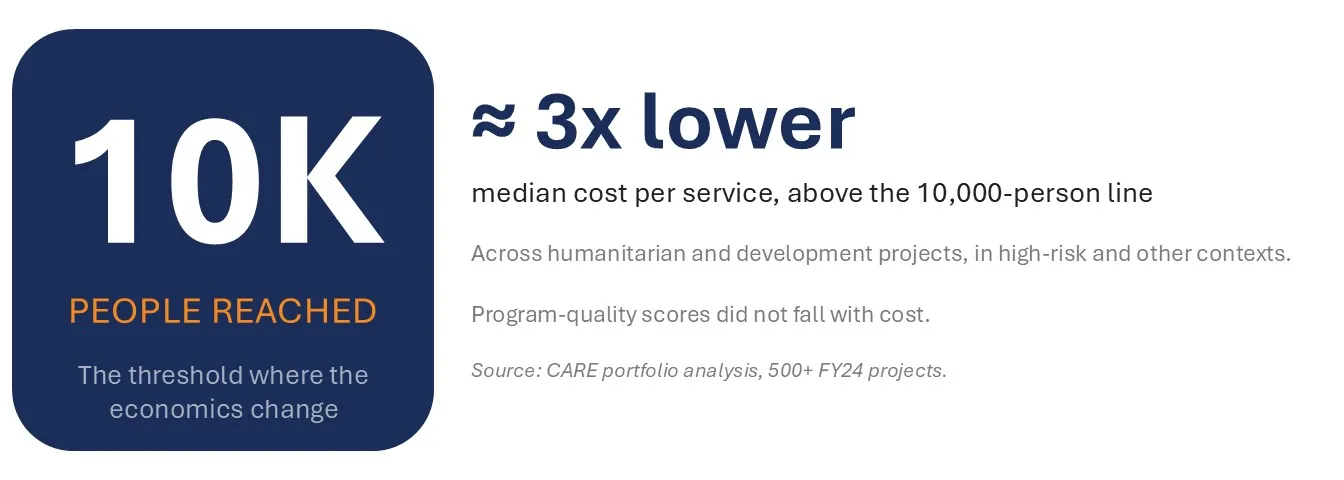
- Mid-2026: The "10K Rule" is identified. Data reveals that projects reaching over 10,000 people benefit from economies of scale that reduce the cost-per-service by nearly 70% compared to smaller initiatives, without sacrificing quality.
- Late 2026 (Present): Integration of AI-powered assistants into the proposal design phase. This tool benchmarks prospective programs against sector standards before a single dollar is spent.
Supporting Data: The Power of Scale and Efficiency
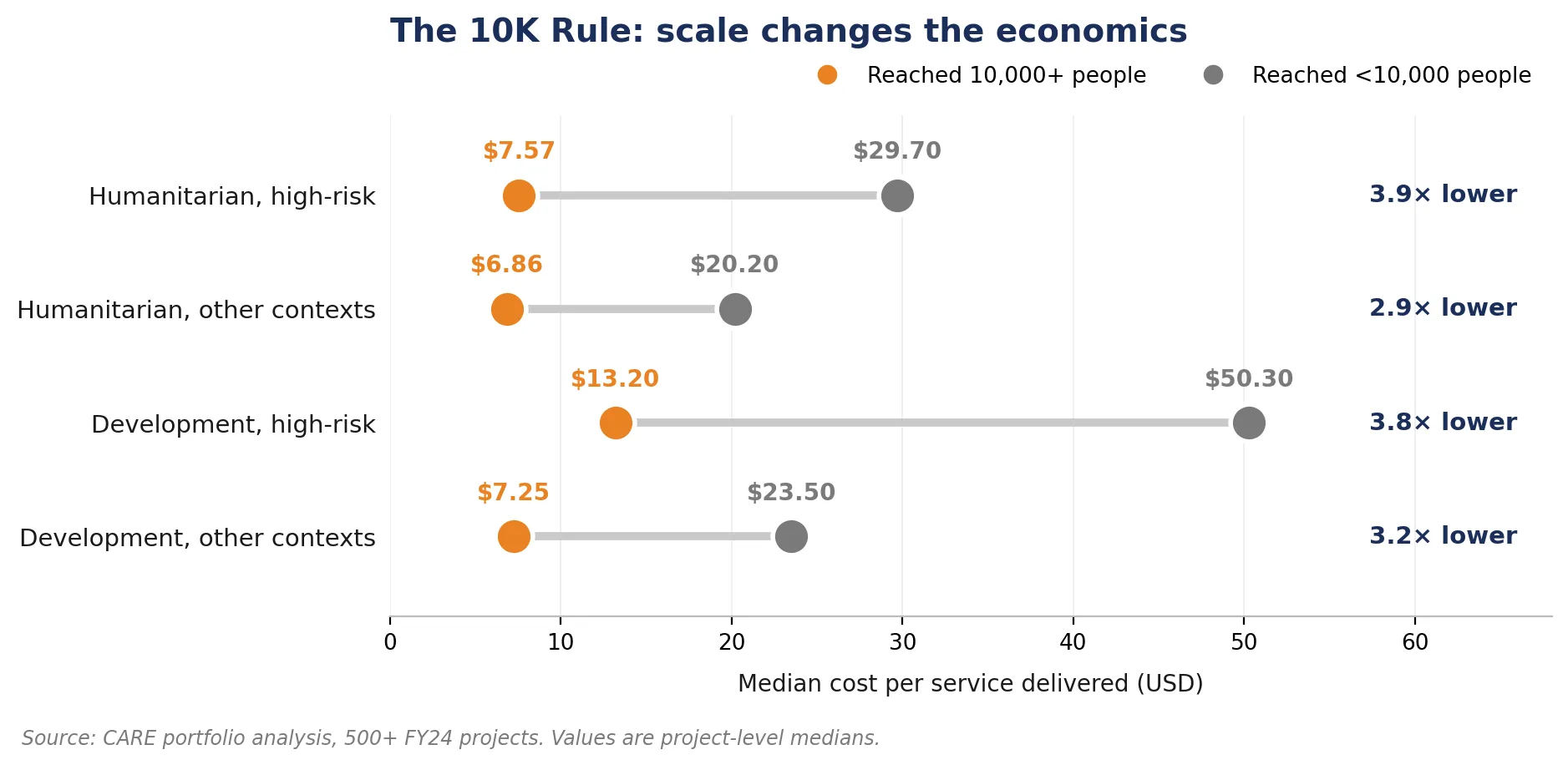
The core of our recent findings rests on the relationship between reach and cost. Our analysis of over 500 projects demonstrates that scale is the most potent lever for efficiency.
The 10K Rule
Our data shows a distinct "economic cliff." Projects that exceed a threshold of 10,000 beneficiaries consistently achieve a median cost-per-service that is roughly one-third to one-quarter that of smaller projects. This pattern holds true even in high-risk, fragile environments. While it might seem intuitive—fixed costs like staff and infrastructure are spread across a larger base—the critical insight is that program quality scores do not decline as these costs drop.
The Three Pillars of Economic Measurement
Beyond simple unit costs, we have adopted three distinct measures to assess the "CARE dollar":
- Program Efficiency: How much of every dollar goes directly to the beneficiary versus overhead and administrative drag?
- Unit Cost: The specific expense required to deliver a single service (e.g., one latrine, one meal, one vaccination).
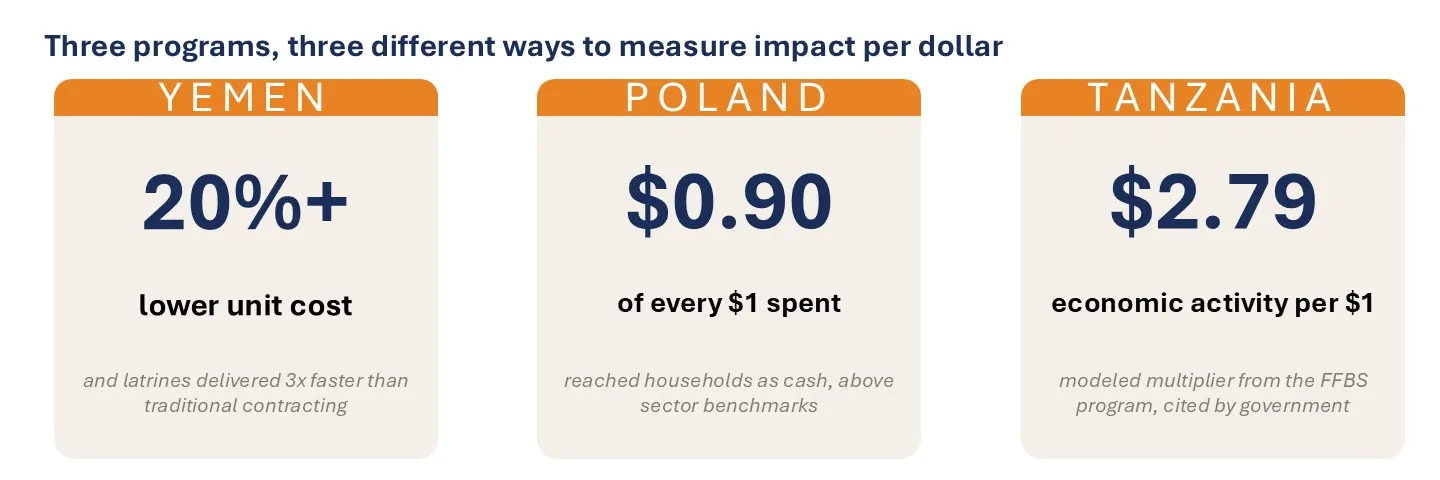
- Economic Return: The multiplier effect. In regions like Tanzania, our analysis indicates that for every $1 spent, the local economy generates $2.79 in associated activity.
Case Studies: Data-Driven Decision Making
Numbers only hold value if they lead to action. We have seen this manifest in three distinct ways across our global operations:
1. Delivery: Yemen’s WASH Initiative
In Yemen, our Water, Sanitation, and Hygiene (WASH) team faced a pivotal choice: contract out latrine construction or implement a cash-for-work model. By running the numbers, the team identified that the cash-for-work approach was not only 20% cheaper but also three times faster. The data allowed the team to pivot instantly, proving that rigorous cost analysis can save lives by accelerating delivery.
2. Design: The AI Proposal Assistant
Before a project even reaches the field, it must survive the design phase. We have deployed an AI-powered assistant that scans new proposals against our global benchmarking data. This tool forces teams to justify their budgets. If a proposal is an outlier in cost-per-beneficiary, the team is prompted to redesign the approach. To date, 18 major proposals have been refined using this tool, ensuring that the "weakest" economic cases are corrected before they ever reach a donor.
3. Validation: Poland and Nigeria
Sometimes, data confirms that the current strategy is the gold standard. In Poland, our cash transfer program for Ukrainian families delivered 90 cents of every dollar directly to households, outperforming the Dioptra benchmark of 88 cents. Similarly, in Nigeria, we found that local NGOs—when funded at appropriate scale—achieved efficiency levels identical to their international counterparts. This provides empirical weight to the argument for shifting resources to local partners.
Official Responses and Strategic Implications
The implications for the sector are profound. By targeting a 30% reduction in unit costs across mature programs, we anticipate that every dollar will produce 43% more output. For the entire CARE portfolio, this represents over $12 million in annual savings that can be reinvested into reaching more people.
When we present these figures to our partners, the reception has been transformative. We are no longer asking for faith; we are providing a roadmap.
"We are moving toward a culture of ‘routine, not artisanal’ economics," says the leadership team at the EEU. "We want the cost-effectiveness of our programs to be as predictable and reliable as the impact they deliver."
The Future of Donor Engagement
As we look toward 2027, we invite our partners and donors to hold us to a new set of standards. When you evaluate a partnership with CARE, we encourage you to ask:
- "What is the scaling pathway for this model?"
- "How does this unit cost compare to the sector benchmark?"
- "What happens to the beneficiaries when this grant ends?"
Conclusion: The Path Forward
The "10K Rule" and our commitment to end-to-end analytics are not just about balance sheets. They are about the moral imperative to do more with less. In a world where the need for humanitarian aid is outpacing the supply, efficiency is the most powerful tool we have to protect the dignity of the people we serve.
By institutionalizing this economic discipline, CARE is ensuring that we are not just providing temporary relief, but building sustainable, scalable systems that can endure long after our presence concludes. We are proving that the most compassionate thing we can do is to be as smart with our dollars as we are dedicated to our mission.
The next dollar we spend will buy more than the last—and that is the only metric that truly matters.



 Layla Zulfa






