

 Evan Lee Salim
Every day across the United States, the final bell rings, students rush to the buses, and behind them, the school cafeteria tells a staggering story. Across the nation’s K-12 landscape, an estimated 530,000 tons of food—up to 40 percent of all food served—is discarded annually. This mountain of waste is not merely a logistical failure; it is an environmental catastrophe. According to a new report from the World Wildlife Fund (WWF), the decomposition of this food in landfills contributes roughly 1.9 million metric tons of greenhouse gas emissions each year.
Yet, amidst the grim statistics, a quiet revolution is taking root in Gwinnett County, Georgia. At Lovin Elementary, a dedicated team of educators and students has transformed the cafeteria from a site of environmental negligence into a thriving, interdisciplinary laboratory. Through a combination of rigorous data collection, student-led innovation, and community partnerships, the school has slashed its food waste by 70 percent, proving that the solution to a global problem might just start in the lunch line.
The Magnitude of the Problem
The scale of food waste in schools is tied to a complex web of challenges: tight district budgets, stringent nutritional requirements, labor shortages, and the notoriously fickle palates of children. Often, unopened milk cartons, sealed bags of baby carrots, and pristine whole fruits are tossed into trash bins alongside half-eaten entrees.
For years, this was the status quo at Lovin Elementary. “Before we tackled this, kids were throwing away vast amounts of unopened food,” says Gerin Hennebaul, a STEM content specialist at the school. "We were looking at mountains of potential nutrition going straight to the landfill."
The WWF’s "Ending Food Waste in K-12 Schools" initiative recognizes that schools are uniquely positioned to address this. By integrating food waste reduction into the school culture, educators can foster a generation of "Food Waste Warriors"—students who view consumption through the lens of sustainability rather than convenience.
A Chronology of Change: The Lovin Elementary Model
The transformation at Lovin Elementary did not happen overnight; it was the result of a deliberate, multi-year strategy rooted in the scientific method.
2018: The Baseline Audit
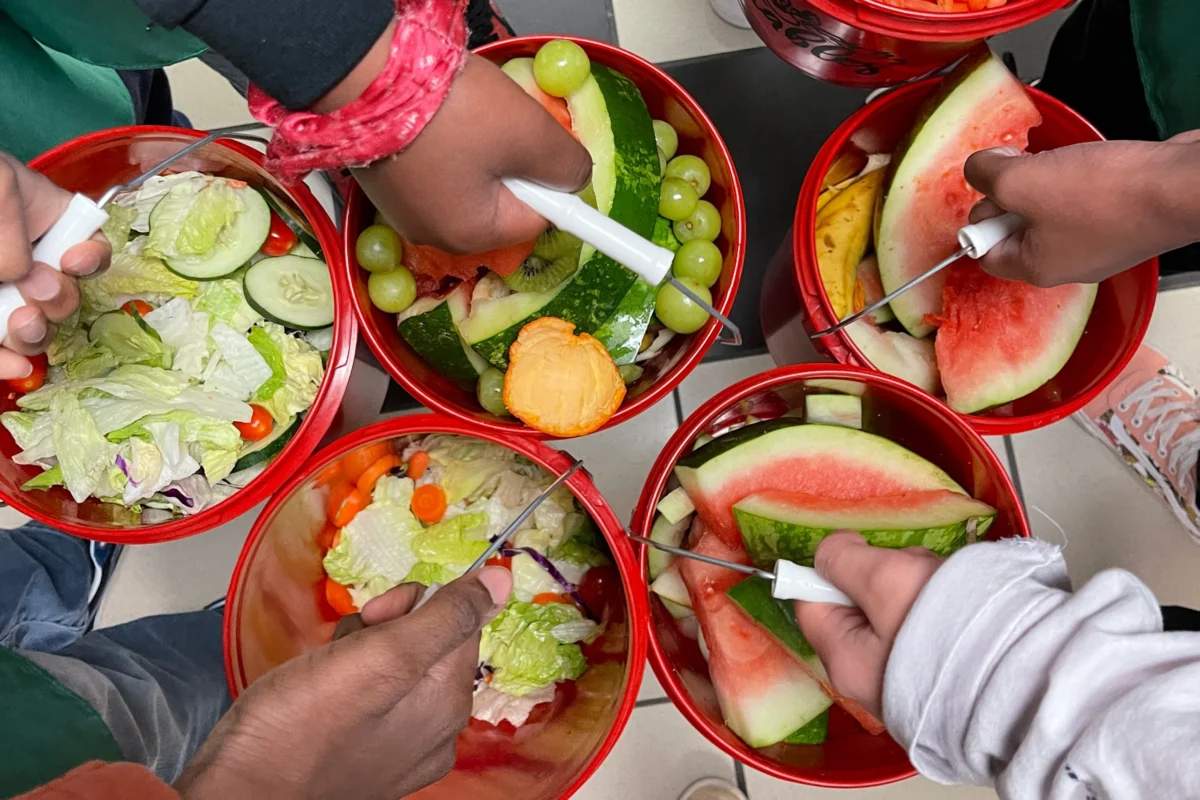
In late 2018, the school partnered with the nonprofit Green & Healthy Schools to conduct its first "food audit." The goal was simple: quantify the problem. Students and staff lined up at the cafeteria exit, manually sorting waste into buckets. The results were jarring. On a single "Taco Day," the school collected 589 pounds of waste. Of that, 120 pounds were "recoverables"—perfectly edible, sealed items. The visual impact of these numbers was the catalyst for change.
2019: Implementing Student-Led Solutions
Armed with the audit data, students began brainstorming. Their first, most immediate solution was the "share table"—a designated station where students can leave unopened, unexpired food for their peers to take if they are still hungry. They also initiated a program to divert salad bar scraps to the school’s garden chickens. By March 2019, the school had already reduced lunch waste to 435 pounds, with 108 pounds redirected to the share table.
2021–2022: Scaling Up to Composting
In the fall of 2021, a grant from the Food Well Alliance allowed the school to construct a dedicated composting bin. Initially, the process was experimental, but as the students mastered the science, it became a cornerstone of the curriculum. By the 2023–2024 academic year, the program had matured into a well-oiled machine, collecting over 5,400 pounds of food waste annually. When the school’s internal capacity was reached, they partnered with a neighboring church to process the excess in the church’s community garden.
Supporting Data: Cafeterias as Classrooms
The success at Lovin Elementary relies on a strategy Hennebaul calls "cafeterias as classrooms." By folding waste management into the standard curriculum, the school ensures that environmental stewardship is not an extracurricular activity, but a core competency.
- Mathematical Literacy: Fourth-grade students rotate roles to manage the waste-weighing station. They use the data to practice decimal addition and graphing, turning lunch waste into a tangible math problem.
- Scientific Inquiry: Students track the temperature of compost bins, learning about biological decomposition and thermodynamics.
- Communication Skills: Third-graders serve as "mentors" to younger students, creating original songs, skits, and PowerPoint presentations to explain the importance of composting and waste reduction.
- Technological Integration: The school recently piloted "Raccoon Eyes AI," a system developed by a Georgia Tech student that uses image recognition to analyze tray waste. While currently in transition, the data provided insights into student preferences—such as realizing that a specific roll was rejected because it lacked a favored garlic sauce, allowing the school to adjust menus to increase consumption and reduce waste.
Official Perspectives and Operational Barriers
While the model at Lovin Elementary is highly successful, it is not without its hurdles. Hennebaul notes that the primary barrier for many schools is administrative bandwidth. Her role as a "fully released" teacher—someone without a standard homeroom—is a luxury that many districts cannot afford.
"When the cafeteria manager, the head custodian, and the administrative team are all on board, that is when the magic happens," Hennebaul explains. "But consistency requires someone to oversee the share tables, monitor the compost, and maintain the data. Without that support, programs often struggle to survive the first year."
Furthermore, schools are often beholden to rigid district-wide vendor contracts. While Lovin Elementary has the flexibility to add a sauce to a meal to increase palatability, they cannot simply choose to switch to a different, less-wasted brand of chicken nuggets. The systemic changes needed to fully eliminate waste require the cooperation of district procurement offices and state-level food service policies.
Implications for the Future
The implications of the Lovin Elementary experience are profound. If one school can divert thousands of pounds of food from a landfill, the cumulative impact of thousands of schools doing the same could be transformative.
The environmental benefits are twofold: first, the direct reduction of methane emissions from rotting food; second, the creation of nutrient-rich compost that regenerates local soil. Beyond the planet, there is an educational dividend. Students who learn to value food as a resource—rather than a disposable commodity—are likely to carry those values into adulthood, influencing household behaviors and future public policy.
As the WWF report emphasizes, the K-12 sector is an untapped frontier in the fight against climate change. The roadmap is clear:
- Audit: Measure the waste to understand the reality.
- Engage: Let students lead the problem-solving process.
- Connect: Align waste reduction with existing educational standards.
- Partner: Leverage local community assets, such as churches or master gardeners.
The "Lovin model" proves that food waste is not an inevitable byproduct of feeding children. With data-driven strategies and a commitment to student empowerment, schools can turn their cafeterias into the most important classrooms in the building. As Hennebaul notes, the key is to "start by collecting data, and go slow." The results, as evidenced by the 70 percent reduction in waste, are more than worth the effort.

 Laily UPN
 Nila Kartika Wati






