


 Ali Ikhwan
By Ansam Al-Kitaa
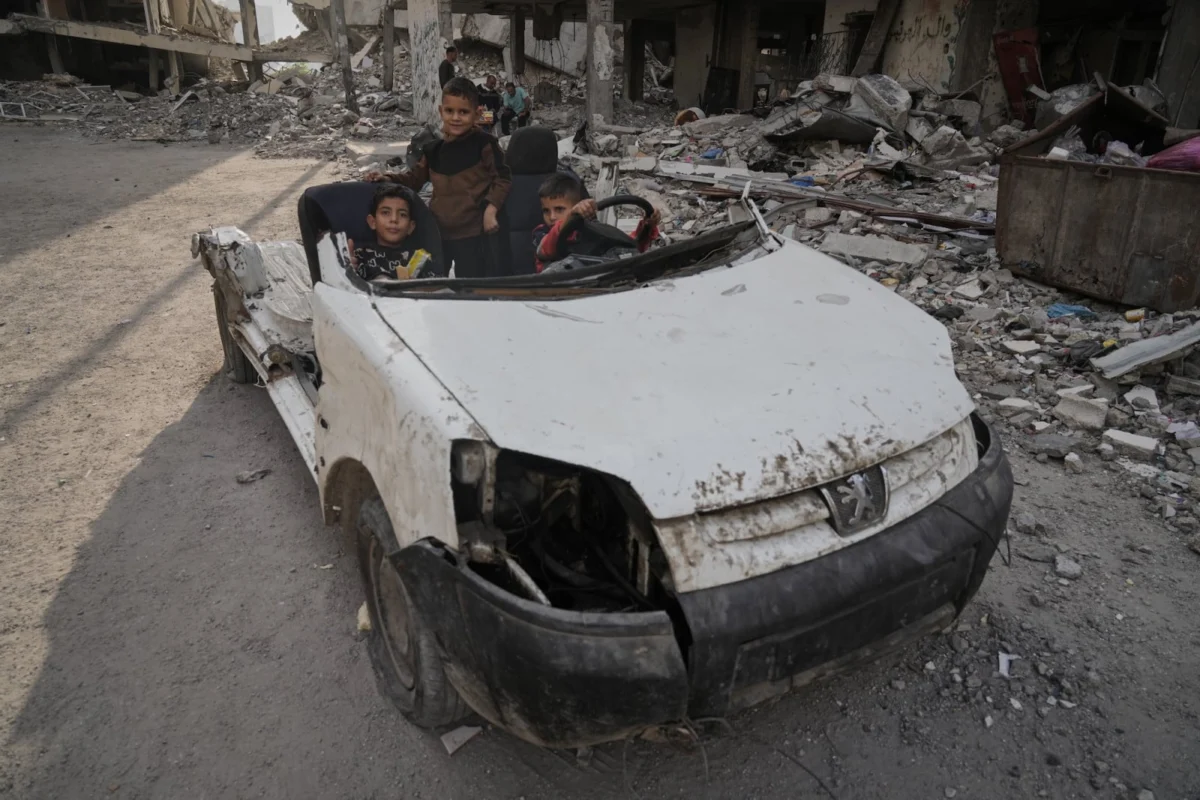
For the residents of Gaza City, the act of moving from one neighborhood to another has transformed from a mundane daily chore into a harrowing exercise in endurance. As the war stretches into its third year, the infrastructure that once defined urban life has been largely erased, replaced by a terrain of craters, twisted metal, and shifting mountains of debris. Yet, amidst this landscape of total structural collapse, a small, stubborn institution persists: the Al Shati Driving School. With only four functional vehicles remaining, its survival mirrors the wider struggle of a city that refuses to stop, even when its roads have been ground into dust.
The Vanishing City: A Personal Reckoning
I began taking driving lessons in the autumn of 2023, a time that now feels like a lifetime ago. Back then, my lessons were defined by the rhythm of an ordinary city. We moved through streets lined with shops, cafes, and trees. I navigated traffic, observed stop signs, and worried about the trivialities of parallel parking. I looked out the windshield at the Gaza skyline—the Palestine Tower, where I had worked for eight years, stood as a pillar of professional pride.
When the bombing campaign began, those lessons came to an abrupt, violent halt. The tower was leveled, and with it, the professional identity I had spent nearly a decade cultivating. Walking down Al-Shuhada Street became impossible, not just physically, but emotionally. I was terrified to confront the reality of the ruin. Every time I compare old photos of my city to the jagged, colorless horizon of today, the nostalgia is replaced by a fresh, visceral grief. The geography of my childhood has been overwritten by the geography of war.
Chronology of Collapse: From Traffic to Rubble
The degradation of Gaza’s mobility did not happen overnight, but it has been relentless. In the first months of the war, the primary obstacles were immediate: unexploded ordnance, active shelling, and the displacement of entire neighborhoods. As the conflict persisted, the damage became systemic.
- Late 2023: Driving schools cease operations as the city descends into a humanitarian emergency.
- 2024: Satellite analysis from the UN confirms that 65% of Gaza’s road network has sustained significant damage.
- 2025: The "scorched earth" impact on infrastructure reaches its zenith; the World Bank and UN estimate that nearly 87% of all roads in the Gaza Strip are now impassable.
- 2026: A new, precarious "normal" emerges. With the destruction of major arteries like the Salah al-Din Road, residents turn to makeshift paths, animal-drawn carts, and recycled vehicles to navigate the remains of their home.
Supporting Data: The Anatomy of a Broken Infrastructure
The numbers tell a story of total systemic failure. According to recent assessments conducted by the World Bank, the European Union, and the United Nations, the scale of infrastructure damage is unprecedented. In northern Gaza and the Rafah region, nine out of every ten roads are effectively closed to standard vehicular traffic. The Gaza City Municipality reports that over 500 miles of paved streets have been pulverized into dirt and gravel.
For those attempting to keep a vehicle running, the economic barrier is insurmountable. A car that might have been valued at $10,000 before the war now commands upwards of $40,000, if one can be found at all. Fuel is a luxury, and spare parts are practically non-existent. A single tire—an essential commodity for traversing the jagged, rubble-strewn streets—now costs roughly $1,500. This is the financial reality that makes the continued operation of the Al Shati Driving School not just a commercial endeavor, but a feat of extreme mechanical improvisation.
Official Responses and Humanitarian Efforts
The international community has begun to acknowledge that the reconstruction of Gaza requires more than just money; it requires a radical reimagining of how the city moves. The United Nations has established two primary rubble recycling centers, aiming to transform the millions of tons of debris into construction material. A feasibility study is currently evaluating the potential to reclaim coastal land using the estimated 57 million tons of war-torn masonry.
Simultaneously, the organization "Architects for Gaza" is collaborating with the local municipality to create community-led reconstruction proposals. These projects, such as the proposed redevelopment of the Yarmouk Cultural Complex, represent a shift toward grassroots planning. However, these efforts remain in their infancy, hindered by the lack of secure access to building materials and the ongoing security volatility.

The Driving School: A Microcosm of Resilience
When I returned to the Al Shati Driving School earlier this year, the experience was jarring. My instructor, Karam, is a man defined by a constant, low-level anxiety. Every pothole is a threat; every stretch of uneven, debris-filled asphalt is a potential death knell for our tires.
"We are surviving the same way the city is," the school’s director, Ihab Shaheen, told me. "By salvaging, improvising, and refusing to stop."
The school’s fleet was once a symbol of normalcy, boasting ten training cars. Today, only four remain. Three were destroyed by direct bombing, and the rest suffer from a lack of proper maintenance. When a car inevitably breaks down—a near-daily occurrence—the team doesn’t discard it. They dismantle it. Spare parts are harvested from "dead" vehicles to keep the "living" ones mobile. They have even resorted to using burnt or recycled motor oil, fully aware that it shortens the engine’s lifespan, because there is simply no other way to operate.
Implications: The Psychology of Mobility
The psychological shift in how we view "driving" is perhaps the most profound change. Before the war, driving was about freedom, commerce, and connection. Today, the roads are no longer arteries of the economy; they are lines of desperation. They are filled with people waiting in queues for water, food, or fuel. Children, who once carried backpacks to school, now carry heavy plastic containers of water, their childhoods sacrificed to the demands of survival.
My instructor’s manual still shows illustrations of orderly, tree-lined streets and people commuting in suits. It is a relic of a vanished civilization. When I sit behind the wheel, I am navigating a graveyard of landmarks. The street signs are gone, the traffic signals are dark, and the rules of the road are dictated by where the rubble is least dense.
Conclusion: Driving into the Unknown
There is a strange, melancholy hope in watching a car move through a city that has been systematically dismantled. It is a defiant act. In the absence of a functioning government, a formal economy, or safe infrastructure, the people of Gaza have become masters of the workaround. They build their own tuk-tuks, they convert vehicles to run on cooking oil, and they clear the streets by hand, one stone at a time.
As I drive through the unrecognizable remains of my neighborhood, I realize that I am not just learning how to operate a vehicle. I am participating in a collective act of preservation. Nobody is checking for my driver’s license anymore—there are no police, no licensing bureaus, and no traffic laws left to enforce. The roads barely exist, and the destination is often just as uncertain as the path itself. Yet, I keep driving. In Gaza, the refusal to stop moving is perhaps the only form of protest we have left.
As we look toward an uncertain future, the lessons learned at Al Shati are no longer about traffic safety. They are lessons in how to navigate the ruins, how to scavenge for parts of a future, and how to keep moving forward, even when the road beneath you has been erased.

 Neng Nana
 Ammar Sabilarrohman






