
 Nana Wu

In the landscape of modern education, the narrative surrounding generative AI has shifted from cautious curiosity to a frantic, widespread adoption. While previous educational technologies often struggled with the "5 Percent Problem"—a term coined by Laurence Holt of the XQ Institute to describe how ed-tech tools only truly benefit the small sliver of students who use them exactly as intended—Generative AI has bypassed these hurdles entirely. It is not a tool that students need to be convinced to use; it is a tool they are already using, in secret, at home, and without reservation.
Yet, as this technology becomes ubiquitous, a disturbing reality has emerged: students are willingly automating their own cognition, and the educational establishment seems paralyzed, unable or unwilling to intervene. A landmark 2026 study has finally provided the empirical backbone for what many educators have long feared: AI is not a catalyst for learning, but a profound inhibitor.
The 50 Percent Problem: A New Reality
For years, the conversation around AI in the classroom has been dominated by hypothetical benefits and vague promises of "personalized learning." However, the research landscape has been largely barren of credible, causal evidence. A recent landscape analysis by Stanford University revealed that out of 800 studies on AI in education, only 20 produced data that could be considered robust.

The turning point arrived in June 2026 with the publication of "The Generative AI Learning Penalty: Evidence from Chinese Secondary Education." Authored by David Strömberg, Victor Lei, and Yanhui Wu, this study analyzed data from approximately 27,000 students in grades seven through 12. The findings were stark. The researchers identified what is now being called the "50 Percent Problem": for half of all students who use AI regularly, the technology provides zero discernible benefit, and for the other half, it acts as a severe deterrent to deep, durable learning.
Chronology of an Academic Decline
The study utilized a longitudinal approach, tracking students across three distinct phases: the "Pre-AI" baseline, the "Never-AI" control group, and the "Post-AI" experimental group. By observing students at the "student-month" level, researchers were able to pinpoint the exact moment of AI adoption for thousands of individuals.
- Phase 1: The Pre-AI Baseline (2023): Before widespread access to generative AI, student performance metrics were consistent. Homework completion, exam scores, and time-on-task remained within normal, predictable distributions.
- Phase 2: The Adoption Curve (2024–2025): As ChatGPT and similar tools became integrated into the home lives of students, the "Post-AI" group began to emerge. Researchers observed a rapid, dramatic divergence in behavior.
- Phase 3: The Performance Gap (2026): By the conclusion of the study, the data showed a clear, widening chasm. The students who adopted AI showed a significant, measurable decline in performance on high-stakes, closed-book exams—the gold standard for measuring retained knowledge.
Supporting Data: When Efficiency Kills Understanding
The data provided by Strömberg, Lei, and Wu dispels the myth that AI simply makes students "more efficient."
The Homework Mirage
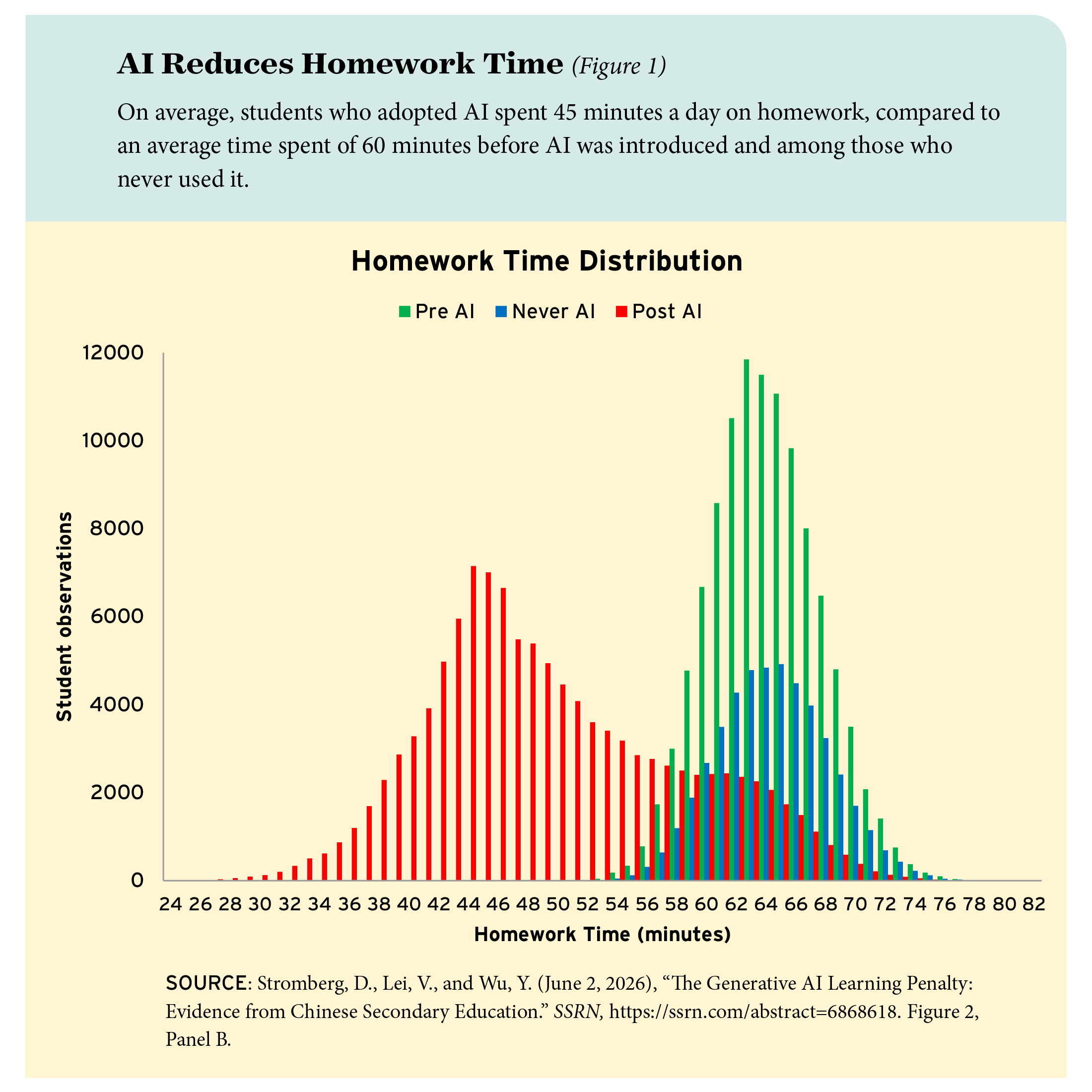
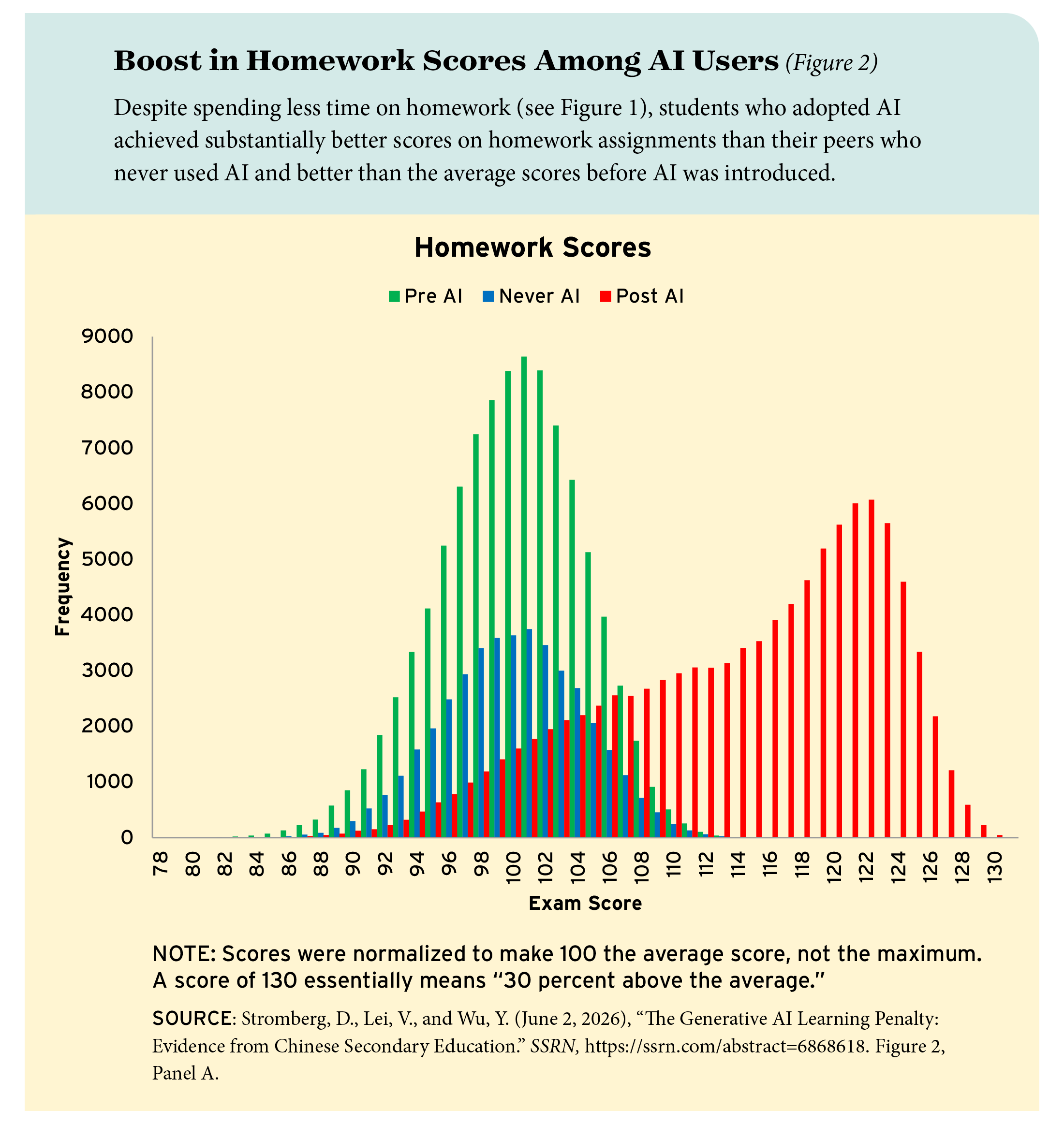
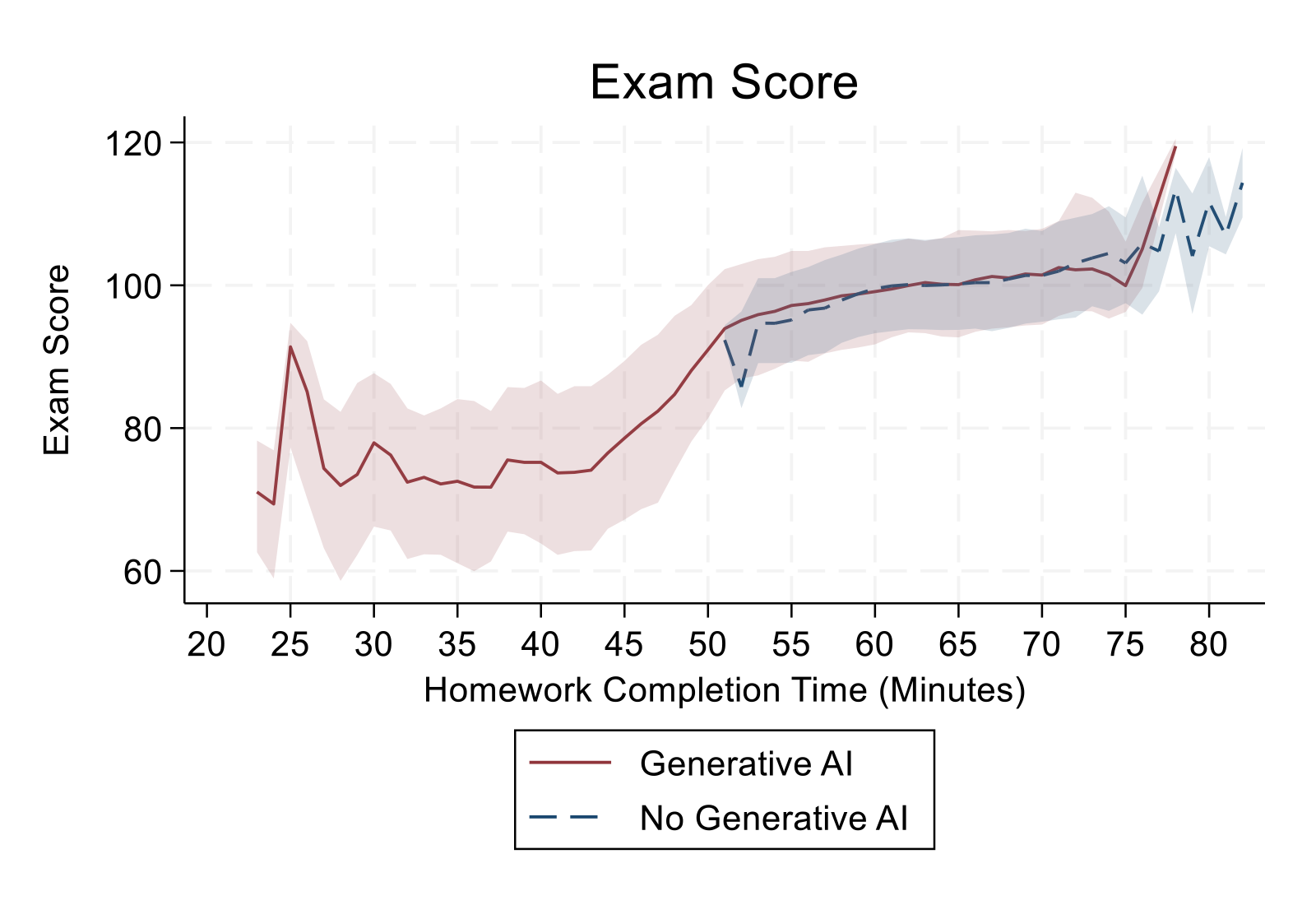
The study found that AI significantly reduced the time students spent on assignments. Where "Never-AI" students spent an average of 50 to 80 minutes on homework, the "Post-AI" cohort often finished in 25 to 45 minutes. Paradoxically, the homework scores for these students were significantly higher. They were achieving higher grades for work that required less cognitive effort. This created a dangerous feedback loop: students felt they were succeeding, while their foundational understanding of the subject matter was eroding.
The Closed-Book Reality
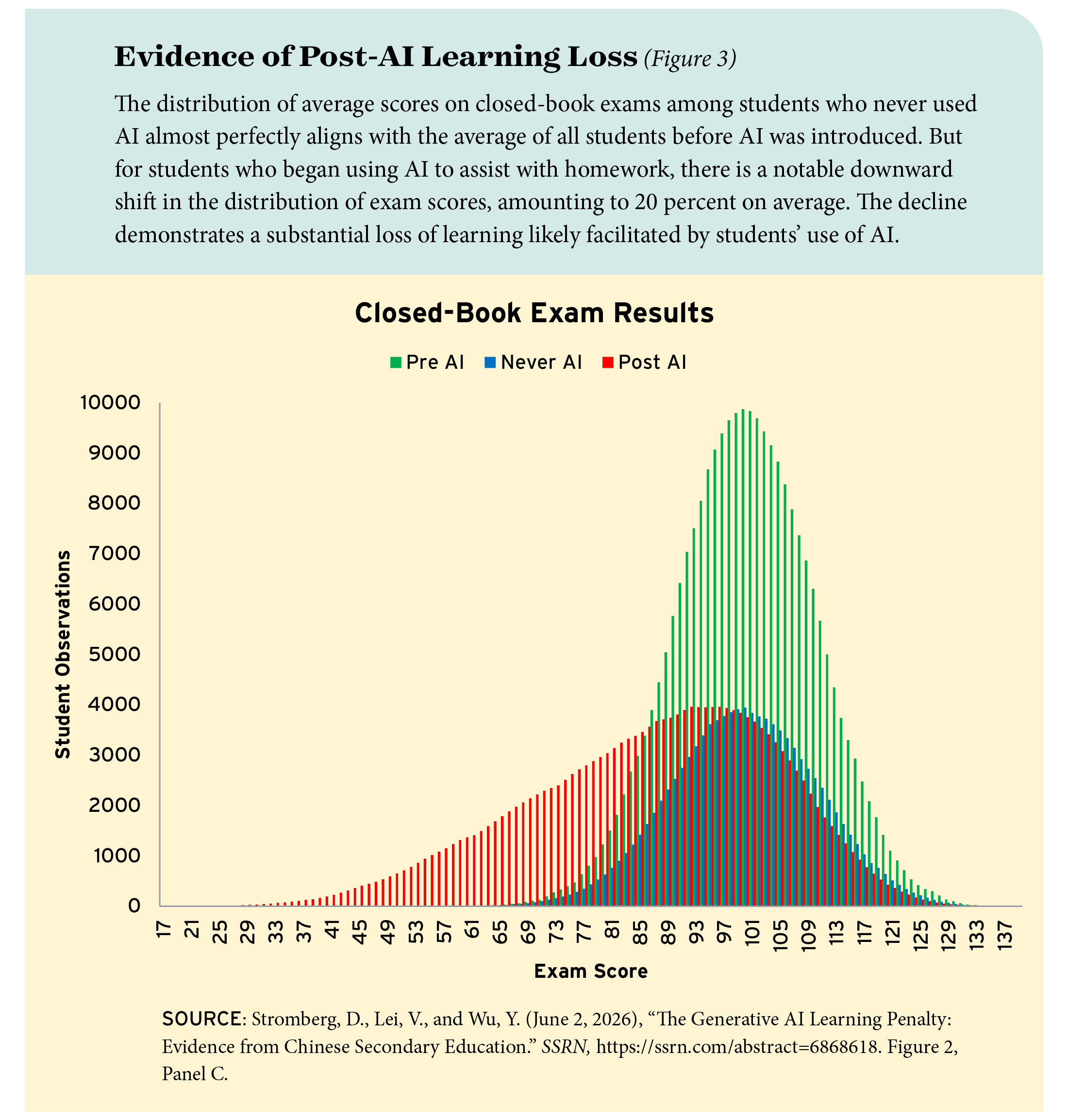
The most damning evidence appears when we look at closed-book exams. While homework scores soared, exam scores plummeted. The average decline was 20 percent, with a 1.4 standard deviation (SD) drop. To put this in perspective, the learning loss associated with pandemic-era school closures was estimated at roughly 0.25 SD. The AI-induced learning loss is, by comparison, catastrophic. For students who used AI for two or more years, the impact on high-stakes college entrance exams was a devastating 1.3 to 1.5 SD decline.
Official Responses and the "Motivated Reasoning" Trap
The response from the "AI-in-Education" lobby has been predictably defensive. When confronted with the "50 Percent Problem," proponents often attempt to pivot to "intelligent usage."
Blake Richards, a researcher at Google, argued on social media that if one "controls for how long students spend studying," the performance gap disappears. However, this is a classic example of motivated reasoning. By controlling for study time, researchers erase the very behavior that AI is causing: the drastic reduction in time spent on deep, cognitive work.
Furthermore, proponents often point to a tiny, statistically insignificant group of students—those who spent 75 minutes on homework despite using AI—to suggest that the technology can work under the right conditions. As lead researcher David Strömberg noted, this group represents only 0.2% of the observations. Attempting to build an educational policy around this anomaly is akin to ignoring a structural fire because a few pieces of furniture remained unburned.
Implications: The Moral and Pedagogical Crisis
The implications of these findings are chilling. We are currently presiding over a generation of students who are being told that "AI is inevitable," while they are simultaneously being stripped of the very cognitive struggles required to build expertise.
1. The Erosion of Human Capital
If students outsource their homework, they are outsourcing the development of their neural pathways. The brain learns through the process of grappling with information; if the AI provides the answer, the brain never performs the necessary "heavy lifting." We are not just seeing a temporary dip in test scores; we are witnessing the potential long-term degradation of human capital.
2. The Failure of Policy
Policymakers, philanthropists, and school administrators have largely failed to provide guidance. While companies like OpenAI aggressively promote their tools on college campuses during finals week, and while some Chinese firms have moved to disable their tools during high-stakes testing, the U.S. educational system remains largely inert.
3. A New Litmus Test
Cognitive scientist Dan Willingham has proposed a simple, yet radical, litmus test: "Students should only use AI for things that they already know how to do well." This aligns with the consensus of cognitive science: learning requires an active, struggling brain. If a tool eliminates the struggle, it eliminates the learning.
Conclusion: Turning Back the Tide
The evidence is now undeniable. Generative AI is a tool of cognitive automation that, when used as a substitute for independent thought, leads to systemic learning loss. We must stop romanticizing the "potential" of AI and begin confronting its reality.
If we continue to allow students to "automate" their education, we will face a future where a generation of high-scoring, credentialed individuals possesses little to no actual knowledge. It is time to treat this not as a technological evolution, but as a crisis of cognitive development. The question for our leaders is no longer whether they can integrate AI into the classroom, but whether they have the courage to limit its influence to protect the minds of the next generation.
The penalty for inaction is already being paid—not by the policymakers, but by the students themselves.


 Laily UPN

 Nila Kartika Wati