


 Jia Lissa
In the rapidly evolving landscape of modern journalism, the traditional morning newspaper and the evening television broadcast are increasingly being supplanted by the rapid-fire feeds of social media platforms. According to a landmark study conducted by the Pew Research Center as part of the Pew-Knight Initiative, a clear majority of American adults—58%—now identify social media as an important conduit for their news consumption. This figure marks a significant shift from previous years, signaling a fundamental transformation in how citizens engage with current events, verify information, and form their civic identities.
The study, which surveyed 3,488 U.S. adults between June 22 and June 28, 2026, reveals that social media is no longer merely a secondary or recreational tool. For 13% of the population, it has become the single most important source of news, a substantial increase from just 5% in 2022. This migration of the American public toward algorithm-driven feeds reflects a broader decentralization of the news industry, where the gatekeepers of the past have been replaced by the dynamic, often unpredictable, currents of digital discourse.
The Evolution of Information Consumption: A Chronology
To understand the current state of media consumption, one must examine the rapid trajectory of digital adoption over the last decade. Historically, the news environment was defined by institutional authority. Whether through the wire services, broadcast networks, or local newspapers, information was curated by professional editors and journalists.
The Rise of the Social Feed (2010–2020)
During the early 2010s, social media began its ascent from a social networking tool to a primary distribution channel for news organizations. Platforms like Facebook and Twitter (now X) allowed news to travel at the speed of virality. During this period, consumers began to experience a "push" model of news—where stories found the reader rather than the reader seeking out specific publications.
The Shift Toward Algorithmic Curation (2020–2024)
The onset of the global pandemic and the subsequent political volatility in the United States accelerated the reliance on digital platforms. As Americans sought real-time updates on health mandates and social movements, the convenience of the scroll became indispensable. During this time, the rise of TikTok and Instagram as news aggregators began to challenge the dominance of traditional text-based platforms. By 2022, Pew data showed that while 43% of Americans saw social media as an important news source, a majority (56%) still viewed it as non-essential to their daily information intake.

The New Reality (2025–2026)
The 2026 data represents a tipping point. With 58% of the public now relying on these platforms, the "social-first" model has solidified. The growth in the "most important" category—tripling in just four years—suggests that for a substantial minority, the traditional news website or television channel is becoming a legacy habit, reserved for secondary verification rather than initial discovery.
Data Analysis: Who is Driving the Change?
The demographic breakdown of the 2026 survey provides critical insight into the generational divide currently shaping the American media landscape. The divide is not just about technology; it is about the fundamental definition of what constitutes a "trusted" or "important" news source.
Generational Disparities
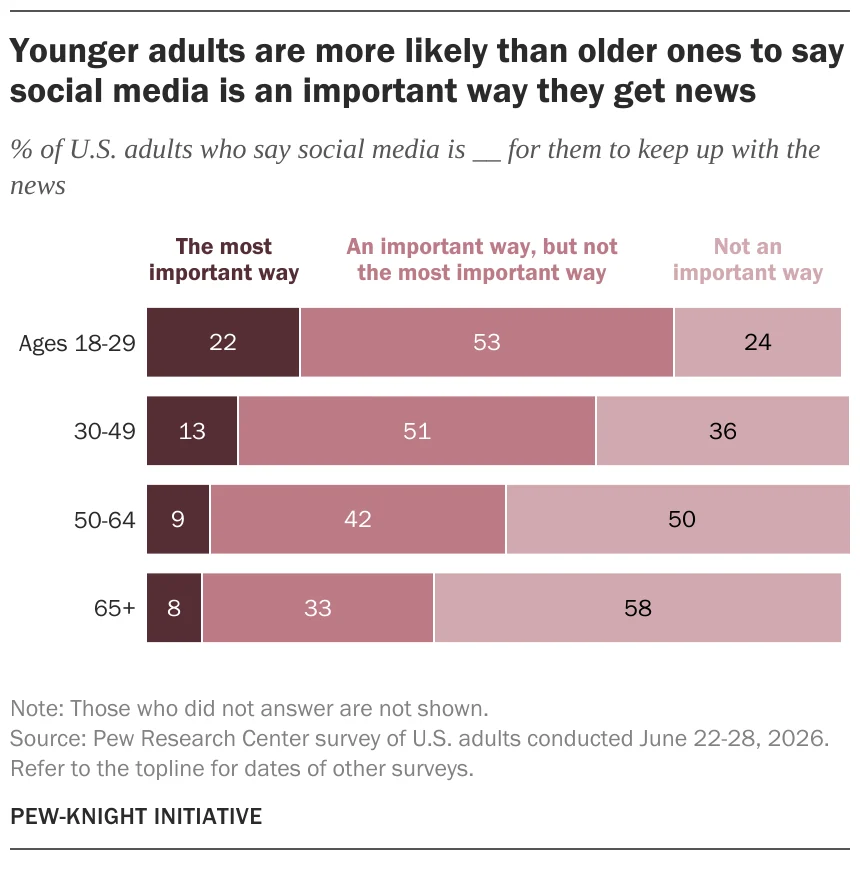
The most striking finding from the Pew-Knight study is the dominance of younger demographics in the social media ecosystem. Among adults aged 18 to 29, a staggering 76% identify social media as an important way they keep up with the news. Even more telling is that 22% of this cohort consider it their primary source of information.
Conversely, the data for older Americans paints a different picture. For those aged 65 and older, only 41% consider social media an important news source. This demographic still relies heavily on legacy media—television and print—which often maintain a more traditional editorial standard. The gap between these two groups suggests that the "news environment" in the United States is effectively split into two distinct realities, operating on different timelines and with different verification standards.
The Trust Factor
Trust in information remains a complex variable. While young adults are the most frequent users of social media for news, they are also navigating an environment rife with misinformation and algorithmic bias. The study notes that about half of adults under age 30 report having at least "some trust" in the information they encounter on social media. This trust is often placed not in the platforms themselves, but in the influencers, content creators, or peer groups that aggregate the news within those apps.

The Role of the Pew-Knight Initiative
The data driving these insights is provided by the Pew-Knight Initiative, a collaborative research program funded by The Pew Charitable Trusts and the John S. and James L. Knight Foundation. The project was established to answer a pressing question: How do Americans absorb civic information in an age of infinite choice?
The initiative serves as a "fact tank," focusing on the nonpartisan, non-advocacy analysis of attitudes and trends. By examining not just "how often" people get their news, but "how important" they believe that news source is, researchers are gaining a deeper understanding of the psychological weight that digital platforms hold in the modern democratic process.
Implications for Democracy and Civic Engagement
The migration of the public square to private social media platforms carries profound implications for the health of American democracy. As traditional journalism organizations face declining revenues and smaller audiences, the role of the "independent content creator" has exploded. While this democratization of information allows for a wider array of voices, it also presents systemic challenges.
1. The Fragmentation of Reality
When news is delivered via personalized algorithms, the common set of facts that once bound the American public together becomes increasingly fragmented. If two citizens are receiving entirely different, algorithmically curated feeds, their understanding of a "national issue" may be based on completely different sets of information.
2. The Speed vs. Accuracy Trade-off
Social media is optimized for engagement, which favors speed, emotional resonance, and visual impact. Traditional journalism, by contrast, is optimized for accuracy, context, and long-form analysis. As the former becomes the dominant source for the majority of Americans, the incentive for high-quality, time-intensive investigative journalism diminishes, as it struggles to compete with the instant gratification of a 60-second video update.

3. Institutional Accountability
The decline of traditional news outlets as primary sources complicates the role of the "watchdog." When news is decentralized, it becomes harder to hold power to account. An investigative report that takes months to produce may struggle to gain traction against the algorithmic momentum of a viral, yet potentially inaccurate, social media post.
Conclusion: A New Era of Information
The transition documented by the Pew Research Center is not merely a technological upgrade; it is a cultural sea change. As we move further into the late 2020s, the importance of social media as a primary news source is likely to grow rather than wane. For policymakers, educators, and journalists, the challenge lies in adapting to this reality without sacrificing the core tenets of media literacy and civic accountability.
The 2026 data makes it clear: the megaphone is now in the hands of the audience, and the mobile phone has replaced the printing press as the primary lens through which the American public views the world. Whether this leads to a more informed or a more polarized citizenry remains the defining question of our time. As the Pew-Knight Initiative continues its research, the focus will undoubtedly shift toward how we can cultivate critical thinking and information hygiene in an era where the feed is always on, and the source is rarely static.
Note: For further information on the methodology of this study, including the full survey questionnaire and detailed response data, readers are encouraged to consult the official reports published by the Pew Research Center.


 Lina Hope

 Basiran