

 Rifan Muazin
For years, a pervasive narrative has dominated the British political and media landscape: that the UK’s commitment to achieving net-zero carbon emissions is the primary engine behind soaring household energy bills. From the halls of Westminster to the pages of national broadsheets, critics have argued that the transition to green energy has imposed an intolerable financial burden on families.
However, a comprehensive new analysis by the thinktank Nesta provides the most robust evidence yet to dismantle this claim. The findings reveal a starkly different reality: the overwhelming majority of the rise in UK electricity and gas bills since 2020 is directly attributable to the volatility of global wholesale gas markets, not climate policy.
The Core Finding: A Crisis of Fossil Fuel Reliance
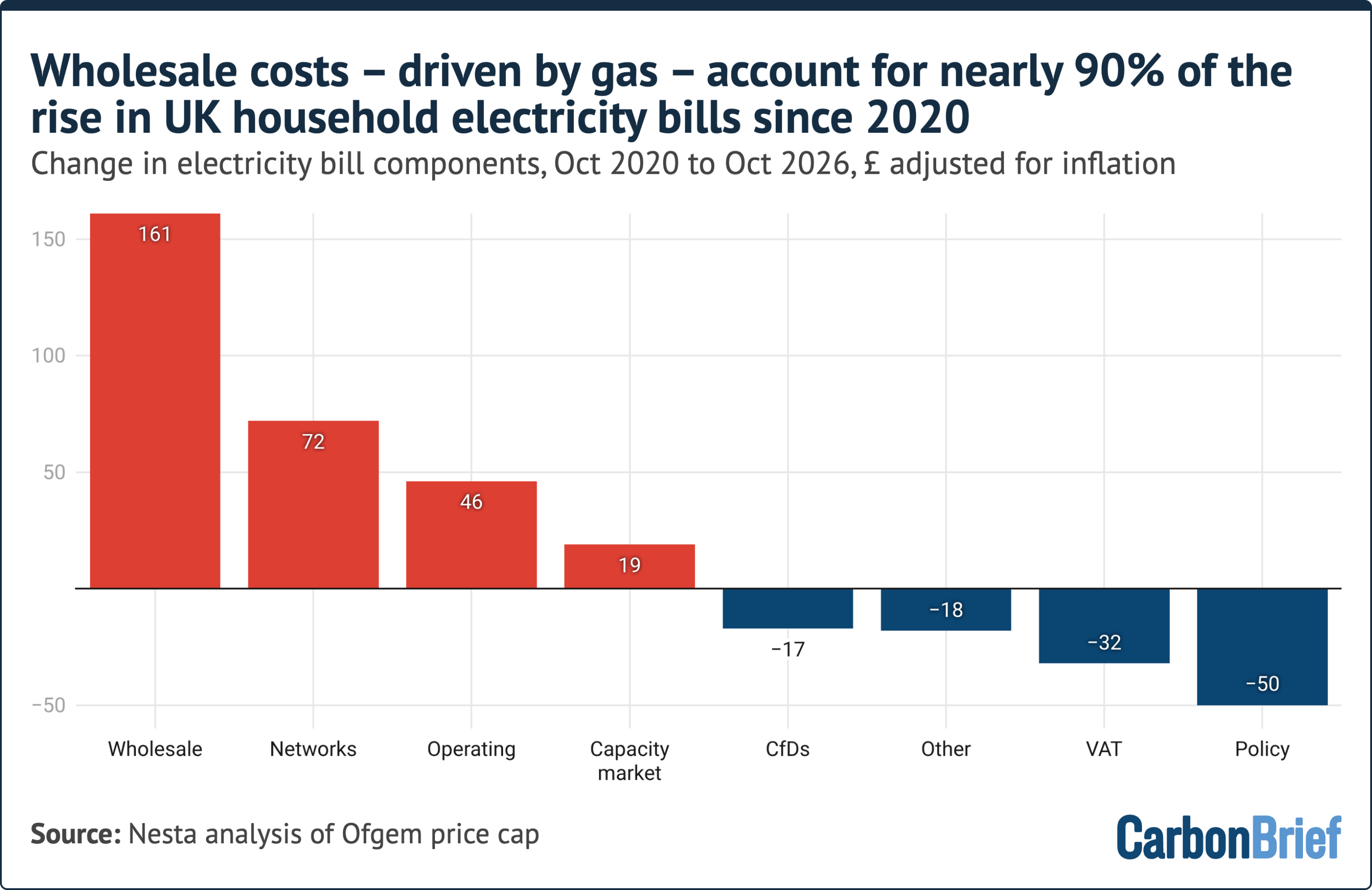
The analysis, shared with Carbon Brief, exposes the mathematical reality of the UK’s energy costs. Since 2020, wholesale gas costs have been responsible for nearly 90% of the increase in household electricity bills. Similarly, the surge in gas bills—which directly impact the vast majority of UK households—is driven by wholesale gas prices in 77% of cases.

These figures represent a definitive rebuttal to the rhetoric suggesting that the "cost of net-zero" is to blame for the current economic squeeze. In fact, experts argue that the opposite is true. Andrew Sissons, director for a sustainable future at Nesta, suggests that the net-zero transition is not a burden, but a defensive shield.
"Rising gas prices, not net-zero, have driven most of the recent surge in Britain’s energy bills," Sissons says. "Britain is particularly exposed, with over 80% of households connected to gas mains, while our electricity system still relies too much on gas as the marginal unit."
A Chronology of Volatility
The current crisis did not emerge in a vacuum. To understand the present, one must look at the trajectory of global energy markets over the past half-decade.
- Pre-2022: The UK energy market was already experiencing inflationary pressures as the world emerged from the pandemic, with gas prices beginning to climb.
- 2022: The Russian invasion of Ukraine sent shockwaves through global energy markets. Wholesale gas prices spiked to unprecedented levels, forcing the government to intervene with massive subsidies to prevent widespread fuel poverty.
- January 2026: Carbon Brief reported that two-thirds of the increase in electricity bills since the start of the 2022 energy crisis was directly linked to high gas prices.
- Late 2026: Conflict in the Middle East—specifically the Hormuz crisis—has exacerbated global instability, keeping wholesale gas prices at levels comparable to, or higher than, the 2022 peak. As of mid-October 2026, wholesale gas prices were hovering around 220p per therm (£75/MWh), eclipsing the 2022 average of 210p/therm (£72/MWh).
This chronology highlights that while domestic political debates focus on wind farms and carbon taxes, the real determinants of UK energy prices are geopolitical conflicts and the global price of methane-based fuel.
Supporting Data: Dissecting the Bill
To understand where the money goes, it is necessary to look at the composition of the average household dual-fuel bill. According to the Nesta analysis, a typical household’s annual bill has risen from £1,175 in October 2020 to £1,723 in October 2026—a 47% increase in real terms.
The Breakdown of the Increase
- Wholesale Gas Costs: This is the elephant in the room, accounting for £444 (81%) of the total increase in real terms.
- Network Costs: These have risen by £127, which includes £72 for electricity transmission and distribution—the "motorways" of the grid—and £55 for maintenance and investment in the gas network.
- Social and Policy Costs: Contrary to the common myth that "green levies" are the main culprit, the share of government social and climate policies on the average bill has actually fallen. In 2020, these costs made up 16% of a bill (£183); by October 2026, they had shrunk to just 7% (£114).
Furthermore, renewable energy is actively working to lower bills. Contracts for Difference (CfDs)—the government-backed schemes that support clean energy projects—are currently reducing electricity bills by £17 under the existing price cap.
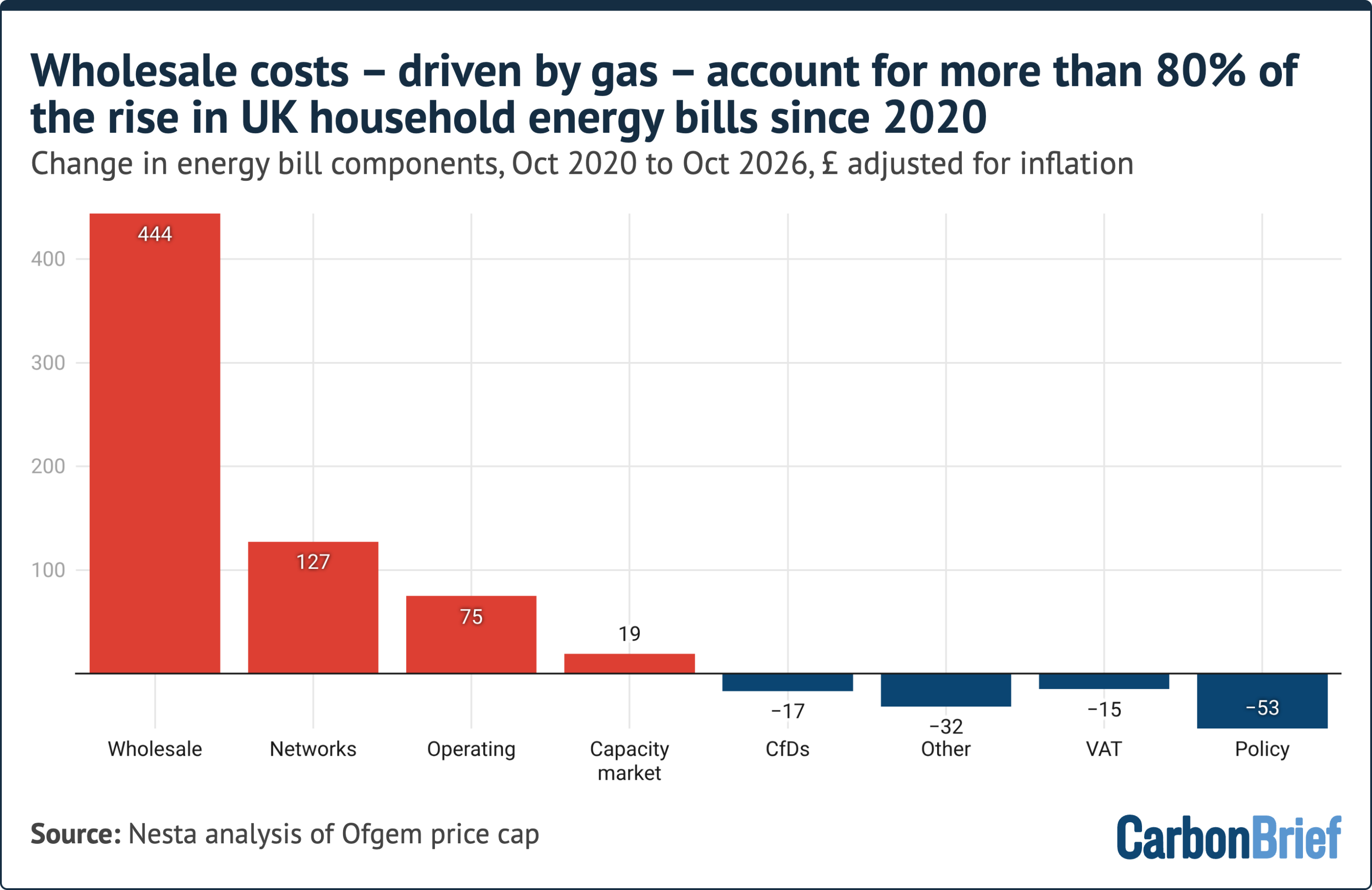
Regarding the "balancing" of the grid, which is often criticized in the media due to "constraint payments" made to wind farms when there is excess power, the data shows this is a minor issue. Balancing costs represent only £35—or 4%—of a typical £858 annual electricity bill. The narrative that wind power is "too expensive" because of these payments ignores the fact that gas plants are also paid to be available, and that overall, the shift to renewables is helping to insulate the UK from the extreme volatility of the gas market.
Official Responses and Political Implications
The UK government has faced intense pressure to address the cost-of-living crisis. While it recently approved the development of the Jackdaw gas field in the North Sea, ministers have acknowledged, albeit quietly, that such projects would not fundamentally alter global energy prices. The price of gas in the UK is set on the international market; increasing domestic supply does not change the reality that the UK remains a price-taker, not a price-setter.
The political discourse remains fraught. The opposition and certain media outlets continue to suggest that rolling back environmental targets would lower bills. However, this argument lacks a factual basis. As Sissons notes, "Upgrading the grid is not cost-neutral, but that price tag is dwarfed by the impact of rising gas prices. In fact, net-zero is helping to shelter Britain from the impact of expensive gas."

As the UK approaches the 28 October budget, the Chancellor is expected to announce further interventions to assist households. With predictions that the January 2027 price cap could rise by as much as a quarter, the government is in a race against time to decouple the cost of British energy from the volatility of the global gas market.
The Path Forward: Electrification as Protection
The findings from Nesta suggest a clear, if challenging, path forward. The primary solution to breaking the link between volatile global gas prices and household bills is further electrification.
By moving away from fossil-fuel-reliant heating (gas boilers) and transport (petrol/diesel cars) toward heat pumps and electric vehicles, the UK can reduce its dependence on the very commodity that is currently driving inflation. While this transition requires significant upfront investment in the electricity grid, the long-term benefit is a more resilient, localized energy system that is less susceptible to international shocks.
"By focusing on growing electricity demand, the government can spread upgrade costs more widely," Sissons explains. "This can lock in the consistent investment in electrification that is Britain’s best path to stop global turmoil showing up on winter energy bills."
Conclusion
The evidence is clear: the UK’s energy crisis is a fossil fuel crisis, not a net-zero crisis. For years, the political debate has been diverted by the convenient narrative that climate policy is the enemy of the household budget. However, as global instability continues to drive up the price of gas, it is becoming increasingly evident that the transition to clean energy is not the cause of the problem, but the primary solution.
As the UK looks toward the winter months and the next fiscal budget, the challenge for policymakers will be to resist the temptation of short-term, fossil-fuel-centric populism and instead lean into the structural changes required to achieve true energy independence. The data proves that while the road to net-zero requires investment, the cost of staying shackled to the global gas market is infinitely higher.


 Siti Muinah

 Nila Kartika Wati