

 Basiran
Introduction: A Ghostly Geography
The act of learning to drive is usually a rite of passage, a mundane milestone representing independence and the promise of a future. For Ansam Al-Kitaa, a journalist in Gaza City, those lessons—begun in the autumn of 2023—were meant to be a step toward a new chapter of personal mobility. Today, they represent something far more somber: a desperate attempt to maintain a vestige of normalcy in a landscape that has been systematically erased.
Al Shati Driving School, once a thriving enterprise, now operates with a fleet reduced from ten vehicles to just four. Its survival, much like the survival of Gaza City itself, is predicated on an endless cycle of salvaging, cannibalizing, and defying the odds. As the city’s infrastructure collapses under the weight of sustained bombardment, the simple act of turning an ignition key has become a profound statement of refusal—a declaration that life, however broken, must continue to move.
Main Facts: The Anatomy of a Decimated Infrastructure
The transformation of Gaza’s transit network is not merely a byproduct of war; it is a total inversion of urban functionality. Before the escalation of hostilities, Gaza’s roads were the veins through which the economy, education, and social life flowed. Today, those veins have been severed.
- The Fleet: Al Shati Driving School, like many local businesses, has seen its capital assets decimated. From ten training vehicles, only four remain operational, each requiring constant, costly, and ingenious maintenance.
- The Cost of Mobility: The economic landscape has shifted violently. A vehicle that might have cost $10,000 in early 2023 now commands prices as high as $40,000, if one can be found at all. Spare parts are virtually non-existent, and tires—vital for navigating the jagged, debris-strewn streets—now cost upwards of $1,500 each.
- The New Landscape: The roads themselves have changed. According to data from the World Bank, the European Union, and the United Nations, nearly 87% of Gaza’s roads are now either destroyed or impassable. In North Gaza and Rafah, that figure climbs to nine out of every ten roads. Over 500 miles of paved streets have been ground down into dirt, dust, and rubble.
Chronology: From Ordinary Traffic to Existential Survival
The arc of this story is etched in the memory of those who lived through the transition from a functioning city to a site of profound deprivation.
- Fall 2023: Lessons began at Al Shati. The experience was standard: navigating neighborhoods, observing traffic laws, and looking out the windshield at a city that felt permanent.
- Late 2023: The bombing campaign commenced. The Palestine Tower—the site of the author’s former workplace—was destroyed, serving as the first visceral symbol of the loss of institutional and personal history. Lessons stopped abruptly.
- 2024: A period of stasis and destruction. The UN’s satellite centre estimated 65% road damage during this period. The city’s rhythm shifted from the cadence of work and school to the desperate search for water and food.
- 2026 (The Present): Driving schools have tentatively resumed operations. The author returns to the wheel, only to find a city that is unrecognizable. The landmarks are gone; the streets are no longer thoroughfares but pathways through a vast, open-air site of reconstruction and survival.
Supporting Data: The Logistics of Ruin
The scale of destruction in Gaza is corroborated by international bodies that have mapped the collapse of the strip’s physical framework. The Gaza Strip Rapid Damage and Needs Assessment (2026) highlights the sheer scope of the crisis:
- Rubble and Debris: The massive volume of debris—estimated at over 57 million tons—has rendered traditional urban transit impossible. UN-led initiatives are now attempting to establish rubble recycling centers to reclaim land, but the physical reality remains a major impediment to any semblance of "traffic."
- Resource Scarcity: Fuel, oil, and spare parts are under a strict blockade or are simply unavailable. The necessity of using burnt or recycled motor oil—which accelerates engine decay—is a testament to the "improvise or die" mentality that defines current operations at Al Shati.
- The Human Element: The demographic of the road has shifted. Drivers no longer encounter school buses or commuters; they encounter lines of displaced persons, water-collection queues, and children carrying burdens of survival rather than backpacks.
Official Responses and Strategic Proposals
International and municipal authorities are currently grappling with the impossible task of managing a territory that has been stripped of its essential services.

- Architects for Gaza: This collective is working with the Gaza Municipality to develop community-led reconstruction proposals. These projects focus on specific, culturally significant sites, such as the Yarmouk Cultural Complex, hoping to rebuild the city from the "ground up" rather than waiting for top-down international intervention.
- UN Intervention: The United Nations has begun feasibility studies regarding the reclamation of coastal land using the massive amounts of recycled rubble. While this addresses the issue of waste, it does little to solve the immediate crisis of transportation.
- Informal Networks: In the absence of municipal services, the population has pivoted to informal transport. Horse-and-cart setups, makeshift tuk-tuks, and a reliance on bicycles have become the backbone of the "new" Gaza economy. This is not a choice, but a desperate adaptation to an environment where the internal combustion engine is becoming a luxury of the past.
Implications: The Psychology of Driving in a Graveyard
The implications of this situation go far beyond the technical challenges of running a driving school. It is a profound psychological burden to navigate a landscape that one once knew as a home, now reduced to a series of obstacles.
The Loss of the "Future"
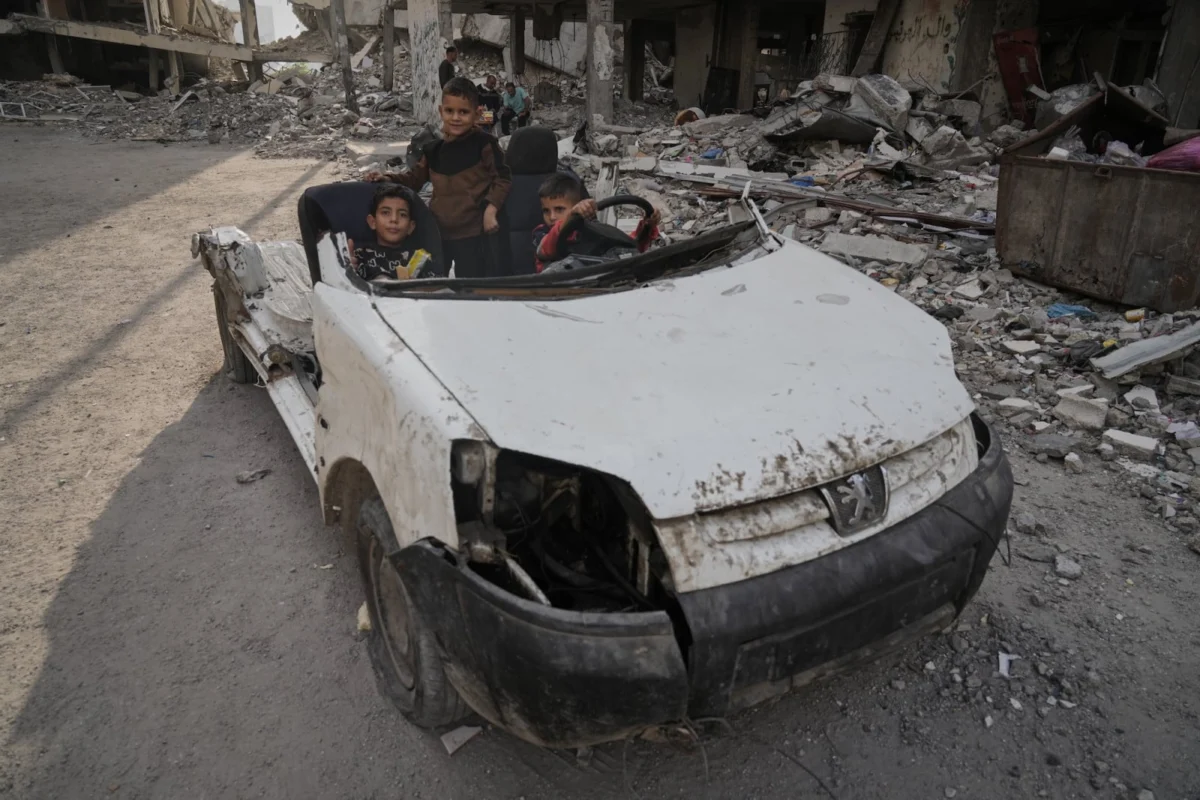
The driving manual still depicts tree-lined streets and professionals heading to work. This manual, now a relic of a vanished reality, creates a cognitive dissonance for students. They are learning to drive in a world that no longer exists, using a vehicle that is literally held together by plastic sheeting and recycled parts.
The Act of Defiance
When Ihab Shaheen, the director of Al Shati, instructs his team to dismantle one dead car to keep another alive, he is performing an act of resistance. The cannibalization of vehicles—taking the life of one to extend the life of another—is the most poignant metaphor for the current state of Gaza. It is an act of refusal to let the city stop moving entirely.
A New Definition of "Road"
"Roads" in Gaza are no longer designated spaces for transit; they are living, breathing spaces where people wait for aid, live in tents, and navigate the remnants of their former lives. To drive in Gaza today is to navigate a graveyard, yet it is also a declaration of presence. As the author notes, "nobody is checking to see if I have a driver’s license." The authority of the state, the rules of the road, and the infrastructure of the past have all been stripped away. Yet, the car keeps moving.
Conclusion: The Road Ahead
The story of the Al Shati Driving School is a microcosm of the Palestinian experience under the current conditions. It is a story of extreme resilience, where every mile driven is an accomplishment against a backdrop of near-total collapse. While the international community discusses "reconstruction" and "feasibility studies," the people of Gaza are already rebuilding, block by block, tire by tire.
The driving school remains open not because the city requires more drivers, but because the act of learning, the act of attempting to master a machine in a broken world, is a way of holding onto the belief that there will eventually be a place to drive to. For now, the students of Al Shati, and the people of Gaza, continue to navigate the ruins, proving that even when the infrastructure of a civilization is destroyed, the human instinct to move forward cannot be so easily paved over.

 Ammar Sabilarrohman

 Nana