


 Ali Ikhwan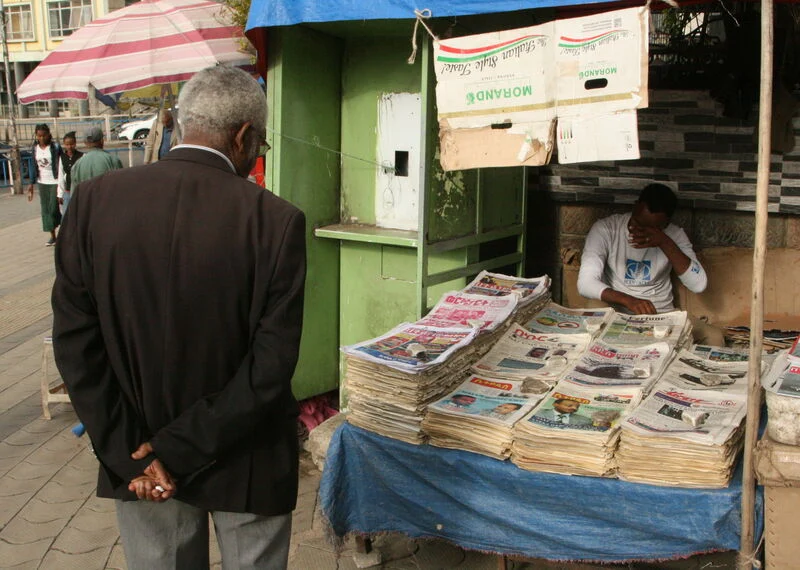
As Ethiopia approaches its pivotal national election on June 1, the landscape of independent journalism is not one of robust debate or democratic discourse, but rather one of shrinking shadows and pervasive fear. According to a scathing new report from Amnesty International, Ethiopian authorities have intensified a systemic campaign of repression, systematically dismantling the infrastructure of a free press to ensure that the lead-up to the polls remains unchallenged by critical voices.
From the arbitrary detention of journalists to the weaponization of bureaucratic “oaths” and digital surveillance, the state’s apparatus is being deployed to insulate the ruling party from accountability. As citizens prepare to cast their votes, the atmosphere in Addis Ababa and beyond is defined by a chilling culture of self-censorship, where the pursuit of truth has become a professional—and personal—hazard.
The Anatomy of Repression: A Chronology of Control
The current crackdown is not an isolated series of incidents, but a calculated progression. Over the past year, the Ethiopian Media Authority (EMA) has acted as the tip of the spear in this campaign, leveraging regulatory power to silence dissent.
2025: The Shift toward Digital Dragnet
The groundwork for the current climate was laid throughout 2025, as the government moved to monitor the digital footprints of those reporting on the administration. Journalists were subjected to targeted surveillance, forcing many to abandon encrypted platforms or move their operations into the dark. By the end of 2025, the arrest of seven journalists in a single month signaled a clear shift: the government would no longer tolerate investigative reporting that questioned its narrative.
Early 2026: The Regulatory Purge
The intensity of the crackdown spiked in early 2026. In February, the Ethiopian Media Authority took unprecedented steps to strip legitimacy from established news organizations.
- February 2026: The accreditation of Reuters journalists was revoked. The move followed a high-profile investigation that exposed the existence of a secret military training camp within Ethiopia hosting Sudan’s Rapid Support Forces (RSF).
- February 2026: Addis Standard, one of the country’s most respected independent outlets, saw its license revoked.
- Ongoing: Wazema Radio remains shuttered, its voice effectively erased from the airwaves as the authorities solidified their grip on the information flow.
The "Oath" of Compliance: A Tool for Censorship
Perhaps the most insidious mechanism of control is the mandatory "oath" imposed by the Ethiopian Election Board. While the Board is constitutionally defined as an independent body, its actions suggest a direct alignment with executive interests.
First introduced in 2021 and reinforced for the upcoming June 1 vote, this oath acts as a prerequisite for media accreditation. On its face, it demands adherence to "ethical responsibilities." In practice, it creates a legal minefield. By mandating that journalists acknowledge it is a crime to publish "false information about the Board," the government has effectively granted itself the power to define truth.
Because the language of the oath is broad and intentionally vague, it provides the state with the flexibility to prosecute any journalist whose coverage of the election is deemed inconvenient. As Tigere Chagutah, Amnesty International’s Regional Director for East and Southern Africa, noted, “The oath is clearly a tool for controlling what is discussed in public about the upcoming election and gives [the Board] the power to censor uncomfortable information.”
Voices from the Dark: The Cost of Reporting
The human cost of this campaign is reflected in the testimonies of those on the front lines. Amnesty International conducted interviews with six media representatives, all of whom requested anonymity out of a well-founded fear of retaliation. Their accounts paint a grim picture of a press corps under siege.
The Death of Sourcing
The culture of fear has reached the political class. Journalists report that opposition politicians, once the primary sources for holding power to account, are now terrified of speaking on the record.
“I had to drop a story because every quoted politician was anonymous,” one news editor admitted. “They refused to disclose their identity for fear of reprisals for criticizing the government or the ruling party.”
The Digital Paranoia
The pervasive belief that the state’s intelligence services have compromised private communication devices has further paralyzed the flow of information. Another journalist interviewed stated, “Most politicians are always reluctant to talk to us about anything critical of the government over the phone. They fear that their devices are compromised.” This has created a sterile media environment where only government-sanctioned narratives are safe to circulate.
Official Rhetoric and the "National Threat" Doctrine
The crackdown is underpinned by a deliberate propaganda effort. Top government officials, including intelligence chief Redwan Hussien and Prime Minister Abiy Ahmed’s advisor, Daniel Kibret, have repeatedly framed independent journalism as a "threat to national interests."
By labeling journalists as agents of instability or national security risks, the administration provides a moral and legal pretext for their arrests and the shuttering of their outlets. This rhetoric is not merely incidental; it is a core strategy. Prime Minister Abiy Ahmed has frequently used such language to discredit critics, essentially delegitimizing the role of the Fourth Estate in the Ethiopian democratic process. This narrative has been echoed by the EMA, which has transitioned from a regulatory body into a vehicle for political enforcement.
Implications for the June 1 Election
The systematic dismantling of independent media has profound implications for the legitimacy of the upcoming election. A democratic process requires an informed electorate; without independent journalism, voters are left in a vacuum where the ruling party’s narrative is the only one permitted to exist.
A One-Sided Dialogue
With opposition politicians afraid to speak and media houses shuttered, the electorate is being denied the opportunity to engage with critical policy analysis. The lack of transparency from the election board—cited by multiple journalists as a barrier to their work—further exacerbates this. If the media cannot verify the integrity of the election process, the public cannot trust the results.
The Erosion of Accountability
The international community, including development partners and human rights organizations, is facing a moment of reckoning. The "systematic dismantling" of the press, as described by Amnesty International, creates a scenario where the state operates without the moderating force of public scrutiny. When the press is transformed into an arm of the state, the mechanism of accountability is effectively broken.
Conclusion: A Call for Reversal
The situation in Ethiopia stands as a stark warning about the fragility of democratic gains. The transition from an open, albeit complex, media landscape to one of enforced silence is happening in real-time, just weeks before the nation heads to the polls.
Tigere Chagutah’s call to action is clear: “Ethiopian authorities should reverse these increasingly authoritarian tendencies and immediately end this campaign of repression against the media.” Without urgent intervention and international pressure, the June 1 election risks being viewed not as a democratic milestone, but as a coronation held in the dark. The silence in Addis Ababa is not a sign of peace; it is a sign of a democracy under extreme duress, where the right to speak has been sacrificed on the altar of political consolidation.
For the Ethiopian people, the path forward requires not just the right to vote, but the right to know—a right that is currently being systematically stripped away.

 Siti Muinah
 Sagoh
Sagoh