



 Layla Zulfa
Despite persistent myths that characterize the juvenile justice system as a lenient "slap on the wrist," the reality is significantly more complex and, often, far harsher than the public perceives. As policymakers across the United States increasingly grapple with how to respond to youth crime, a dangerous trend has emerged: the movement to push more young offenders into the adult criminal justice system. However, a rigorous examination of the data suggests that this "tough on crime" posture is not only counterproductive to public safety but fundamentally ignores the biological and developmental realities of adolescence.
The Developmental Reality: A Brain Under Construction
To understand why juvenile courts remain the appropriate venue for youth, one must first understand the adolescent brain. Temple University psychologist Laurence Steinberg famously described the teenage brain as "a car with a sensitive gas pedal and bad brakes." Adolescence is a period characterized by a heightened drive for risk-taking, yet the prefrontal cortex—the area responsible for impulse control and weighing long-term consequences—is still under construction.
This biological reality creates a unique window of vulnerability. When teenagers break the law, they are rarely acting with the same calculated malice often attributed to adult career criminals. Recognizing this, the juvenile justice system was designed to provide a flexible, tailored approach that considers the individual youth, their environment, and the specific harm caused. Unlike the adult system, which is built primarily for retribution and punishment, the juvenile system is intended to balance public safety with rehabilitation and accountability.
A Historical Chronology of Youth Justice
The juvenile justice system was born out of a reaction to the indefensible excesses of the 19th-century criminal courts. In 1899, Chicago established the first juvenile court after a 10-year-old boy, accused of stealing a pair of shoes, was held in an adult jail for nearly two weeks. The new system was meant to be a paternalistic, age-appropriate alternative.
However, the system’s initial informality often led to arbitrary and abusive outcomes. This era shifted dramatically in 1967 with the landmark U.S. Supreme Court case In re Gault. The Court ruled 8-1 that "the condition of being a boy does not justify a kangaroo court," mandating that youth be afforded due process rights.
By the 1980s and 90s, the political climate shifted toward a "tough-on-crime" era. Influenced by flawed theories—such as the "super-predator" myth—legislators across the country began to pass laws that encouraged boot camps, increased out-of-home placements, and lowered the barriers for transferring youth to adult courts. It is a bitter irony that these policies were enacted just as youth offending began a significant, long-term decline.
In recent decades, the pendulum has begun to swing back, guided by scientific evidence. The 2005 Supreme Court decision in Roper v. Simmons, which banned the death penalty for juveniles, explicitly cited the developmental differences between youth and adults as the reason for the ruling. Since then, numerous state legislatures have begun to reconsider the harshness of their juvenile sentencing laws.
Supporting Data: The Truth About Youth Crime
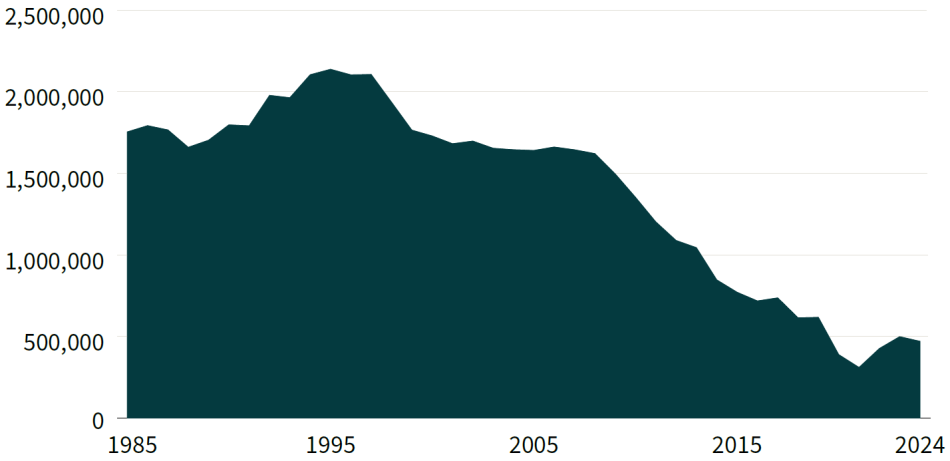
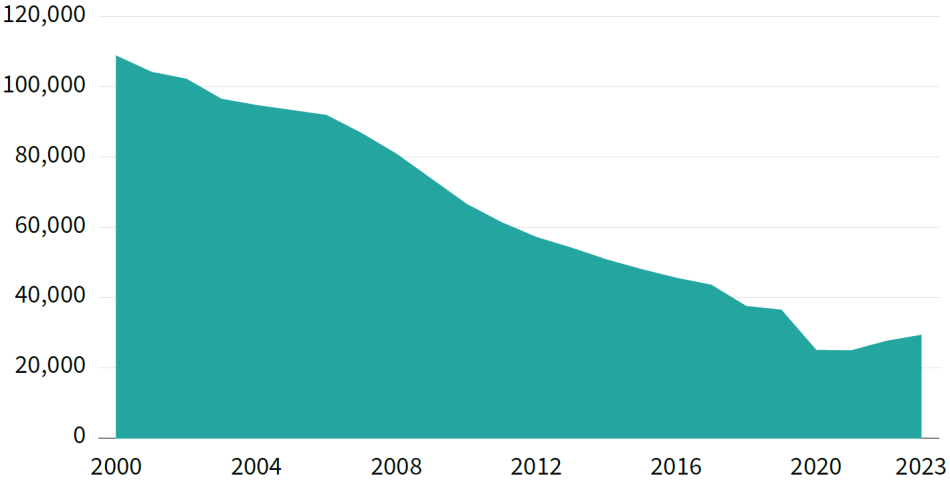
Public perception of youth crime is often fueled by media sensationalism, which frequently obscures the data. In reality, youth arrests have plummeted over the last thirty years. In 1995, youth arrests reached an all-time peak; since then, they have declined by more than 75%.
The data from 2024 further illustrates this shift:
- Shrinking Proportion: The proportion of all arrests involving people under 18 has fallen from 15% in 2000 to just 7% today.
- Non-Violent Nature: Most youth arrests are for non-violent offenses. In 2024, only 8.5% of youth arrests were for FBI-categorized Part 1 violent crimes (murder, rape, robbery, and aggravated assault).
- Low Recidivism: Contrary to the fear of a "revolving door," roughly 63% of youth referred to juvenile court have that visit as their only encounter with the system.
Despite these trends, the juvenile system remains a place of significant hardship. Probation is often highly burdensome, and roughly 25% of youth referred to the system are detained upon arrest—meaning they are incarcerated before they have even been convicted of a crime. Furthermore, reports of staff abuse, solitary confinement, and physical mistreatment in juvenile facilities are alarmingly frequent. The system is, by no means, "soft."
Racial and Ethnic Disparities
One of the most persistent failures of the juvenile justice system is the existence of deep-seated racial and ethnic disparities. Because the system relies heavily on professional discretion—giving judges, police, and probation officers the power to decide who gets a warning and who gets detained—bias often infects the process.
The numbers are stark: Black youth are 60% more likely to be detained and 64% more likely to be committed to a facility than white youth for similar delinquency offenses. These inequities are not merely statistical anomalies; they are systemic failures that demand urgent reform. When we discuss the "discretion" of the juvenile system, we must also address how that discretion is applied with uneven, often discriminatory, outcomes.
The Failed Alternative: Moving Youth to Adult Courts
In response to public anxiety, some legislators have sought to transfer more youth cases to adult criminal courts. This strategy, often framed as "adult crime, adult time," is fundamentally flawed.
Research consistently shows that youth processed in the adult system are more likely to reoffend and, when they do, they are likely to commit more serious, violent crimes. The adult system is not equipped to provide the education, therapy, or developmental guidance that teenagers require. Furthermore, the administrative strain is immense: cases take significantly longer to resolve in adult court. For instance, in North Carolina, the average length of stay in detention for a youth processed in the juvenile system is 27 days, compared to 200 days for those processed as adults.
This approach is also prohibitively expensive. States like Louisiana have recently set aside over $150 million to build new detention facilities—a massive investment in incarceration that could be better spent on community-based mental health services and diversion programs.
Implications for Public Safety and Policy
The path forward requires a shift in priorities. Instead of focusing on incarceration, policymakers should focus on the "off-ramps" that prevent deeper system involvement. Diversion programs—which steer youth toward community services rather than into a courtroom—have proven to be highly effective at reducing reoffending.
Moreover, the intersection of mental health and youth justice cannot be ignored. The U.S. Surgeon General has documented a significant rise in depression, anxiety, and mental health emergencies among teens. Many youth who land in the justice system are struggling with untreated trauma, substance abuse, or emotional instability. Treating these issues as public health problems rather than criminal ones is the most effective way to ensure long-term public safety.
Recommendations for Reform:
- End Automatic Transfers: States should eliminate laws that allow or mandate the transfer of youth to adult court, particularly for those under 18. The decision should never rest solely with prosecutors.
- Raise the Age: Every state should ensure that the juvenile court has jurisdiction over all individuals under 18, regardless of the severity of the offense.
- Expand Diversion: Invest in evidence-based diversion programs that address the underlying causes of delinquency, such as family dysfunction or lack of educational opportunity.
- Targeted Accountability: Prioritize restorative justice models that require youth to take responsibility for the harm they caused, while providing the support necessary to ensure they do not repeat their mistakes.
The juvenile justice system is undeniably imperfect. It struggles with bias, it is often overly punitive, and it frequently fails to protect the vulnerable youth in its care. However, it remains a critical safeguard. To dismantle it or to replace it with the adult criminal justice system would be a historic error. Adolescence is a temporary state, and our justice system should be designed to nurture that growth, not to punish it into permanent criminality. As we look toward the future, the goal must remain clear: invest in the potential of the next generation, rather than their containment.


 Lina Hope
 Neng Nana