
 Asro
Asro
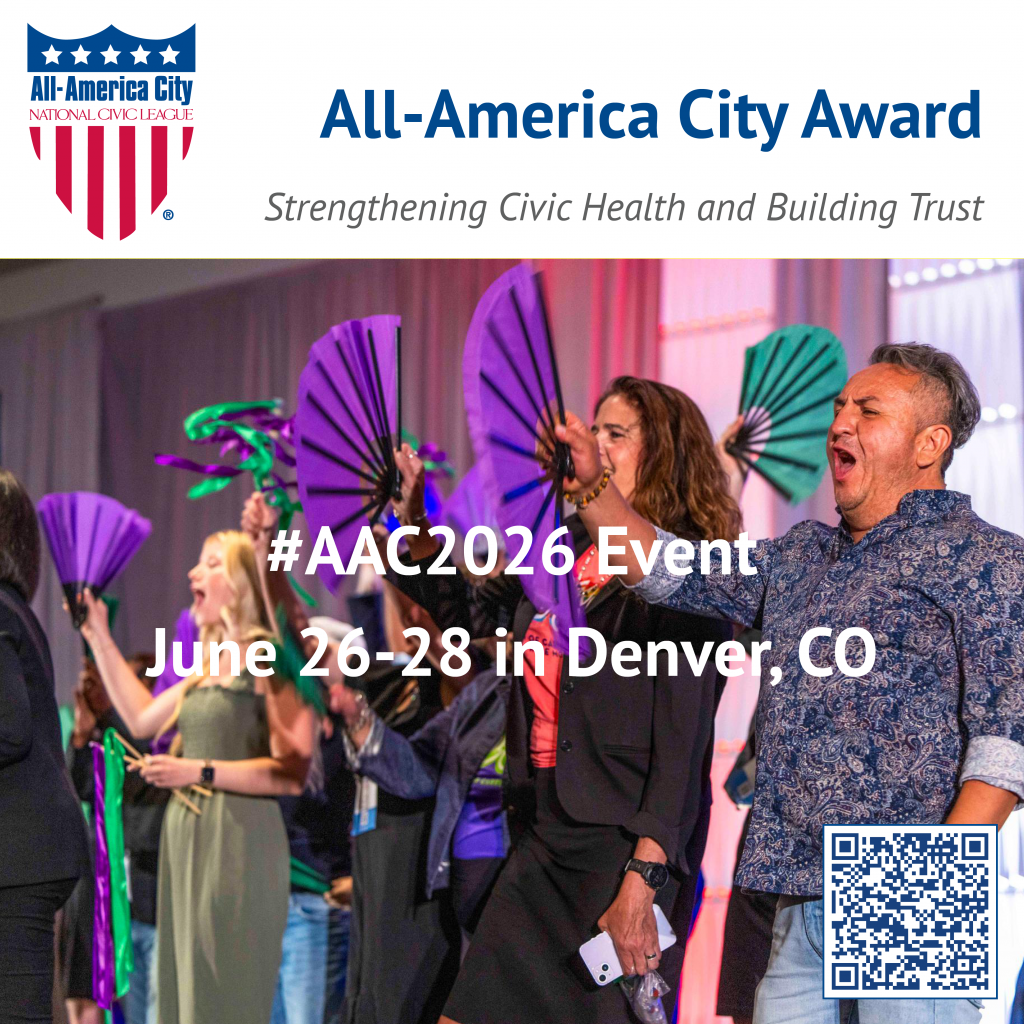
DENVER, CO — As the United States approaches its semiquincentennial, the question of what sustains a healthy democracy has never been more urgent. From June 26–28, the city of Denver will become the epicenter of this national conversation as the National Civic League hosts the 2026 All-America City Award event. While the competition itself—showcasing the innovative efforts of twenty finalist communities—remains the primary draw, this year’s summit distinguishes itself through an unparalleled lineup of keynote speakers.
Leaders from the spheres of philanthropy, government, and grassroots activism will converge to dissect the state of civic health, democratic participation, and the mechanics of local organizing. Under the theme “America at 250: Strengthening Civic Health and Building Trust,” the event aims to move beyond rhetoric, offering attendees actionable strategies for rebuilding the social fabric of American communities.
The Architecture of Participation: A Fireside Opening
The event kicks off with a high-profile fireside chat moderated by civic expert Matt Leighinger. The panel features three luminaries who have redefined how citizens interact with their institutions: Cristin F. Brawner, Shamichael Hallman, and Evan Weissman.
Reimagining Civic Infrastructure
Cristin F. Brawner, Executive Director of the National Issues Forums Institute (NIFI), brings a focus on deliberative democracy. NIFI, a nonpartisan nonprofit, is a titan in the field of public engagement, specializing in empowering citizens to move from polarized debate to constructive decision-making. Brawner’s career—spanning her tenure at the David Mathews Center for Civic Life and her founding of the Southern Deliberative Democracy Network—is rooted in the belief that democracy is a muscle that must be exercised through consistent, structured dialogue.
Joining her is Shamichael Hallman, a pioneer in civic and social technology. Hallman, whose work at Memphis Public Libraries gained international acclaim, has challenged the traditional view of public libraries as mere repositories of books. His TEDx talk, “Reimagining the Public Library to Reconnect the Community,” serves as a blueprint for how physical public spaces can function as hubs for social cohesion. As a former Loeb Fellow at Harvard, Hallman’s work emphasizes urban design as a tool for democratic inclusion, a theme he continues to explore as the Senior Director of Civic Health and Economic Opportunity.
Rounding out the trio is Evan Weissman, the founding executive director of Warm Cookies of the Revolution. A former theater professional whose work was once described by the Denver Post as “Monty Python’s anarchist grandchildren,” Weissman has turned his creative energy toward civic health. His organization treats "civic health" as a lifestyle, hosting hundreds of arts-based programs—from Tax Day Carnivals to Civic Stitch ‘n Bitch sessions—that strip away the intimidation factor of traditional governance. His presence at the summit signifies a growing recognition that arts and culture are essential, not optional, components of a functioning democracy.
Celebrating Leadership: The Hall of Fame and All-America Awards
On the evening of Saturday, June 27, the focus shifts from grassroots innovation to institutional stewardship. The gala will feature keynote speaker David N. Cicilline, President and CEO of the Rhode Island Foundation. Cicilline, a veteran of both the U.S. House of Representatives and the mayoral office in Providence, represents a bridge between policy-making and community philanthropy.
The Role of Foundations in Civic Health
Cicilline’s leadership at the Rhode Island Foundation, which oversees more than $1.5 billion in assets, highlights the pivotal role of community foundations in driving local progress. During his keynote, Cicilline is expected to discuss the "Community Foundations for Civic Health Initiative," a strategic framework designed to leverage philanthropic capital to solve long-term systemic challenges. His transition from the halls of Congress—where he championed LGBTQ+ equality, economic equity, and healthcare reform—to the helm of one of the nation’s largest foundations underscores a critical trend: the shift of leadership power toward regional and community-based organizations.
Closing the Loop: Bridging the Access Gap
The event will culminate in a closing ceremony headlined by Kat Calvin, the founder of Spread The Vote + Project ID. Calvin’s career is a study in identifying systemic failure and engineering precise, scalable solutions. Her work has enabled over 15,000 individuals to secure the identification necessary for housing, employment, and—most crucially—the ballot box.
A New Model for Nonprofit Evolution
The 2026 summit is particularly significant due to the recent acquisition of Spread The Vote by the National Civic League, a landmark structural transition in the nonprofit sector. This move reflects a broader industry push toward consolidation to achieve greater impact. As a Senior Advisor to the League, Calvin now focuses on national strategies for civic infrastructure, while her new initiative, Abby Lab, aims to streamline how resources move within the philanthropic ecosystem. Her closing remarks are expected to provide a roadmap for the next decade of advocacy, focusing on how to break down the barriers that prevent marginalized populations from accessing the levers of power.

Chronology and Context: The Path to Denver
The selection of Denver as the host city is symbolic. As the nation prepares for the 250th anniversary of the signing of the Declaration of Independence in 2026, the National Civic League is positioning these finalists as the "front line" of a new American experiment.
- June 26: Opening Ceremony featuring the fireside chat with Brawner, Hallman, and Weissman.
- June 27: Panel sessions and the Hall of Fame & All-America Leader Awards, with keynote address by David Cicilline.
- June 28: Closing ceremony featuring Kat Calvin and a summary of the twenty finalist community projects.
The finalist communities—which will present their work throughout the three-day period—have been selected based on their commitment to trust-building. In an era of heightened political polarization, these projects represent a deliberate attempt to focus on the "local" as the primary site of recovery.
Supporting Data and Implications
According to the National Civic League’s recent internal assessments, the decline in public trust is directly correlated with a reduction in the "civic infrastructure"—the clubs, libraries, neighborhood associations, and local organizations that once served as the backbone of community life.
The data supporting the speakers’ arguments is clear: communities with robust civic infrastructure show higher resilience against economic shocks, lower rates of social isolation, and higher voter turnout. For instance, the initiatives pioneered by Hallman and Calvin demonstrate that when barriers to participation—whether they be lack of IDs or lack of accessible physical space—are removed, civic engagement metrics rise significantly.
The implications for the public are substantial. Attendees at the summit are not merely passive observers; they are tasked with taking these lessons back to their home states. By focusing on "practical, scalable solutions," the summit aims to avoid the pitfalls of theoretical discussion and instead provide a toolkit for local leaders to address the following:

- Deliberative Democracy: Moving from shouting matches to structured problem-solving.
- Infrastructure Investment: Using public spaces (libraries, parks) as community anchors.
- Resource Equity: Ensuring every citizen has the documentation and tools required to participate in the democratic process.
Conclusion: Why This Matters Now
The 2026 All-America City Award is more than an awards ceremony; it is a diagnostic tool for the state of American democracy. As the keynote speakers and finalists gather in Denver, they represent a collective effort to answer a singular question: How do we build a nation that is resilient enough to withstand the pressures of the next 250 years?
By integrating the arts, philanthropy, policy-making, and grassroots organizing, the event provides a holistic view of what it means to be a citizen in the 21st century. Those interested in the future of American civic health are encouraged to register through the official conference portal. As the country looks toward its semiquincentennial, the lessons shared in Denver may well define the next chapter of the American experiment.
For more information on the twenty finalists, the full speaker schedule, and to secure your registration for the June 26–28 event in Denver, please visit the National Civic League’s official event portal.

 Neng Nana
 Nana Muazin