


 Iffa Jayyana
By Shareef J. Phillips, Digital Communications Manager, Benetech
With expert insights from Charles LaPierre, Principal, Accessibility & Content Quality Architect at Benetech
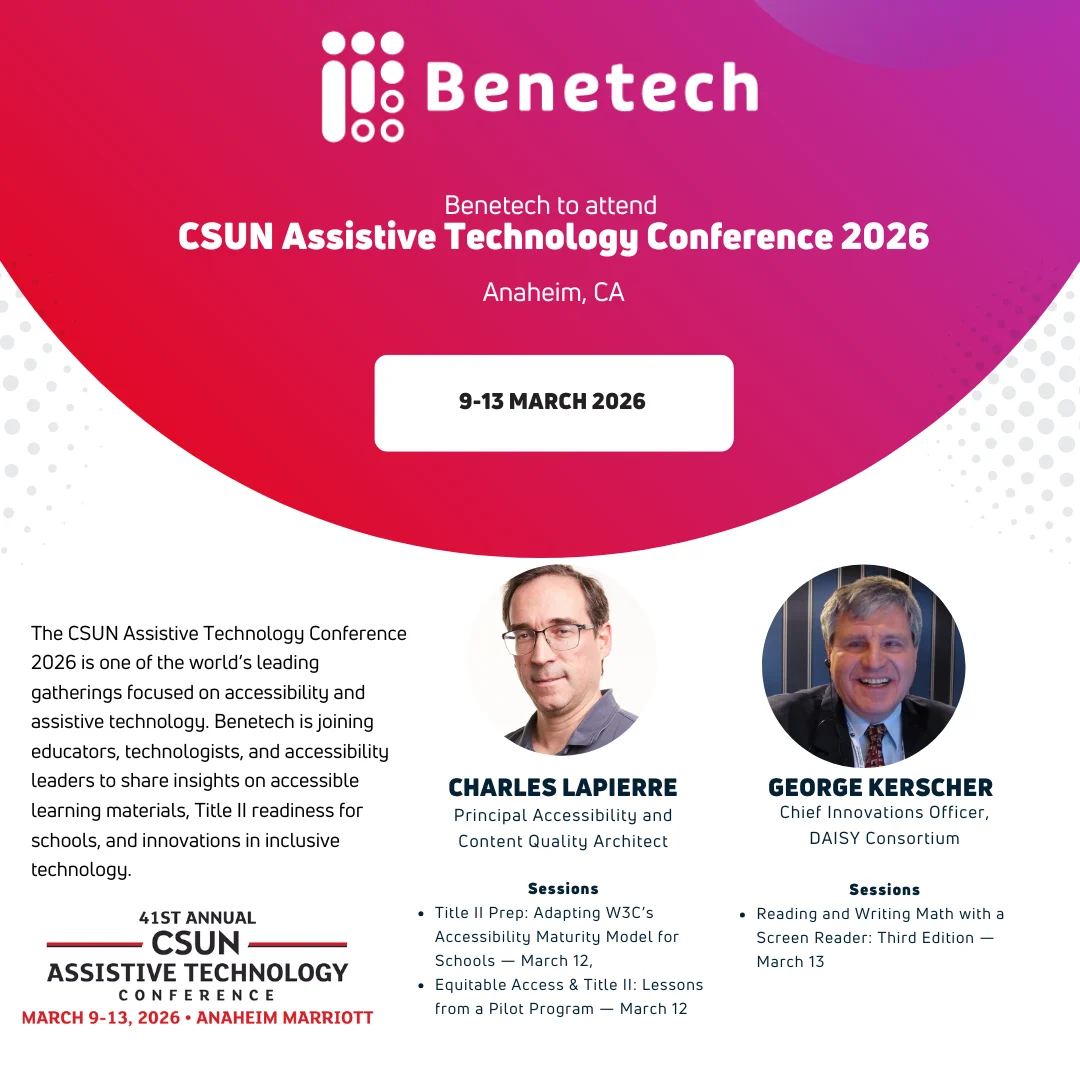
The digital landscape is undergoing a tectonic shift. As artificial intelligence transforms how we interact with information, the fundamental right to digital access has moved from a niche technical requirement to a central pillar of global equity. Earlier this month, Benetech stood at the epicenter of this transformation, joining global accessibility leaders at the CSUN Accessibility Conference 2026. As one of the world’s most influential gatherings dedicated to assistive technology and inclusive innovation, CSUN served as the ideal backdrop for Benetech to demonstrate its commitment to a future where information is universally accessible.
Representing the organization, Charles LaPierre, Principal Accessibility and Content Quality Architect at Benetech, navigated a week of high-level discourse, technical workshops, and strategic networking. His presence underscored Benetech’s role not just as a participant, but as a thought leader helping to shape the policies and standards that will define the next decade of accessibility.
The Core Mandate: Navigating Title II Readiness
A primary driver of conversation at CSUN 2026 was the looming enforcement of ADA Title II. As educational institutions across the United States face tighter deadlines to ensure their digital offerings are compliant, the demand for actionable, scalable, and standardized frameworks has reached an all-time high.
Addressing the Compliance Wave
Benetech’s session, "Title II: Adapting W3C APA Note A11y Maturity Model for Schools," served as a critical touchpoint for administrators and IT leaders. With a packed room of over 30 attendees and a surge of post-session engagement, it was clear that institutions are moving past the "awareness" phase and into the "implementation" phase.
The session focused on the W3C’s Accessibility Maturity Model—a framework designed to help organizations assess, track, and improve their accessibility posture over time. For schools, this means transitioning away from reactive, one-off patches and toward a proactive, system-level strategy. The interest from major academic entities, such as the California State University system and the University of Tokyo, highlights that this is a global challenge; universities worldwide are seeking robust, documented processes to ensure their digital environments—from learning management systems to library databases—are inclusive by design.
Chronology of Collaboration: Strengthening the Ecosystem
The CSUN experience was defined by a deliberate effort to cross-pollinate ideas across disparate sectors. Accessibility is no longer siloed; it is a shared responsibility between big tech, government, education, and legal advocacy.
A Week of Strategic Engagement
- Day 1-2: Industry Alignment: Charles LaPierre engaged with engineering leads from technology giants including Amazon and eBay. The focus of these discussions was the scalability of accessibility—how global platforms can automate the identification of barriers without sacrificing the nuance required for a positive user experience.
- Day 3: The Certification Imperative: Discussions with partners reinforced the industry’s hunger for standards like Benetech’s Global Certified Accessible (GCA) program. As the digital marketplace becomes increasingly complex, certification provides a "north star" for publishers and content creators.
- Day 4: Institutional Advocacy: The conference provided a unique platform to host sessions with accessibility advocates and researchers. A highlight for the Benetech team was the opportunity to connect with Board Member Judy Dixon, whose decades of advocacy for accessible reading continue to ground Benetech’s technical advancements in the lived reality of the communities they serve.
Supporting Data: The Shift Toward "Shift-Left"
The conversations at CSUN 2026 revealed a profound trend: the rejection of "overlay" solutions. For years, the industry was flooded with "quick-fix" widgets that promised instant accessibility but often failed to provide genuine usability for users relying on screen readers or other assistive tools.
From Retrofitting to Integration
The data gathered from participant feedback suggests a shift toward a "shift-left" philosophy. In software development, "shifting left" means moving testing and quality assurance to the earliest stages of the development lifecycle. By embedding accessibility requirements into the initial wireframing and coding phases, organizations can reduce the long-term cost of compliance and significantly improve the user experience.
Benetech’s own toolkit—including the evolving PageAI and Bookshare+ platforms—is designed specifically to support this systemic shift. These tools empower developers to validate content quality before it ever reaches the end user, effectively automating the grunt work so that human effort can be focused on complex, high-impact accessibility challenges.
Official Perspectives: The Evolution of the "Agent-First" Web
One of the most provocative themes of the 2026 conference was the emergence of the "agent-first" web. As AI-powered personal agents become more prevalent, the way content is consumed is changing. We are moving toward a paradigm where a user’s AI assistant acts as an intermediary, re-rendering, summarizing, or reformatting web content to meet the specific needs of the individual.
The Challenge of AI Governance
While this creates unprecedented opportunities for accessibility, it also introduces significant risks. If the data that powers these AI models is inherently inaccessible or biased, the AI will simply automate the exclusion of marginalized groups.
"The web is shifting from a visual experience to a data-driven one," notes Charles LaPierre. "This requires us to prioritize structured, machine-readable content. If we don’t get the foundation of the data right, the AI agents of the future will propagate the same barriers that have plagued the web for the last twenty years."
Implications: The Human Element in an Automated World
As the industry moves toward greater automation, the "human element" has become a recurring subject of debate. Is there a point where AI replaces the need for accessibility specialists? The consensus at CSUN was a resounding "no."
The Synergy of Machine and Human
Automation is undeniably effective at scaling, identifying syntax errors, and managing massive data sets. However, AI lacks the subjective, nuanced understanding of lived experience. Accessibility is not just about meeting a checklist of technical requirements; it is about human agency and the ability to participate fully in society.
Benetech’s approach remains rooted in a balanced philosophy:
- AI for Efficiency: Utilizing automation to clear the backlog of inaccessible legacy content.
- Human Expertise for Context: Ensuring that the final, rendered experience is tested and verified by people who understand the complexities of diverse user needs.
This hybrid approach ensures that digital tools are not just "compliant" in a legal sense, but truly functional and empowering.
Looking Ahead: The Path Toward Inclusive Infrastructure
The energy at CSUN 2026 was palpable. There is a newfound urgency in the sector, fueled by the realization that the digital divide is not merely an inconvenience—it is a barrier to education, employment, and civic participation.
Benetech’s Strategic Roadmap
As Title II enforcement begins to reshape the landscape, Benetech is uniquely positioned to assist. Our focus for the coming year is threefold:
- Scaling Infrastructure: Expanding the reach of Bookshare+ and PageAI to ensure that high-quality, accessible content is available at scale.
- Standardization: Continuing to lead the charge on certification models like GCA, which provide the trust and transparency needed for global digital accessibility.
- Policy Advocacy: Using our technical expertise to inform policymakers about the realities of AI integration and the necessity of "accessibility-first" development standards.
The discussions at CSUN were not merely theoretical exercises; they were the building blocks of a more equitable future. By aligning our technological innovations with the evolving needs of the global community, Benetech is committed to ensuring that the digital revolution includes everyone, leaving no one behind in the race for technological progress.
Explore Our Work
The future of accessibility is being written today. From accessible reading solutions like Bookshare to the next generation of assistive technologies, Benetech is building the tools that move organizations from mere compliance to genuine, sustainable inclusion.
To learn more about how we are advancing accessibility across education and beyond, visit our resource center: https://benetech.org/what-we-do/

 Suro Senen

 Reynand Wu