



 Nana
Nana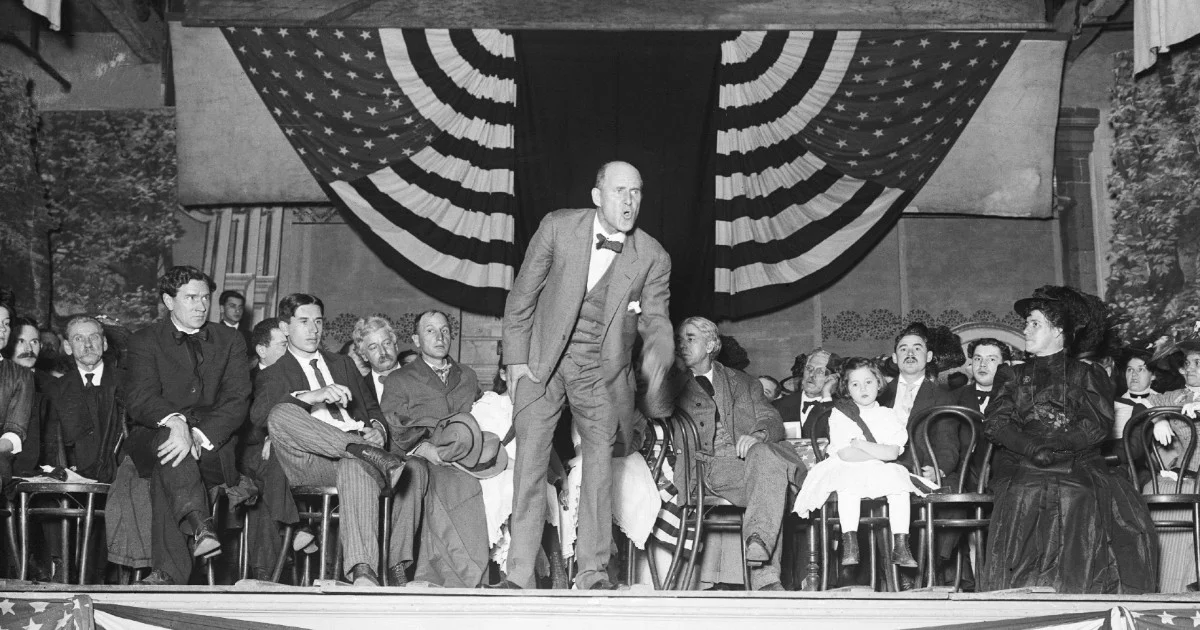
As the United States approaches its 250th anniversary on July 4, 2026, the nation finds itself at a profound political crossroads. Across the country, preparations are underway for a massive, state-sanctioned celebration of American independence. Yet, beneath the veneer of fireworks, military parades, and orchestrated displays of patriotism, a darker tension simmers. It is a tension between two competing visions of the American experiment: one defined by state-mandated orthodoxy and the other by the radical, dissenting tradition of civic liberty. To understand the stakes of this moment, one must look back at the life and legacy of Eugene V. Debs, a man who navigated this exact conflict over a century ago and whose voice remains a haunting reminder of what is at risk when "liberty" is reduced to a hollow slogan.
The Specter of 1895: A Warning from the Past
In 1895, writing from his cell in the Woodstock jail, Eugene V. Debs offered a stinging critique of the American holiday that resonates with chilling clarity today. "It has been regarded as a patriotic duty for Americans, on the 4th of July, to apostrophize Liberty," Debs wrote. "But it will be a hollow mockery. The stage will be gorgeous with scenery for the play of liberty, but liberty will be absent—only its ghost will appear."
Debs, a railroad fireman turned labor leader and socialist, understood that the symbols of American freedom—the flag, the Fourth, the rhetoric of the Founders—were frequently hijacked by the powerful to mask the suppression of the marginalized. As he observed, when the state moves to "root out" its internal critics, the celebration of the nation’s birth becomes a tool of intimidation rather than an act of communal joy.
Chronology of an Era: The Trump Administration’s Domestic Agenda
The current political climate, defined by the executive actions of the Trump administration since early 2025, mirrors the very "money power" and authoritarian overreach that Debs spent his life combating.
- January 2025: Shortly after his inauguration, Donald Trump signed an executive order mandating a "grand celebration" for the nation’s 250th anniversary. This was followed by the "Ending Radical Indoctrination in K-12 Schooling" order, which sought to purge educational curricula of "anti-American ideologies."
- March 2025: The administration expanded its cultural offensive with an order titled "Restoring Truth and Sanity to American History," targeting university faculty and curricula deemed insufficiently patriotic.
- Summer 2025: The shift from cultural to physical suppression intensified. Federalized National Guard troops and U.S. Marines were deployed to Los Angeles to crush protests regarding ICE detention policies. Similar interventions followed in Chicago, Memphis, and Washington, D.C.
- September 2025: Trump issued a memorandum on "Countering Domestic Terrorism and Organized Political Violence," framing his domestic political opponents as existential threats. He subsequently met with top military brass to discuss a "war from within" against cities governed by "radical left Democrats."
- December 2025: The launch of "Operation Metro Surge" saw 3,000 Department of Homeland Security agents deployed to Minnesota. The ensuing crackdown resulted in mass arrests and the tragic deaths of two protesters, Renee Good and Alex Pretti.
These actions serve as the fulfillment of a campaign rhetoric that consistently labeled political opponents as "vermin" and "thugs." By framing these groups as enemies of the "American Dream," the administration has attempted to manufacture a consensus that equates loyalty to the current executive with loyalty to the republic itself.
Supporting Data: The Anatomy of Repression
The suppression of the left in 2025 is not an isolated phenomenon; it is a calculated strategy to consolidate power. The administration’s reliance on the Espionage Act and federal force to suppress dissent mirrors the Wilson-era crackdown that led to the imprisonment of Debs in 1918.
Historical data suggests that such suppressions have long-term structural consequences. Historian Adam Hochschild, in his study American Midnight, notes that the decimation of the Socialist Party during the Red Scare did not merely silence a group of activists; it fundamentally altered the economic trajectory of the nation. Without the pressure of a viable, organized left, the United States failed to develop the robust social safety nets and public health systems that became standard in other Western democracies.

Today’s administrative actions—specifically the targeting of educators and the use of federal troops in domestic centers—represent a modern iteration of this historical pattern. The goal is the creation of a "triumphalist history" that effectively erases the role of labor movements, civil rights organizations, and radical dissenters in shaping the very democratic progress they claim to champion.
Official Responses and Political Narrative
The official stance of the Trump administration remains rooted in the concept of "patriotic administration." Government spokespeople argue that these measures are essential to "restore sanity" and protect the integrity of the American founding. The televised, scripted extravaganzas planned for July 4, 2026—complete with UFC-style spectacles—are intended to present a unified, aggressive front against the "internal enemies" identified by the President.
Conversely, critics and historians point to the hypocrisy of using the Declaration of Independence to suppress the very spirit of revolution that birthed it. The administration’s definition of "American greatness" relies on a static, exclusionary view of national identity, whereas the tradition championed by figures like Debs—and before him, Thomas Paine and Frederick Douglass—sees American identity as a fluid, ongoing project of liberation.
Implications: The Legacy of Debs in the 21st Century
The implications of this divide are severe. If the state successfully monopolizes the symbols of the Fourth of July, it effectively delegitimizes any form of protest as "un-American." However, the legacy of Eugene V. Debs suggests that the spirit of ’76 is not found in parades or executive orders, but in the courage to dissent.
Debs’s 1918 trial is a case in point. When he told the jury, "American institutions are on trial here before a court of American citizens," he was not rejecting the nation; he was claiming the right to hold it to its own promises. His life—from his work as a locomotive fireman to his five presidential runs—was a testament to the idea that true patriotism is not about worshiping the flag, but about fighting to make the country worthy of its citizens.
As we look toward the 250th anniversary, the "ghost of liberty" that Debs spoke of is once again haunting the American stage. The current administration seeks to use the anniversary as a coronation of its own power. Yet, the history of the American left teaches us that the democratic promise of the United States has never been a gift from the powerful; it has always been won by those who refused to be silent.
Whether the 250th anniversary becomes a celebration of state authoritarianism or a reminder of the unfinished work of democracy depends on the willingness of the citizenry to resist the "hollow mockery" of manufactured patriotism. The struggle for freedom is, as Debs argued, a global mission, and the American experiment remains its most contentious and necessary site of battle. If the "spirit of ’76" is to survive, it must be reclaimed by those who understand that liberty is not a monument to be worshiped, but an ongoing, often dangerous, struggle for justice.

 Dwi Wanna
 Evan Lee Salim