 Siti Muinah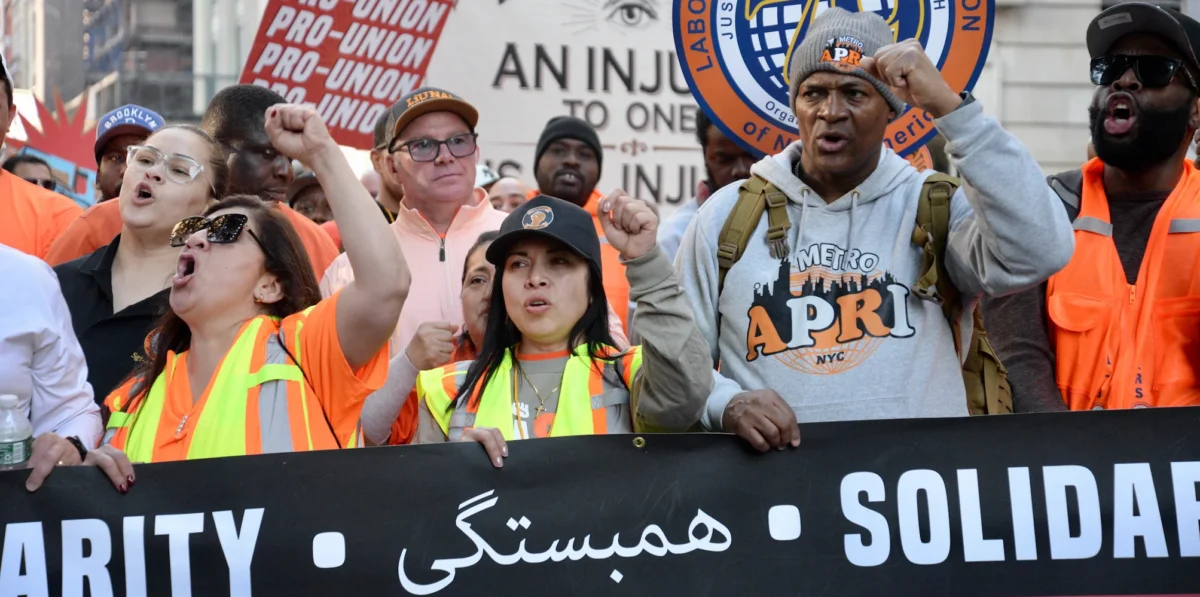
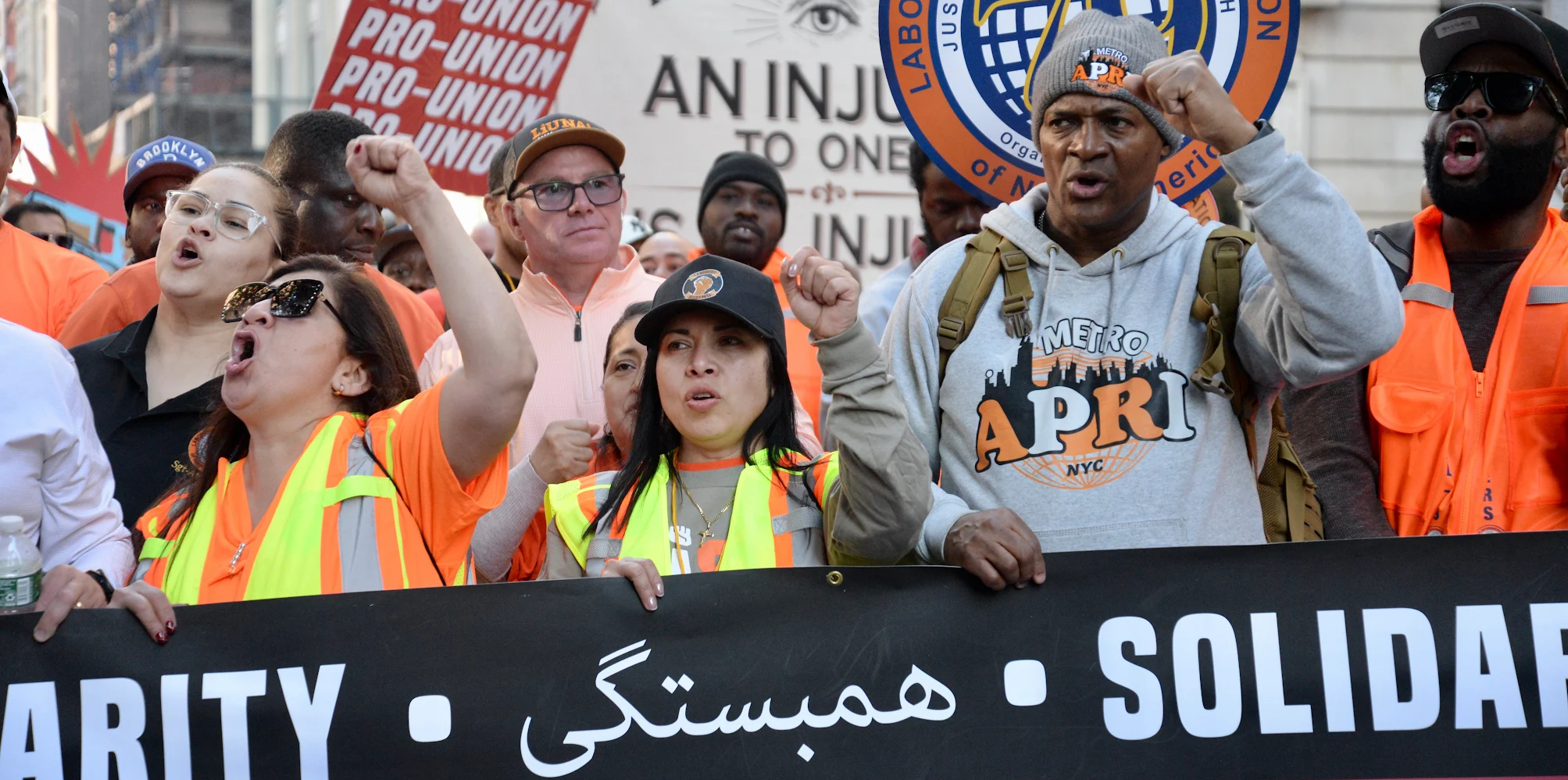
On May 1, 2026—International Workers’ Day—a formidable wave of labor activism surged across the United States. From the industrial hubs of the Inland Empire to the historic streets of Chicago and New York City, thousands of workers, students, and community organizers participated in over 4,000 coordinated actions. Under the unified banner of “Workers over Billionaires,” the day marked a significant escalation in the struggle against corporate hegemony, anti-immigrant policies, and the erosion of democratic norms.
The mobilization was more than a symbolic gesture; it was a strategic display of economic power. Inspired by the “May Day Strong” coalition, protestors adopted the mantra of “no work, no school, no shopping,” aiming to disrupt the machinery of daily commerce to highlight the vital contributions of the labor force.
The Core Demands of a Growing Movement
The 2026 May Day actions were galvanized by a triad of urgent demands: the taxation of the ultra-wealthy, a definitive end to Immigration and Customs Enforcement (ICE) operations, and the expansion of democracy at the expense of corporate influence.
These protests occurred against a backdrop of intensifying political instability. Following a controversial Supreme Court decision that further gutted the Voting Rights Act, and amidst escalating geopolitical tensions in Iran and Lebanon, the domestic climate has become increasingly hostile to organized labor. Organizers frequently drew parallels between current administration policies and the systemic injustices fought by the original May Day martyrs in the 1880s. The prevailing sentiment among the demonstrators was that the current political apparatus is actively upholding anti-worker, anti-immigrant, and anti-democratic legislation that demands an immediate, collective response.
Chronology of Disruption and Mobilization
The day’s events unfolded in a rhythmic, country-wide cadence, demonstrating a sophisticated level of inter-organizational cooperation.
Morning: Civic Engagement and School Walkouts
In Chicago, the day began with a high-energy rally fueled by a coalition of powerhouses, including the Chicago Teachers Union (CTU), Arise Chicago, and the Illinois Coalition for Immigrant and Refugee Rights. The CTU had successfully negotiated May 1 as an official “Civic Day of Action,” ensuring that buses were provided for students and that no retaliation would be taken against participants.
Simultaneously, North Carolina saw a massive “Kids Over Corporations” mobilization. Nearly two dozen school districts shuttered as thousands of educators marched on the state capital in Raleigh. This grassroots fervor was mirrored in Memphis, Tennessee, where students staged a “die-in” outside an xAI data center, linking the fight for labor rights to the environmental and social costs of industrial-scale artificial intelligence controlled by billionaires like Elon Musk.
Midday: Picket Lines and Direct Actions
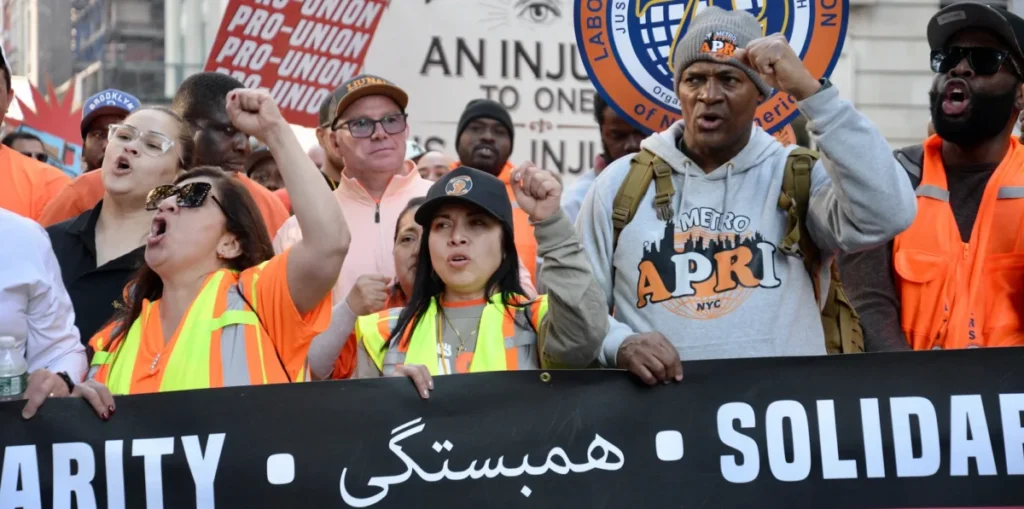
As the day progressed, the focus shifted to direct economic action. In New York City, a massive contingent of Teamsters, Amazon workers, and local unions—including the United Auto Workers and SEIU 32BJ—marched on Amazon’s corporate offices. Their demand was specific and severe: an immediate end to corporate contracts with the Department of Homeland Security (DHS). The demonstration later coalesced into a sea of orange in Washington Square Park, with thousands marching down Broadway toward Foley Square.
In Minneapolis, the economic pressure was palpable. Workers at the Normandy Hotel and Hotel Ivy initiated walkouts, while concessions workers with UNITE HERE Local 17 voted to authorize a strike. Meanwhile, direct action took a physical form as activists from Sunrise Twin Cities blocked the Hennepin Avenue Bridge to protest ICE detention practices, resulting in six arrests.
Evening: Solidarity and Regional Growth
In Louisville, Kentucky, the city hosted its inaugural May Day action. Despite historic scheduling conflicts with the Kentucky Derby, organizers successfully carved out space for a multinational, labor-focused gathering, featuring voices from the Kentucky AFL-CIO and the Democratic Socialists of America.
In California’s Inland Empire, the rally took on a defensive tone. As a critical logistics hub where 40% of Amazon’s goods transit, the region has become a flashpoint for labor exploitation. Hundreds marched on the San Bernardino City Hall, demanding an end to the region’s role as a logistical engine for ICE-collaborating corporations.
Supporting Data: The Logistics of Resistance
The 2026 actions were characterized by an unprecedented level of institutional support. Unlike previous years, the scope of the May Day coalition expanded to include major service unions, federal worker organizations, and healthcare professionals.
In New Orleans, for example, National Nurses United (NNU) utilized the momentum of May Day to solidify their five-day unfair labor practice strike against LCMC Health. The hospital’s history of bad-faith bargaining and retaliation against organizing drives served as a microcosm of the national labor struggle, proving that community-supported, worker-led strikes remain the most effective tool for challenging corporate inertia.
In Ithaca, New York, the involvement of UAW Local 2300—representing over 1,000 Cornell University service and maintenance workers—highlighted how local workplace victories feed into the national narrative. The recent unionization of the Family and Children’s Service of Ithaca, achieved by a 22-to-5 vote, provided a localized victory that attendees cited as proof that systemic change begins at the bargaining table.
Official Responses and Political Implications
The response from the establishment has been a mix of caution and confrontation. In Ithaca, the tension reached a boiling point just days after May Day, when Cornell University President Michael Kotlikoff was involved in a widely publicized incident involving his vehicle and protesting students. This event underscored the increasingly fraught relationship between university administrations—often acting as extensions of corporate interests—and the students and workers they employ.
In San Francisco, the response was more punitive. Several elected officials were arrested during a blockade at San Francisco International Airport. The officials were supporting union members who were picketing for higher wages and protesting the persistent presence of ICE at transit hubs. Such arrests illustrate the degree to which state power is being deployed to protect the status quo of corporate and federal infrastructure.
The Solidarity Schools Movement
Jackson Potter, Vice President of the Chicago Teachers Union, emphasized that these events were not spontaneous. “What happened on May Day didn’t come out of nowhere,” Potter stated. “It came from solidarity schools, picket lines, and months of organizing in Chicago and cities across the country.” This reference to “solidarity schools” highlights a new pedagogy of labor activism, where education is used as a tool to bridge the gap between classroom theory and picket-line reality.
Implications for the Future of American Labor
The May Day 2026 actions signal a shift in the American labor movement. By connecting climate justice, immigrant rights, and workplace democracy, organizers have successfully moved beyond the narrow focus of wage negotiation.
The strategy of targeting the intersection of corporate profit and federal policy—specifically the relationship between companies like Amazon and the Department of Homeland Security—suggests that labor unions are increasingly viewing themselves as social justice organizations. The demand to “tax the wealthy” is no longer just a political slogan; it is becoming a central pillar of union bargaining platforms.
As the Inland Empire logistics workers and the Ithaca service employees demonstrate, the movement is effectively linking local grievances to national and global power structures. The success of the “no work, no school, no shopping” call to action indicates a growing public appetite for disruptive protest as a means of achieving policy shifts.
With the momentum generated by thousands of rallies, and with new unions forming in sectors previously thought difficult to organize, the events of May 1, 2026, serve as a potent reminder that the fight for fair labor practices is far from over. Instead, it is evolving into a broad-based, multi-sector coalition that shows no signs of abating in the face of political opposition. The message from the streets is clear: the current model of corporate dominance is under siege, and the workers are prepared to hold the line until their demands for a more equitable society are met.

 Nana
Nana
 Pevita Pearce