
 Lina Irawan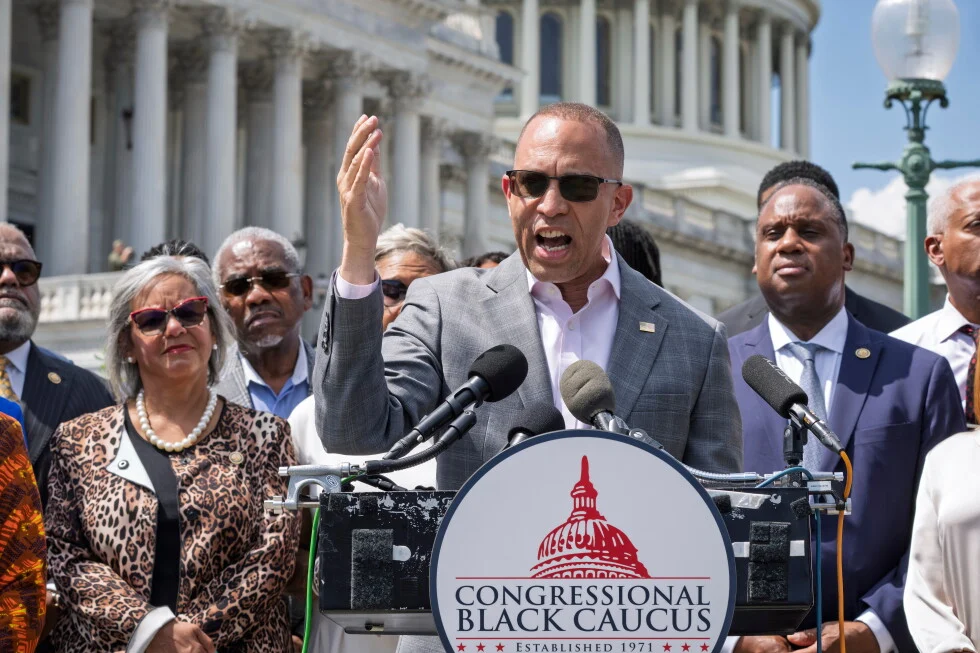
WASHINGTON — In a pointed challenge to the American private sector, Maya Wiley, president and CEO of The Leadership Conference on Civil and Human Rights, has issued a formal declaration aligning the organization with the Congressional Black Caucus (CBC) in their demand for corporate accountability. The call to action follows the Supreme Court’s controversial Callais decision, a ruling that civil rights advocates argue has dismantled the foundational protections of the Voting Rights Act (VRA) and ushered in a new era of disenfranchisement for Black voters across the South.
As the nation reflects on the systemic inequalities highlighted by the anniversary of George Floyd’s murder, the intersection of corporate influence and democratic integrity has become a primary battleground. Wiley’s statement underscores a pivotal shift: the demand that corporate America move beyond performative allyship and toward the active defense of the democratic infrastructure that underpins a stable, equitable society.
The Core Conflict: The Callais Decision and the VRA
The catalyst for this renewed mobilization is the Supreme Court’s ruling in Callais, a decision that critics characterize as a devastating blow to the legacy of the Voting Rights Act. By narrowing the scope of what constitutes racial discrimination in redistricting, the Court has effectively sanctioned the dilution of Black voting power in states with significant minority populations, including Alabama, Louisiana, Georgia, and South Carolina.
In these states, where Black citizens often comprise nearly one-third of the population, the Callais ruling provides a legal roadmap for state legislatures to redraw electoral maps that diminish the influence of Black voters. The Leadership Conference argues that this is not merely a legal technicality but an existential threat to the “multi-racial democracy” the organization has spent 76 years fighting to protect.
Chronology of the Struggle: From Civil Rights Legacy to Current Crisis
The current tension is the result of a decades-long erosion of voting protections. To understand the gravity of the CBC’s demand, one must look at the historical timeline:
- 1965: The landmark Voting Rights Act is signed into law, providing federal oversight to prevent discriminatory voting practices.
- 2013: Shelby County v. Holder removes the preclearance requirements of the VRA, effectively weakening federal oversight.
- 2020: The murder of George Floyd sparks a global reckoning on racial justice, leading many corporations to pledge millions in support of racial equity initiatives.
- 2025–2026: The Callais decision emerges, further narrowing the legal mechanisms used to challenge gerrymandering and voter suppression.
- May 25, 2026: The anniversary of George Floyd’s death serves as a backdrop for the CBC’s formal demand for corporate engagement.
- May 26, 2026: The Leadership Conference on Civil and Human Rights formally joins the CBC, expanding the scope of the protest to a broader coalition of civil rights groups.
This chronology highlights the transition from a period of expanded voting rights to a decade defined by the systematic chipping away of those same protections. The CBC and The Leadership Conference now argue that the progress made during the civil rights movement is being systematically dismantled through the judicial system.
Supporting Data: The Impact of Disenfranchisement
The urgency of the CBC’s call is rooted in stark demographic and electoral data. In the states targeted by the Callais decision, the gap between the Black voting-age population and the number of representatives who are actually accountable to those communities is widening.
The Math of Exclusion
In Louisiana and Alabama, for example, federal census data shows that Black residents represent a significant portion of the total population. However, under post-Callais maps, these communities find themselves fractured across multiple districts, effectively “cracking” their voting power.
According to analyses by The Leadership Conference, the absence of robust VRA protections leads to:
- Reduced Legislative Responsiveness: When districts are gerrymandered to favor a single party regardless of the Black vote, elected officials face less pressure to address issues like healthcare access, environmental justice, and economic reform.
- Increased Barriers to Participation: The weakening of the VRA often correlates with local-level policies that make voting more difficult, such as restrictive voter ID laws and the reduction of polling sites in minority-majority neighborhoods.
- Corporate Complicity: Corporations that donate to political action committees (PACs) supporting the architects of these maps are, by extension, funding the suppression of the very communities they claimed to support in 2020.
Official Responses: A Divided Corporate Landscape
The response from the corporate world has been notably mixed. While some companies have publicly committed to "non-partisan" participation in democracy, the CBC and The Leadership Conference contend that silence is a political act.
"The project of creating a more perfect union is under direct attack," Wiley stated in her address. "Communities across the country are hungry for principled corporations and protectors of civil rights."
The CBC’s letter to corporate leaders explicitly requests three actions:
- Transparency: Full disclosure of lobbying efforts and campaign donations to state and federal candidates who support legislation that undermines the VRA.
- Consistency: Ensuring that corporate political engagement strategies align with public statements made regarding diversity, equity, and inclusion (DEI).
- Active Advocacy: Utilizing corporate influence to oppose legislation that creates hurdles to the ballot box or dilutes minority voting power.
While some major firms have begun to review their political giving, many remain hesitant to alienate state legislators, fearing regulatory retaliation. This tension between "doing good" and "doing business" remains the central friction point of the debate.
Implications: The Future of Multi-Racial Democracy
The demand for corporate accountability is not merely about donations; it is a fundamental challenge to the role of the private sector in American public life. If the judiciary is no longer the primary guardian of civil rights, the burden shifts to other institutions—including the media, academia, and, crucially, the corporate sector.
A New Political Reality
If corporations continue to fund political figures who prioritize partisan power over equitable representation, they risk a permanent fracture in their relationship with Black consumers and employees. Recent trends in "conscious consumerism" suggest that the American public is increasingly aware of the gap between corporate values and corporate funding.
The Legislative Path Forward
The Leadership Conference is clear: legislative remedies are required. This includes the push for the John Lewis Voting Rights Advancement Act, which would restore and modernize the protections gutted by the Supreme Court. The coalition is urging corporations to stop treating civil rights as a side project and start treating them as a core business priority.
A Call for Mobilization
The alliance between the CBC and The Leadership Conference signals a shift toward a more aggressive, coordinated advocacy strategy. By positioning the Callais decision as a threat to the nation’s democratic stability, they are reframing the fight for civil rights as a fight for the stability of the American marketplace itself.
"The fight for racial justice did not end with statements, donations, or temporary commitments," Wiley concluded. "We are witnessing blatant discrimination against Black voters. We will continue to work in partnership with the CBC, corporations, and allies to protect our multi-racial democracy from its enemies."
As the 2026 election cycle approaches, the eyes of the nation turn to the boardrooms of the Fortune 500. The question is no longer just how much a corporation can donate to a cause, but whether it will continue to facilitate the erosion of the fundamental rights that allow that cause—and the nation—to exist.
About The Leadership Conference
The Leadership Conference on Civil and Human Rights is the premier coalition of more than 240 national organizations. Charged with promoting and protecting the rights of all persons in the United States, the organization serves as the vanguard of the civil rights movement, working to ensure that the nation lives up to its promise of equality for all. For further information, visit www.civilrights.org.

 Neng Nana
 Ammar Sabilarrohman