


 Reynand Wu
Date: July 7, 2026
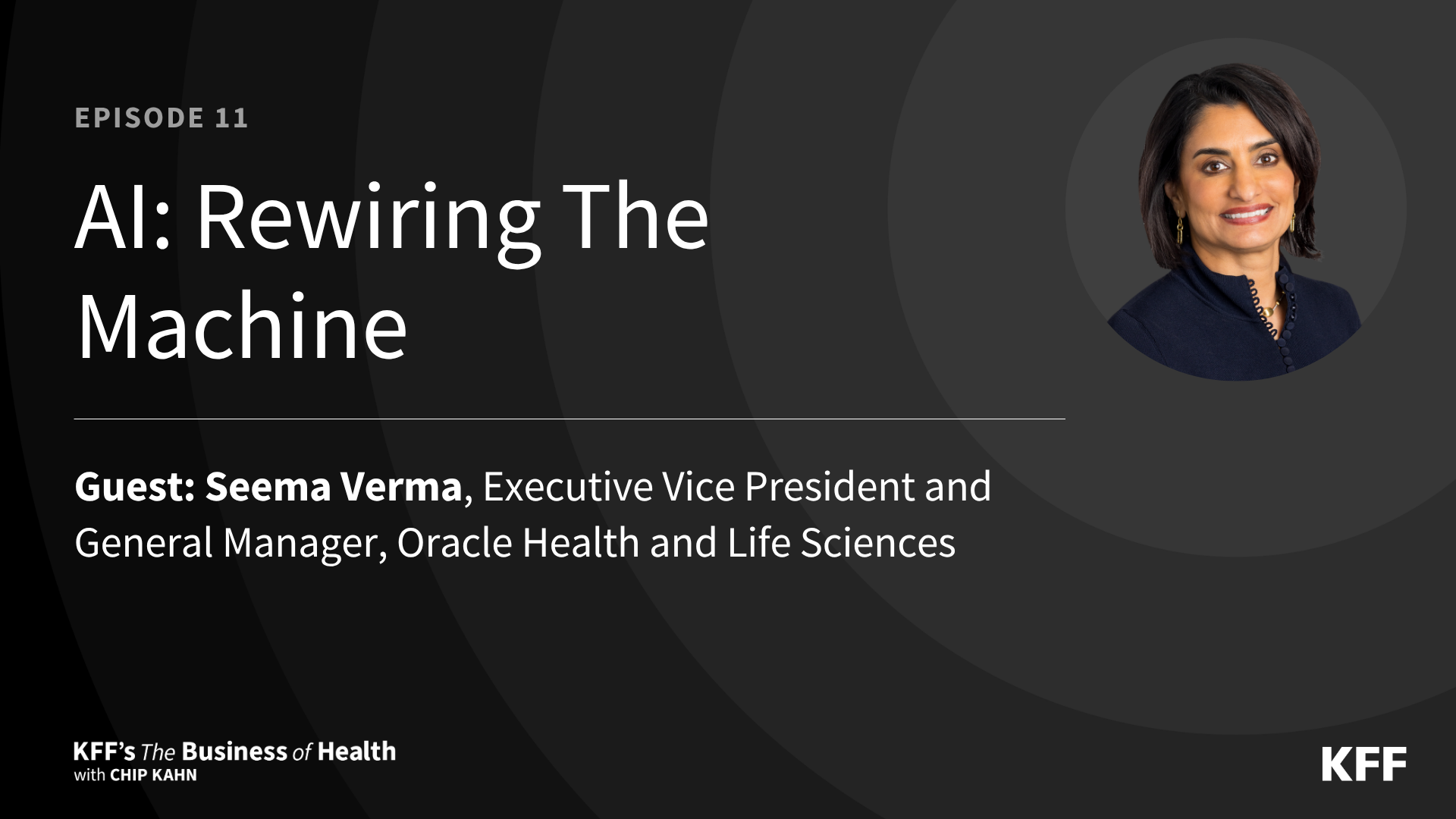
Series: The Business of Health with Chip Kahn, Episode 11
In an era where artificial intelligence (AI) is rapidly transitioning from a theoretical utility to a functional cornerstone of industry, the healthcare sector stands at a critical juncture. On the latest installment of The Business of Health, host Chip Kahn sat down with Seema Verma—former Administrator of the Centers for Medicare & Medicaid Services (CMS) and current Executive Vice President and General Manager at Oracle Health and Life Sciences—to dissect the technological architecture required to usher healthcare into a new, AI-driven reality.
The conversation centered on a fundamental premise: the Electronic Health Record (EHR) systems that currently house the world’s most sensitive medical data were not designed for the age of generative AI. To unlock the true potential of machine learning in clinical settings, Verma argues that a systemic, foundational redesign is not merely an option—it is an imperative.
Main Facts: The Intersection of Legacy Systems and Modern Innovation
The discussion between Kahn and Verma highlighted the stark contrast between the administrative burden of current EHR platforms and the promise of a seamless, data-rich future. Oracle Health and Life Sciences, which operates the second-largest EHR platform in the United States, finds itself at the epicenter of this transformation.
- The Design Flaw: Current EHRs were largely built to satisfy billing requirements and regulatory documentation mandates rather than to facilitate clinical intelligence. Consequently, physicians are often tethered to screens, inputting data rather than interpreting it.
- The AI Integration Gap: AI requires clean, interoperable, and real-time data to function. Many legacy EHR systems operate in "data silos," preventing the fluid exchange of information between specialists, hospitals, and pharmacies.
- The Strategic Shift: Verma posits that the next generation of EHRs must move beyond being "digital filing cabinets." Instead, they must evolve into "clinical partners" that use AI to surface relevant information, suggest diagnostic pathways, and reduce the administrative friction that leads to clinician burnout.
Chronology: From Documentation to Intelligence
To understand where the industry is going, one must look at where it has been. The evolution of the EHR, as discussed by Verma and Kahn, can be viewed in three distinct phases:
Phase I: The Digitization Era (2000s – 2015)
The primary goal was the migration from paper charts to digital records. Policy initiatives, such as the HITECH Act, incentivized the adoption of EHRs. The success of this era was measured by the sheer volume of digitized patient records, though it inadvertently created a "documentation burden" that overwhelmed healthcare providers.
Phase II: The Interoperability Struggle (2016 – 2023)
As digital records became ubiquitous, the industry faced the challenge of "silos." Providers struggled to share data across different software platforms. Efforts by CMS—spearheaded during Verma’s tenure—focused on breaking down these walls to ensure that a patient’s medical history could travel with them.
Phase III: The AI-Integrated Ecosystem (2024 – Present)
We are currently in the early stages of the third phase. Here, the focus has shifted from simple storage and sharing to the synthesis of data. AI models are now being trained to parse millions of data points within the EHR to identify patterns, predict patient outcomes, and suggest clinical interventions in real-time.
Supporting Data: Why Redesign is Necessary
The argument for a complete architectural overhaul of health records is supported by mounting evidence of inefficiency.
- The Burnout Crisis: According to industry reports from 2025, over 50% of physicians report symptoms of burnout, with EHR documentation cited as the primary administrative culprit. For every hour spent with a patient, providers spend roughly two hours on EHR-related tasks.
- Clinical Inaccuracy: Inconsistent data entry across legacy systems leads to "chart fatigue," where critical diagnostic information is buried under pages of template-generated text. AI-driven EHRs promise to automate the extraction of relevant clinical notes, potentially saving thousands of hours per facility annually.
- Data Scalability: Oracle’s current integration efforts involve managing massive, multi-modal datasets. Verma noted that the volume of health data is doubling every 73 days. Without an AI-ready infrastructure, the current systems will eventually collapse under the weight of this information.
Official Responses: The Regulatory and Corporate Perspective
As a former CMS Administrator, Seema Verma occupies a unique position. She understands the levers of government policy and the realities of private-sector technological deployment.
The Government’s Role
Verma emphasizes that policy cannot mandate innovation; it can only create the environment where innovation flourishes. She notes that the federal government must continue to push for standards that allow AI models to operate safely across different platforms without stifling the competition that drives technological advancement.
The Corporate Responsibility
Representing Oracle, Verma argues that the responsibility of the vendor is to move away from proprietary, closed-loop systems. "If the technology is not interoperable, it is not serving the patient," she remarked. Oracle’s current strategy involves heavy investment in cloud-native EHR architectures that allow third-party AI developers to "plug in" their algorithms safely, ensuring that the best technology reaches the bedside without compromising data privacy.
Implications: A New Era of Quality of Care
The shift toward an AI-ready EHR infrastructure has profound implications for every stakeholder in the healthcare ecosystem.
For the Patient
The most immediate impact will be the reduction of diagnostic delays. With AI analyzing historical data and current symptoms, rare diseases could be identified much faster. Furthermore, the reduction in clinician administrative burden means more face-to-face time during consultations, restoring the "human touch" that many feel has been lost to the computer screen.

For the Physician
Physicians will evolve from being data-entry clerks to being high-level clinical decision-makers. AI will handle the "heavy lifting" of summarizing charts, flagging drug interactions, and updating coding requirements. This allows the doctor to focus on the nuance of patient care—the aspect of medicine that AI cannot replicate.
For the Healthcare System
The systemic redesign will facilitate a shift toward "Value-Based Care." By using predictive analytics to manage chronic diseases before they escalate into acute emergencies, hospitals can significantly reduce the costs associated with hospital readmissions. This creates a sustainable economic model where the goal is the health of the population rather than the volume of services rendered.
Conclusion: The Path Forward
The conversation between Chip Kahn and Seema Verma serves as a roadmap for the future of health technology. The path forward is not simply about adding an "AI layer" onto outdated software. It is about fundamentally re-engineering the way healthcare data is captured, stored, and utilized.
As we look toward the remainder of the decade, the integration of AI into the EHR will likely be the single most transformative event in medical administration since the invention of the digital record itself. Whether the industry can successfully pivot to this new model will depend on the collaboration between policymakers, technology providers, and frontline clinicians.
The lesson from the 11th episode of The Business of Health is clear: In the age of AI, the data is the medicine. If we can fix the delivery system—the EHR—we can finally unlock the full potential of modern healthcare to treat, cure, and improve the lives of patients on a global scale.
For more information on the ongoing AI series and future episodes, visit the KFF "Business of Health" podcast page.

 Rifan Muazin
 Laily UPN