


 Reynand Wu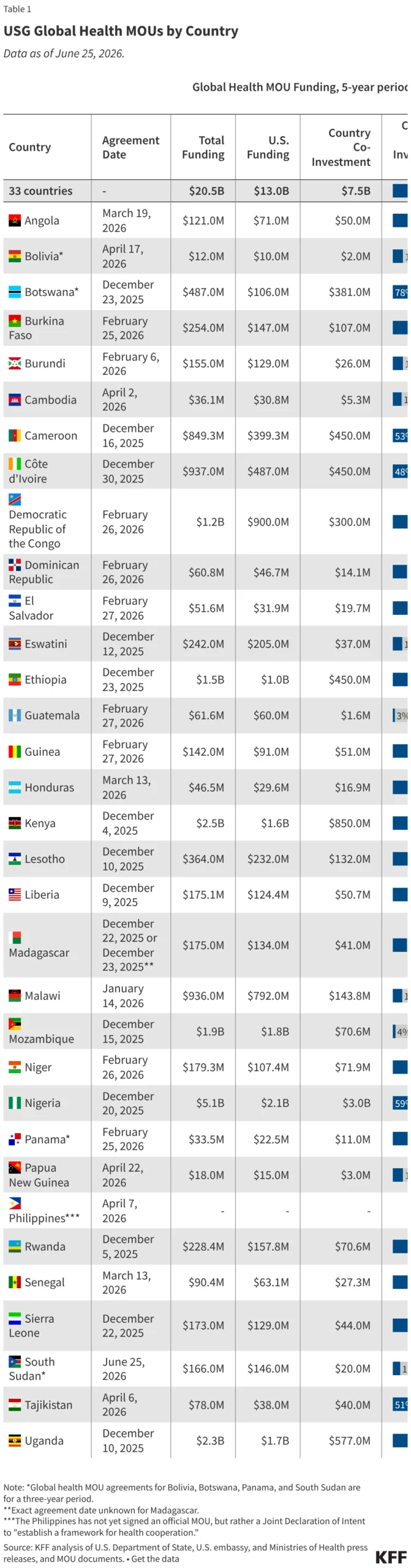
Editorial Note: Originally published on January 13, 2026, this report has been continuously monitored and updated to reflect the evolving landscape of U.S. international health engagement. The most recent update was finalized on June 29, 2026, incorporating the latest bilateral data.
Executive Summary: A New Paradigm in Global Health
On September 18, 2025, the United States government officially unveiled the "America First Global Health Strategy," a foundational document signaling a fundamental pivot in how Washington engages with international partners on public health. Moving away from the traditional, indefinite assistance models of the early 21st century, this new strategy emphasizes fiscal responsibility, national sovereignty, and the transition toward partner-country self-reliance.
At the heart of this policy is the implementation of bilateral Memorandums of Understanding (MOUs)—formal five-year plans covering the 2026–2030 period. These agreements serve as the architectural blueprint for U.S. health engagement, stipulating a clear "glide path" for the reduction of U.S. financial assistance in tandem with a mandated increase in domestic health spending by partner nations. By shifting the financial burden toward local ownership, the U.S. government aims to foster more resilient and durable health systems that are not tethered to the fluctuations of American congressional appropriations.
Chronology: The Road to the 2026 Strategy
The rollout of the "America First" strategy did not occur in a vacuum; it was the culmination of years of debate regarding the sustainability of foreign aid.
- Early 2025: Internal discussions within the State Department and USAID intensified regarding the "aid dependency trap," with policymakers advocating for a model that incentivizes countries to assume budgetary control of their own health sectors.
- September 18, 2025: The U.S. government officially releases the America First Global Health Strategy report, outlining the shift toward time-bound bilateral cooperation.
- Late 2025: The first wave of MOUs is signed. These initial agreements act as prototypes for the new engagement model, setting the standard for co-investment requirements.
- January 13, 2026: Launch of the U.S. Global Health MOU Tracker to provide transparency on the scale and scope of these new agreements.
- June 2026: Mid-year assessment of MOU implementation. As the first full year of the five-year plan reaches its halfway point, initial data indicates a mixed response from partner nations regarding the speed of domestic funding increases.
Supporting Data: Mapping the Transition
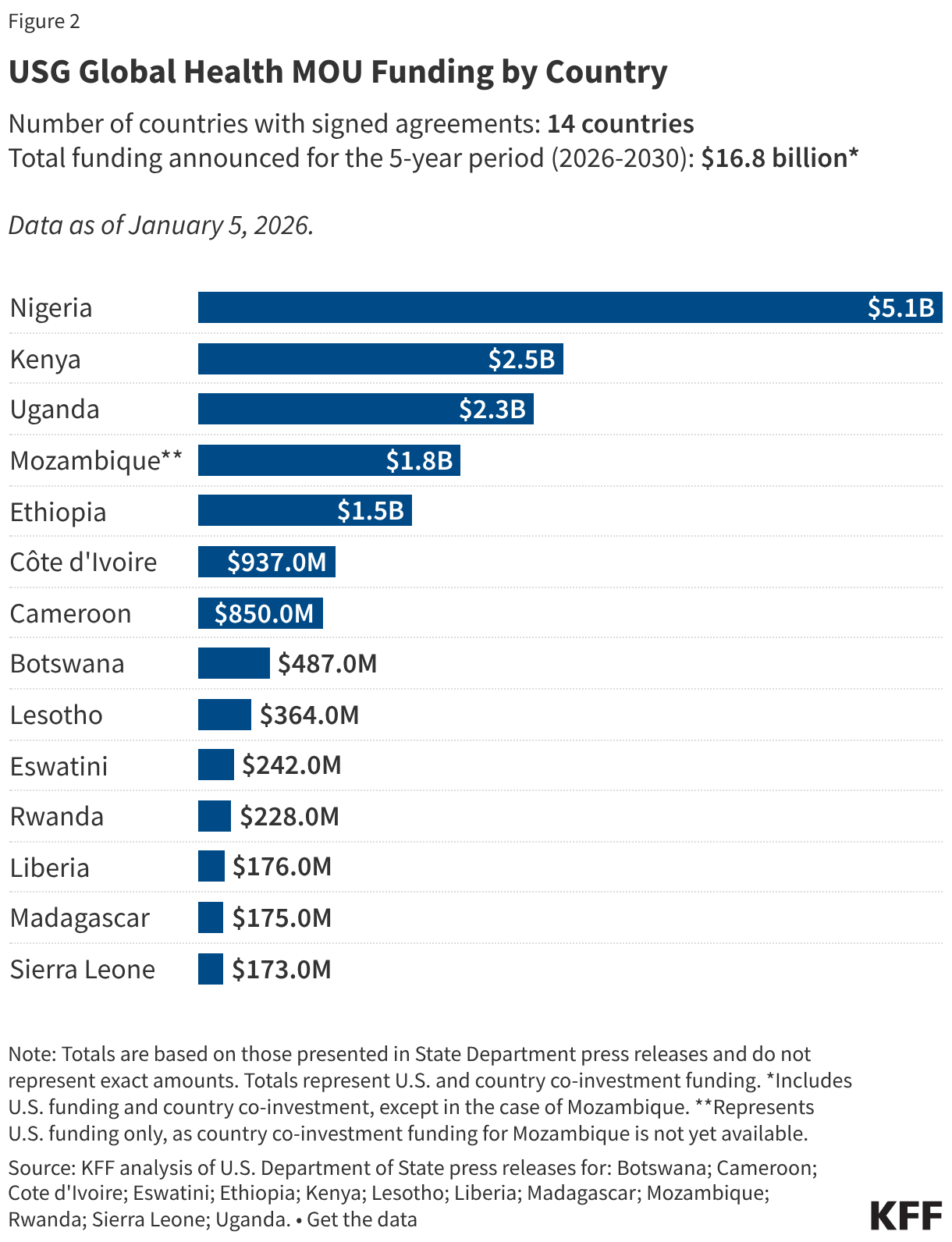
The U.S. government has prioritized transparency by publishing various metrics to track the progress of these agreements. The data, sourced from U.S. embassy press releases, Ministerial statements, and, where available, the full text of the MOUs, reveals a diverse range of commitments.
Key Data Metrics
- Geographic Distribution: Choropleth maps reveal a focus on regions with historically high levels of U.S. assistance, particularly in sub-Saharan Africa and Southeast Asia.
- Financial Trajectories: Grouped bar charts comparing historical funding levels against the new 2026–2030 MOU targets show a clear, intentional downward trend in U.S. contributions.
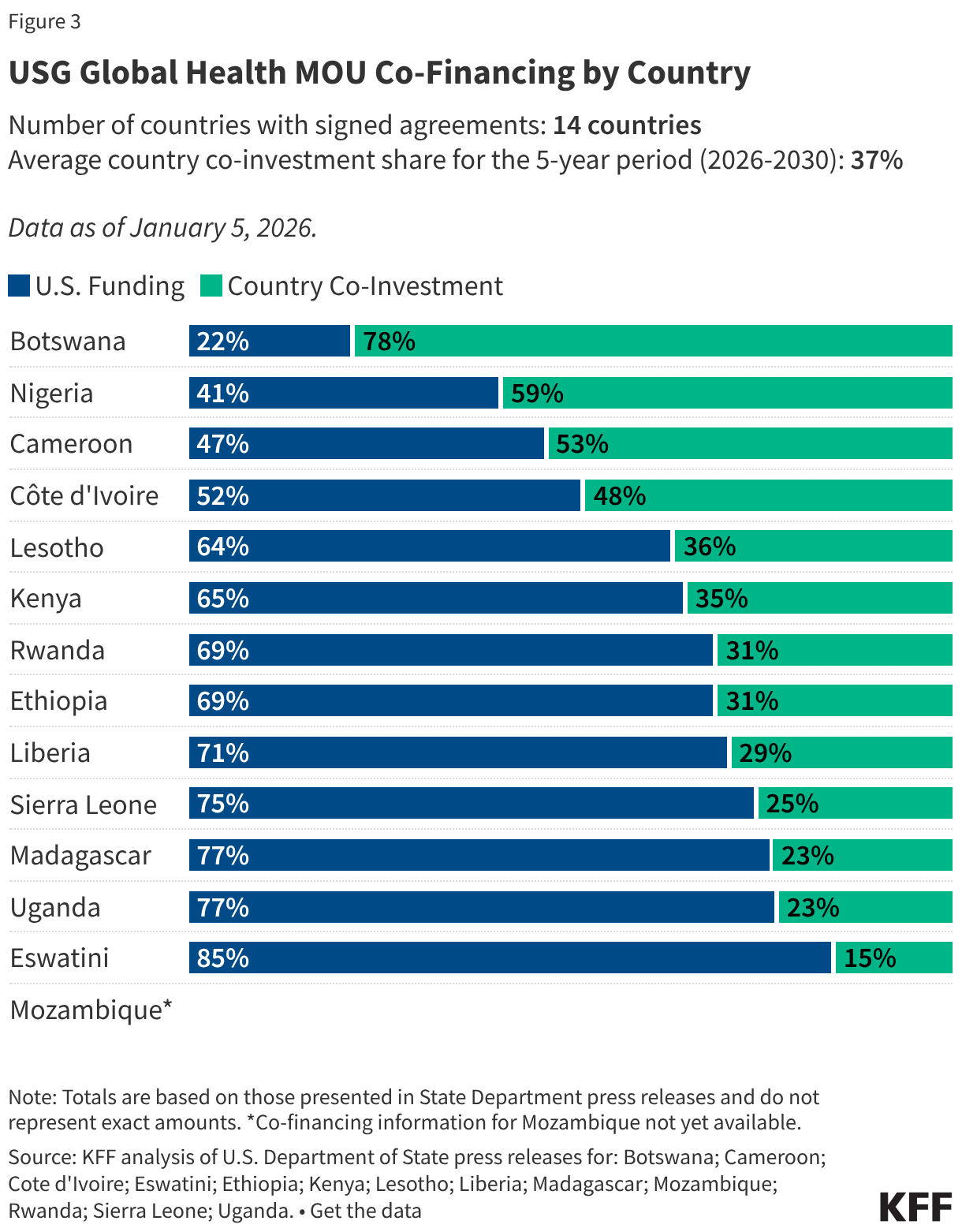
- Co-Financing Ratios: Perhaps the most critical data point, the stacked bar charts showing "U.S. vs. Partner Co-Financing" indicate that while some nations have aggressively ramped up their domestic budgets, others remain heavily reliant on U.S. subsidies, potentially signaling future diplomatic friction.
- Programmatic Focus: Using keyword analysis, the tracker identifies key areas such as Global Health Security (GHS), infectious disease control, and maternal/child health. Agreements specifically mentioning GHS are prioritized, reflecting a post-pandemic emphasis on outbreak preparedness and containment.
Official Responses and Diplomatic Perspectives
The reaction to the "America First" strategy has been bifurcated. Within Washington, the strategy is framed as a long-overdue application of fiscal prudence. Supporters argue that by "weaning" countries off U.S. aid, the U.S. fosters a more equitable partnership where recipient nations are viewed as sovereign equals rather than perpetual dependents.

The U.S. Perspective
Administration officials emphasize that this is not a withdrawal, but an evolution. "The goal is to build health systems that can withstand the test of time," a State Department spokesperson noted during the launch. "A system that is funded by its own people is a system that lasts."
The Partner-Country Perspective
Conversely, several partner countries—particularly those with lower GDPs—have expressed concern. While many Ministries of Health publicly support the concept of "country ownership," private conversations reveal anxieties regarding the capacity of their national budgets to absorb the costs of expensive HIV/AIDS treatment programs, malaria prevention initiatives, and pandemic surveillance infrastructure. Critics argue that a rigid five-year timeline fails to account for economic downturns, political instability, or sudden health crises that could derail the planned increase in domestic spending.
Implications: The Long-Term Outlook
The shift toward 2026–2030 MOUs carries significant implications for the future of global health architecture.

1. The Sustainability Test
The most significant question is whether the "co-investment" model can survive a reality check. If a partner country fails to meet its domestic spending targets, the current strategy implies a subsequent reduction in U.S. support. This creates a high-stakes environment where the withdrawal of American assistance could lead to a collapse in local service delivery, particularly for marginalized populations.
2. The Definition of "Resilience"
The strategy defines resilience as domestic ownership. However, international health advocates suggest that true resilience is defined by the ability to pivot during crises. By tying funding to rigid five-year plans, the U.S. might inadvertently create a system that is too inflexible to respond to the next "Disease X" or unexpected regional health catastrophe.
3. Diplomatic Leverage
The MOU process is inherently political. By linking financial aid to specific budgetary and programmatic benchmarks, the U.S. has effectively created a new mechanism for diplomatic leverage. Countries that align with U.S. health priorities—such as specific pandemic preparedness protocols—may find it easier to negotiate the terms of their transition, potentially leading to a bifurcation in the quality of health systems across the developing world.
Methodological Note: Challenges in Transparency
As outlined in the tracker’s methodology, obtaining full transparency on these agreements remains a work in progress. While the State Department has been forthcoming with press releases, the full legal texts of the MOUs are not always available to the public.
When analyzing program areas, researchers rely on keyword searches. This presents a specific limitation: a document might omit mention of "Global Health Security" while still funding relevant activities, leading to a potential undercounting of U.S. efforts in that domain. Furthermore, the reliance on press releases—which are often drafted to highlight successes—may mask the underlying challenges or "negotiation friction" that occurred during the drafting of these five-year plans.
As we move toward 2030, this tracker will continue to serve as the primary resource for monitoring whether the "America First" strategy creates the promised "durable health systems" or whether it marks the beginning of a retreat from global health leadership.
Conclusion
The 2026–2030 period will be remembered as the era in which the United States fundamentally redefined its role in global public health. By formalizing the transition to country ownership through bilateral MOUs, Washington is conducting a grand experiment in international development. Whether this strategy succeeds depends entirely on the ability of partner nations to stabilize their fiscal health and the willingness of the U.S. to maintain its commitment even when targets are missed. As the data continues to flow in, the international community watches closely, aware that the success or failure of these agreements will dictate the health security of the entire globe for decades to come.
Appendix: Tracking Methodology
- Data Sources: U.S. Department of State press statements, U.S. Embassy bulletins, and partner nation Ministry of Health announcements.
- GHS Classification: Agreements are flagged as "Global Health Security" if they explicitly mention outbreak preparedness, biological threat containment, or surveillance infrastructure.
- Updates: This resource is a "living document." Users are encouraged to check back regularly as new MOU texts are declassified and added to the analytical framework.


 Rifan Muazin